




Posts Industry Ukraine’s iron and steel industry 913 12 February 2026
According to last year's results, contributions to budgets at all levels from companies in the industry increased to UAH 33.1 billion
In the context of a war that has been going on for almost five years, ensuring revenues to the state and local budgets has become critically important for financing the army, supporting the population, and rebuilding the country.
Steel industry plays an important role in filling budgets at various levels, so in wartime, the state needs to strike a balance between the need to replenish the treasury and creating conditions for the stable functioning of the industry. It is important to ensure the stability of tax legislation, the easing of currency restrictions, the predictability of state monopoly tariffs, and support for enterprises that have encountered problems as a result of military operations.
Tax figures
Despite the war and destruction, steel enterprises continue to operate and pay taxes to the state and local budgets, contributing to the support of the country and its defense capabilities. Tax deductions for steel sector include income tax, unified social tax, personal income tax, land tax, subsoil use tax, and other payments.
At the end of last year, contributions to budgets at all levels by the four largest steel companies increased by 2.1% compared to 2024, reaching UAH 33.1 billion. Between 2021 and 2025, the largest steel enterprises paid taxes and fees totaling UAH 193 billion, or $5.9 billion.
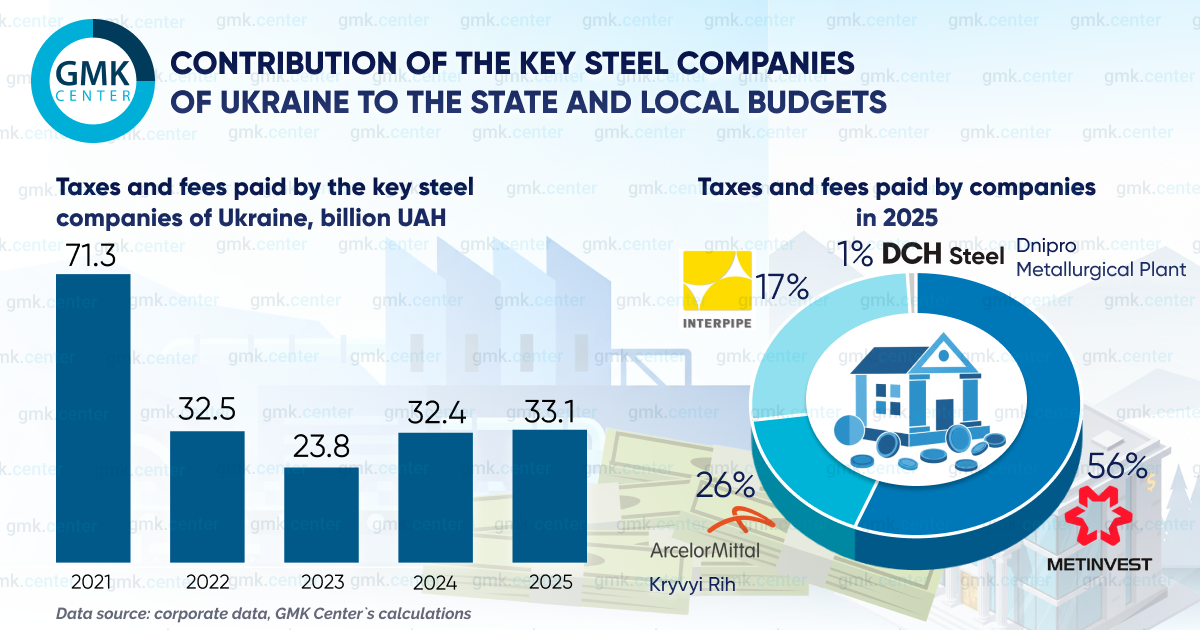
Last year, the dynamics of tax and fee payments by the largest companies in the industry varied:
- ArcelorMittal Kryvyi Rih – an increase of 28% to UAH 8.5 billion;
- Interpipe – an increase of 1% to UAH 5.6 billion;
- Metinvest – a decrease of 5% to UAH 18.7 billion;
- Dnipro Metallurgical Plant – a decrease of 41.8% to UAH 290 million.
There has been a slowdown in tax payments in the industry. For comparison: in 2024, the growth in tax and fee payments to budgets of all levels at ArcelorMittal Kryvyi Rih, Metinvest, and Interpipe was 60%, 36%, and 27%, respectively.
The general trend towards a decrease in tax deductions is associated with the deterioration of the economic situation in the industry. The decrease in taxes and fees paid by the largest company in the industry, Metinvest, is primarily due to the fact that 2025 was the first year when the group operated without coking coal supplies from its own enterprise and with a reduction in production volumes in the mining segment. One of the largest mining and processing plants, Ingulets Mining, was idle for the entire past year due to high electricity and logistics tariffs.
All this affected the industry. At the end of 2025, the mining industry reduced iron ore exports by 8% compared to 2024, to 31 million tons.
«The war and global challenges have changed the realities of business and forced us to work in a new way. The role of steel industry remains strategic: it continues to support the economy, generate foreign exchange earnings, and fill the budget. As the largest company in the industry, Metinvest continues to operate, support the regions, and help the army,» said Yuriy Ryzhenkov, CEO of Metinvest Group.
Despite the difficult situation in the industry, the companies support their workforces and local communities in the regions where they operate. Of the UAH 8.5 billion in tax payments made by ArcelorMittal Kryvyi Rih in 2025, UAH 2.6 billion were contributions to local budgets.
«ArcelorMittal Kryvyi Rih remains a reliable partner of the state and ensures stable tax revenues to the state budget and local communities, despite the challenges of wartime. In 2025, the company continued its efforts to achieve break-even profitability and did significant work to optimize its operational processes and costs. Problems with energy supply due to enemy attacks, high electricity tariffs, and the need to import electricity significantly undermined these efforts and the competitiveness of our products in the markets,» said Pavlo Zadorozhny, CFO of ArcelorMittal Kryvyi Rih.
The largest Ukrainian steel producers are located in frontline regions and are under constant shelling: Metinvest (Zaporizhia, Kryvyi Rih), Interpipe (Nikopol, Dnipro), and others. These enterprises are effectively city-forming, providing jobs in extremely difficult conditions.
«We continue to produce and export value-added products, paying tens of thousands of hryvnias from each ton of finished products to budgets at all levels, both regional and national. Thanks to this, thousands of Ukrainians in the frontline region are provided with jobs,» emphasized Serhiy Kuzmenko, Director of Economics and Finance at Interpipe.
Industry outlook
Ukrainian steel enterprises are in one of the most difficult situations among all sectors of the domestic economy. 2025 was probably one of the most challenging years for the Ukrainian steel industry. In such conditions, steel companies continue to operate and fulfill not only production plans but also social functions: they pay taxes on time and support their workforces and communities.
The combination of problems caused by the war makes it difficult to further increase production and budget revenues at all levels. Among the main ones are the following:
- Production capacity has reached its ceiling. Although Ukraine’s steel industry increased its production of pig iron and rolled steel by 11.2% and 4.8% in 2025 compared to 2024, steel production fell by 2.2% year-on-year. According to GMK Center analysts, this is the maximum possible level in wartime conditions.
- The electricity shortage has led to shutdowns at the largest iron and steel companies over the past three months. Large energy-intensive industries are critically dependent on centralized power supply, which cannot be fully replaced by alternative sources of generation.
- Increase in import costs. Due to the shutdown of coking coal mines in Pokrovsk, Ukrainian steelmakers were forced to import this product throughout the past year. In January-August 2025 alone, Ukraine increased its imports of coking coal by 3.1 times y/y, to 2.3 million tons. This has led to an increase in the cost of steel production in Ukraine.
- Impact of European regulations. Ukraine has not received a temporary exemption from the CBAM, which will hit the domestic steel industry hard due to its high dependence on the EU market. In the next few years, the country may lose exports of long products and square billets to the EU, as well as part of its pig iron exports. New EU tariff quotas will be a risk factor for the industry in 2026.
- Tariffs of state monopolies. Due to the shortage of domestic energy generation and gas production in Ukraine, industrial enterprises consume imported resources – gas and electricity (mainly), the final price of which is the highest in Europe. Added to this is the constant increase in tariffs of the relevant state monopolies.
- Low prices for Ukrainian iron and steel products. Prices for the main products of Ukrainian iron and steel exports in 2025 were quite low, which affected the low profitability of production. A similar situation is expected this year – global commodity markets are expecting a period of low prices and excess supply. According to World Bank forecasts, the price index for metals and minerals will remain virtually unchanged (+0.3% y/y).
- Availability of maritime logistics. Due to electricity shortages and shelling of port infrastructure in December 2025, exports through seaports fell by at least a quarter. In December, Ukraine exported 35.6% less raw materials compared to December 2024. The deepening energy crisis could have serious consequences for iron and steel logistics.
The results of 2025 form a complex but indicative basis for assessing the industry’s prospects in 2026. According to GMK Center estimates, steel production in Ukraine is likely to remain at a neutral level – approximately 7.2 million tons in the baseline scenario. In fact, this means reaching the current production ceiling in wartime conditions. This year, analysts expect iron ore exports from Ukraine to decline by 5% to 29 million tons, assuming a 7% decline in prices in China.
Ukrainian businesses understand the complexity of the situation in the country caused by the war. If the state takes almost no steps to help, the industry cannot simultaneously be an economic rear and show growth in the current conditions.

-
OpinionsIndustrysteel consumption
13 July 2026
24 June 2026
18 June 2026
15 June 2026