
Posts Industry railway tariffs 219 18 June 2026
According to UZ own estimates, a 20 per cent increase in freight tariffs will lead to a 19 per cent fall in freight volumes
Ukrainian Railways’ (UZ) current financial situation is critical: the company has declared a technical default and suffered record losses. To address these issues, the carrier plans to increase freight tariffs by 45 per cent. The business community regards this as ‘shooting itself in the foot’: instead of generating revenue, it will lead to a loss of customers, the shutdown of businesses and a threat to the entire industry.
On the initiative of the National Association of the Extractive Industry of Ukraine (NAEIU), a round-table discussion was held on ‘Ukrainian Railways’ tariff increases: risks for the extractive sector and the economy’. Representatives from the steel, mining, construction and other sectors — that is, precisely those areas of the economy already facing financial difficulties — spoke out against this decision. GMK Center summarises the key points from the business representatives’ speeches.
The railway situation
Ukrainian Railways’ current financial situation can be described as critical: the state-owned company has declared a technical default, and recorded a loss of 7.9 billion hryvnias in the first quarter. This situation is the result of several factors — a decline in freight transport, rising energy costs, increased losses due to constant shelling, and the pressure of accumulated debts. Even state support amounting to 16 billion hryvnias to cover losses from passenger transport failed to save the situation.
Against this backdrop, Ukrainian Railways is seeking to resolve its funding shortfall and negotiate a debt restructuring. The approach chosen is a traditional one — to increase revenue from the profitable freight segment: last year, profits from this segment totalled 6 billion hryvnias, although in 2026 rail freight transport could become loss-making for the first time. At the same time, according to Serhiy Kudryavtsev, executive director of UkrFA, a state-owned enterprise should not aim to generate high profits during wartime, but merely ensure the stable functioning of the economy.
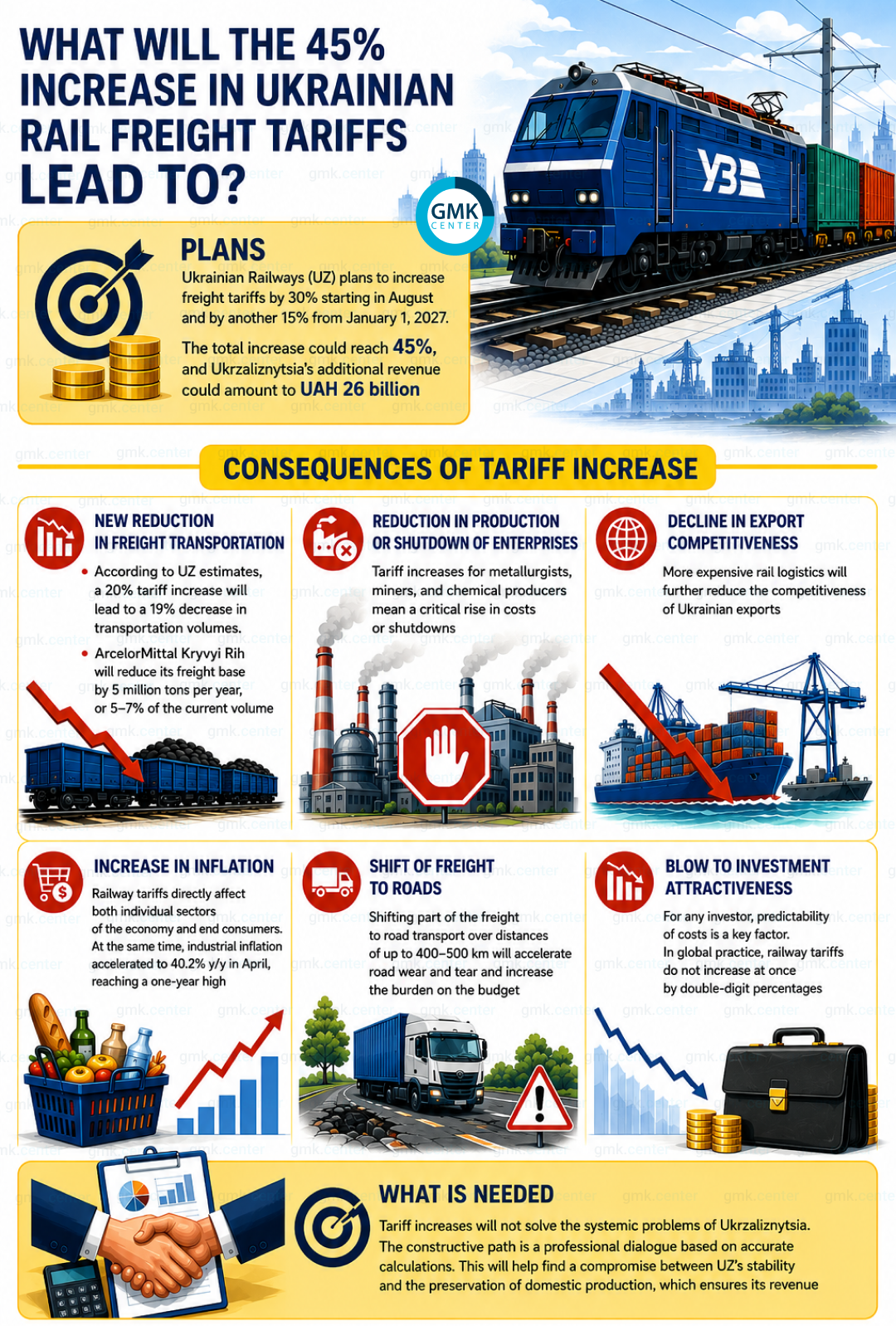
Ukrainian Railways plans to increase freight tariffs by 30 per cent from August and by a further 15 per cent from 1 January 2027. The total increase could reach 45 per cent, with Ukrainian Railways’ revenue rising by 26 billion hryvnias. The last increase in rail freight tariffs took place in 2022.
Why business is opposed
Ukrainian businesses understand the problems facing Ukrainian Railways better than anyone else, as they face them themselves, but the state-owned carrier’s survival cannot come at the expense of shippers. Participants at a round-table discussion on this issue highlighted several reasons why the financial burden on businesses must not be increased at this time:
- The industrial sector is already operating on the edge of survival.
Sky-high energy prices and tariffs, the impact of the CBAM and European protectionism, staff shortages and expensive borrowing — and, against this backdrop, yet another blow in the form of a 45 per cent tariff increase.
“Our company is consistently making a loss: at the end of the first quarter of this year, the loss stood at $160 million. Operations are sustained solely by subsidies from the parent company. Every month, shareholders and investors weigh up two options: to close the company and exit the Ukrainian market, or to continue operations. So far, the decision has been to continue — in order to preserve the workforce of 20,000 people and the much larger number of people employed in related sectors,” said Yuriy Litvin, Logistics Director at ArcelorMittal Kryvyi Rih.
- Anomalous tariff increases.
In international practice, rail tariffs do not rise by double-digit percentages all at once: such an increase is abnormal and damaging to the market.
- UZ tariffs already losing to road transport.
According to Oleksandr Zagrebelny, commercial director of the Marganets Mining and Processing Plant, transporting 1 t of cargo from Marganets to Odesa by rail costs 1,000 UAH including VAT, whilst by road it costs 720 UAH. What is more, Ukrainian freight rates for certain types of cargo are already higher than those in neighbouring countries.
- UZ has not exhausted internal reserves.
Participants pointed to several untapped sources: scrap sales, sale or lease of non-core assets, and cost optimization.
- Lack of transparency and violations of regulatory procedures.
The UZ’s financial plan for 2025 was approved on 30 December — just one day before the end of the financial year. The financial plan for 2026 has still not been approved. Under these circumstances, it is impossible to verify the validity of the expenditure. Furthermore, a decision of national importance is being pushed through behind closed doors rather than through open debate.
‘The current format for discussing an issue that has a colossal impact on the economy of the entire country is utterly unacceptable. Instead of the civilised practice of frank and open discussions… what is currently being used is, in effect, a semi-secret, backroom mechanism. Attempts to justify and push through a decision by going from office to office and posting emotional messages on social media cannot be considered an adequate substitute for a transparent procedure,” emphasised Serhiy Vovk, Director of the Centre for Transport Strategies.
- A blow to investment attractiveness.
For any foreign investor — particularly in the extractive sector and critical raw materials — cost predictability is key. A 45 per cent jump in a monopoly’s tariffs immediately raises a ‘red flag’, signalling unacceptable regulatory risks.
Furthermore, according to estimates by the Ukrmetallurgprom Public Organisation, the cumulative effect of inflation for the period 2022–2025 amounts to more than 61 per cent. At the same time, the cost of freight transport services provided by Ukrainian Railways for a comparable volume by the end of 2025 has reached 71 per cent. In other words, the previous sharp 70 per cent rise in rail tariffs in 2022 has not yet been fully offset by cumulative inflation, so the issue of further tariff adjustments can only be raised at the earliest by the end of 2026.
What the business will do
During the meeting, participants emphasised the need for transparent and collaborative decision-making mechanisms. At present, decisions to raise tariffs are being pushed through behind closed doors, without dialogue with the business community or an assessment of the impact on key sectors of the economy.
Following the discussion, industry associations, together with individual companies, will send individual and collective appeals to the relevant ministries. Most importantly, the round-table participants are drafting a letter to international partners, in particular the European Commission. The aim is to secure a review of the decision and for partners to consider the possibility of targeted financial support for Ukrainian Railways, rather than shifting the burden onto industry. An extended press conference is also planned, involving representatives from the steel, chemical, agricultural and construction sectors.
‘The authorities will only take this issue seriously when they realise the real threat of mass closures of private enterprises and losses to the budget. So far, officials have taken a patronising attitude towards business, assuming that we won’t go anywhere and will pay up anyway. Public attention is crucial,” noted Kseniia Orynchak, Executive Director of the National Association of Private Entrepreneurs (NAPU).
For his part, Roman Dzhuranuk, Deputy Head of the State Regulatory Service (SRS) for Digitalisation, emphasised that once the draft act has been received, the SRS will conduct an independent review of it, including a thorough review of the regulatory impact assessment and compliance with the principles of state regulatory policy, adding that public consultation on business proposals is not a mere formality but a fundamental prerequisite for high-quality state policy.
What the rise in fares will lead to
In the opinion of major freight shippers, a sharp increase in freight tariffs will have extremely negative consequences for the entire Ukrainian economy and even for Ukrainian Railways itself:
- A new cycle of freight transportation reduction.
The increase in freight tariffs will exacerbate Ukrainian Railways loss of its freight customer base. By the end of 2025, freight volumes had fallen by 7.8% year-on-year to 161.3 million tonnes, whilst revenue from this sector dropped by 19% year-on-year. At the start of this year, Ukrainian Railways expected freight volumes in 2026 to remain virtually unchanged (161 million tonnes); however, by the end of the first quarter, the decline had continued – by 6.4% year-on-year to 34.8 million tonnes.
According to estimates by ArcelorMittal Kryvyi Rih, the tariff increase will lead to a further reduction in the company’s freight base of approximately 5 million tonnes per year — that is, 5–7% of current volumes. This, in turn, will trigger a chain reaction: Ukrainian Railways’ revenues will fall, creating the grounds for a further increase in tariffs.
According to Ukrainian Railways’ own calculations, a 20% increase in freight tariffs will lead to a 19% reduction in transport volumes and a further decline in revenue from this sector. A reduction in the freight base will mean the physical loss of millions of tonnes of freight and a further drop in revenue. A measure presented as a means of plugging the financial gap will only make it worse.
- Reduction or shutdown of production facilities.
Large industrial shippers — steelmakers, miners and chemical producers — unlike farmers, cannot switch to road transport. For them, a rise in tariffs means a critical increase in production costs or a halt to operations. According to Stanislav Zinchenko, CEO of the GMK Centre, even without the impact of rail tariffs, the steel industry could, in the worst-case scenario, lose 25 per cent of its output by the end of 2026, and a further 20 per cent during 2027.
“Products from domestic manufacturers are becoming increasingly uncompetitive even on the domestic market. A few more such increases, and it will prove more cost-effective to rebuild the country’s infrastructure through imports from Poland, Romania and Hungary than through production at Ukrainian plants. An additional burden is the constant rise in both export duties and resource usage charges,” added Kostyantyn Saliy, president of the All-Ukrainian Union of Building Materials Manufacturers.
- Undermining export competitiveness.
Ukraine’s trade balance is already deteriorating: in the first five months of 2026, imports rose by 30 per cent (to $41 billion), whilst exports increased by just 3 per cent (to $17 billion). The rising cost of rail logistics will further reduce the competitiveness of domestic products, particularly given the introduction of the CBAM and new quotas on steel products from 1 July.
- Rising inflation.
Inflation in Ukraine reached 8.2% year-on-year in May 2026. Industrial inflation accelerated to 40.2% year-on-year in April, up from 36.6% year-on-year in March, reaching its highest level of the year. Railway tariffs have a direct impact on both specific sectors of the economy and end consumers, as any additional costs are ultimately passed on to the public.
- Shift of cargo to road transport.
For some types of freight (building materials, grain, processed goods), there is an alternative to rail: switching to road transport for distances of up to 400–500 km will accelerate road wear and tear and increase the burden on the budget.
Dialogue is needed
Further loss of freight volume by Ukrainian Railways means not only a reduction in revenue but also the idling of capacity (wagons, locomotives, terminals, tracks), which does not reduce the costs of maintaining them (around 80 per cent of the state-owned company’s expenditure is relatively fixed). As a result, the cost of transporting each tonne of freight will rise. Signs of this are already evident on the Odesa route: constant shelling of port infrastructure is hampering exports via the ports of Greater Odesa and the Danube.
Raising freight tariffs will not solve UZ’s systemic problems; under current conditions, it is tantamount to ‘shooting oneself in the foot’.
“If the aim of the current policy is to make a further 10,000 workers in the sector redundant in order to encourage them to join the Armed Forces of Ukraine, we ask that this be officially communicated. In that case, we will allocate resources to provide financial support for these processes,” said Oleksandr Kalenkov, President of the Ukrmetallurgprom Public Organisation.
To halt the deterioration of Ukrainian Railways’ financial position, it is necessary to adopt a comprehensive approach to resolving the issue and to seek a balanced and mutually beneficial solution as partners (client and service provider). The only constructive way forward is to bring the discussion into the public domain, based on accurate calculations and professional dialogue. This is essential to strike a balance between the financial stability of Ukrainian Railways and the preservation of domestic production, which is what generates its tariff revenue.