




Posts Industry Ukraine’s iron and steel industry 2822 18 July 2025
Ukraine can become a hub for low-carbon steel production
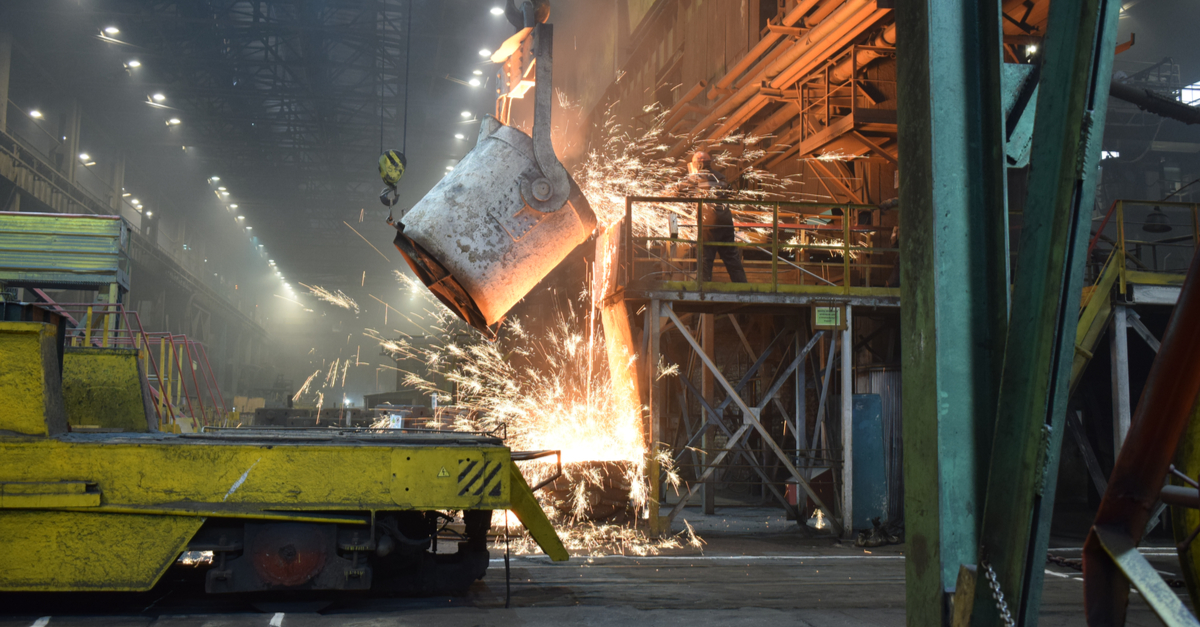
In 2025, Ukraine recorded a 4.9% decline in steel production over six months. And that’s not all, because at the end of 2024, GMK Center predicted a 9% drop in steel production in 2025. At first glance, this looks like a sign of decline in an industry that was one of the key sectors of the country’s economy just 15 years ago. However, the reality is more complex: the war and the loss of capacity have forced Ukrainian steel companies to restructure, become more efficient, and prepare for a new stage of development once the war is over.
Steel industry of war: less capacity, but higher efficiency
Until 2014, there were 12 steel producers in Ukraine with a total capacity of 42 million tons. However, Russian aggression led to the loss of a significant part of steel assets—currently, there are only six companies left in the country, of which only five are operating, and the total nominal steel production capacity has decreased to 16.5 million tons.
The capacity utilization rate of the plants in operation was 84%, and some units are almost fully loaded. For example, Interpipe’s railway product manufacturing capacity is 100% loaded.
The remaining enterprises have not only survived but have significantly improved their efficiency. The war has become a catalyst for change: companies are forced to operate in conditions of resource scarcity, but at the same time they actively encourage employee initiatives, implement continuous improvement systems, and invest in energy efficiency.
The continuous improvement system has been in place at Ferrexpo since 2017 in the form of the so-called “Bank of Ideas” program. As part of this initiative, more than 1,000 employees, almost one in ten, have submitted their proposals. During this time, more than 500 projects have been implemented on the initiative of the workers.
Within the framework of the proposal submission system at Zaporizhstal, energy efficiency measures were implemented in the cold rolling shop last year, which will yield an economic effect of UAH 2.1 million per year.
Energy efficiency comes first. Metinvest allocated $17 million to energy efficiency projects in 2024, which is 50% more than in 2023. The company plans to meet up to half of its energy needs with its own power generation facilities by 2030.
Zaporizhstal has successfully passed supervisory audits of its integrated management system for compliance with the requirements of the international energy management standard ISO 50001:2018. This year, the company plans to invest UAH 75 million in the modernization of the thermal power plant’s energy equipment. Overall, it plans to increase capital investments by 17% in 2025.
Reducing energy consumption has another positive result: reducing emissions. Ferrexpo has been included in the Financial Times and Statista’s Europe’s Climate Leaders ranking for the third time in a row. This ranking includes companies that have demonstrated the most significant reduction in greenhouse gas (GHG) emissions intensity between 2018 and 2023.
Interpipe maintains its competitiveness by investing in production. In recent years, the modernization of finishing lines has opened up new market segments for the company, including pipes with premium connections and wheels for high-speed passenger transport.
In 2025, Kametstal will implement 114 investment projects worth UAH 2.5 billion, which will expand its sales markets and improve the company’s competitiveness.
Development through new markets
Ukrainian companies are not only cutting costs, but also developing new niches with high added value.
For example, since the beginning of the war, Interpipe has brought more than 250 new types of pipes to the market, most of which are niche products for mechanical engineering, construction, and energy. The company also plans to invest $120 million in the expansion and modernization of the production of railway wheels and axles, products with high added value. This is a specific, narrow niche where Interpipe occupies a leading position in the world.
In 2024, Zaporizhstal mastered six new types of products for the production of profile pipes, sheet steel for railway car manufacturing, and others. In 2022-2023, 22 new products were introduced. The company is constantly working to improve its product portfolio.
Ferrexpo is ready to support the green transition of the global steel industry by supplying the necessary raw materials – DR pellets. Last year, the production volume of this product reached a record high of almost 0.5 million tons.
Belief in the future
Despite all the difficulties, the industry remains one of the key investors in the Ukrainian economy. In 2024, iron and steel companies increased their investments by 8.3% to $650 million, accounting for 18.3% of capital investments in industry.
Companies in the industry will remain major investors in the future, seeking to create successful investment cases that will help increase Ukraine’s investment attractiveness when the war ends.
We can answer the question “does Ukrainian steel sector have a future” based on the large-scale projects announced by domestic companies.
Interpipe plans to expand its electric steel production to manufacture flat rolled products. The $1 billion project will create a low-carbon steel offering with emissions in line with global best practices, strengthening the company’s position as a leader in decarbonization in the industrial sector in Ukraine and Europe.
Dnipro Metallurgical Plant (DMP) has announced plans to restructure its production facilities by building an electric furnace to replace two blast furnaces and three converters that are currently idle. This project will enable Ukraine to establish production of green shaped rolled products for reconstruction.
Ferrexpo has announced plans to build a DRI module, which will enable it to supply hot briquetted iron (a raw material in demand for electric furnaces) to the global market.
Metinvest is considering potential projects to build two DRI modules with a capacity of 2.5 million tons each, as well as electric furnaces at Kametstal and Zaporizhstal, which will decarbonize production at these large enterprises. At Kametstal, there are plans to replace the steel casting machines, which will enable the production of semi-finished products for further production of flat and shaped rolled products.
These projects show that the Ukrainian steel industry is not just surviving, but is preparing to become a hub for the production of low-carbon products.
Resilience despite everything
The Ukrainian steel industry is part of the European steel industry, as 64% of Ukraine’s exports in 2024 went to the EU market. Domestic companies are deeply integrated into European value chains. Accordingly, in addition to the difficulties caused by the war, they face the same problems as their European counterparts.
The question of survival is faced not only by the Ukrainian steel business, but also by the European steel business, which since 2022 has had to operate in conditions of low margins against a backdrop of falling prices due to the influx of cheap imports and high energy prices. A number of companies have been unable to withstand working in such conditions and have become permanently bankrupt. Examples include ADI in Italy, Liberty Ostrava in the Czech Republic, Liberty Galați in Romania, and Liberty Dunaújváros in Hungary. As we can see, the situation is particularly critical in Central and Eastern Europe, where production is gradually declining. Only two large integrated plants remain there: US Steel Košice in Slovakia and ArcelorMittal Dąbrowa Górnicza in Poland.
To keep the plants running, European authorities provide steel companies with subsidies, including energy subsidies. Compensation for indirect carbon costs included in the price of electricity for energy-intensive industries, including steel insustry, amounted to €4 billion in 2023. According to some estimates, in the same year, subsidies to compensate for rising energy prices for EU industrial companies amounted to €5-7 billion. Surplus free greenhouse gas emission allowances, which for many companies fully cover their emissions, are also a source of profit through the sale of allowances. Member states provide preferential access to capital for production modernization and energy efficiency projects through the relevant infrastructure. The announced amount of EU-27 and UK government grants is €15 billion.
At the same time, the Ukrainian steel industry is demonstrating greater resilience, continuing to operate and develop in wartime without state subsidies, unlike its European competitors, which have ceased production. Providing jobs in the regions is an important part of the steel business’s responsibility in Ukraine.
Responsible business
At the end of last year, Ukraine’s four largest steel companies increased their tax payments to budgets at all levels by 36% – to UAH 32.4 billion. In total, over the past five years, the largest steel enterprises have paid taxes and fees amounting to UAH 190 billion, or $6.2 billion, which is an important support for the state fighting the aggressor.
Iron and steel companies also perform an important function of reintegrating veterans, which is one of their most important missions. Domestic mining and steel companies are currently implementing large-scale initiatives aimed at helping demobilized soldiers and their return to social and professional life. Prototypes of such programs appeared 11 years ago and were subsequently significantly expanded, as, unfortunately, the scope of tasks has changed.
Interpipe is one of the few companies that supports mobilized personnel not on a case-by-case basis, but systematically. For this purpose, a corporate Patronage Service was created within its structure back in 2014 — a separate structural unit that cares for mobilized personnel, veterans, and families of those killed, missing, and captured. Since the start of the full-scale invasion, more than a thousand Interpipe employees have been assigned coordinators who “guide” the mobilized personnel. And in the event of demobilization, veterans return to their families and willingly participate in the corporate reintegration program.
Metinvest’s large-scale veteran reintegration program began in October 2023. The group has developed a support system for demobilized veterans (both internal and hired on the labor market) and families of Ukrainian defenders based on certain principles: responsibility of managers at all levels, consistency, and internal fairness.
At ArcelorMittal Kryvyi Rih, a broad, comprehensive program of social and psychological support and adaptation for combatants, their families, and the families of fallen defenders of Ukraine has been in place since the end of 2023. In this work, the company focuses on a number of areas: medical rehabilitation, information and administration, etc. The company also implements an additional medical insurance program for veterans.
Ferrexpo introduced its own veteran support program back in 2014, and its scope was expanded in 2023. It provides a comprehensive approach and minimizes the number of problems faced by demobilized workers.
Investing in tomorrow
The industry, which faces a shortage of personnel due to population migration and mobilization, is doing everything possible to attract, retain, and motivate workers. In particular, even despite the full-scale war, the largest companies in the industry are reviewing their wage levels. One of the competitive advantages of the iron and steel complex is the ability to reserve employees.
In addition, extensive training and retraining programs are offered to employees.
For example, Interpipe employees can obtain higher education at the company’s expense. Bachelors and masters in modern technical specialties are trained at the Ukrainian State University of Science and Technology. The company also offers jobs to employees without the necessary experience and knowledge, provided they undergo on-the-job training in their chosen specialty and licensed programs. Employees themselves can master a related profession.
Metinvest finances the acquisition of additional professions by employees, and in some cases, they can obtain higher education at the company’s expense.
ArcelorMittal Kryvyi Rih has a license to train in more than 350 professions at its own training center (ArcelorMittal University in Ukraine). In addition, the company has a training center for safe work practices. The AMU 360 online platform provides free access to a wide range of training programs.
Most companies in the iron and steel complex cooperate in one way or another with educational institutions of various levels.
In particular, Interpipe has been investing in the development of technical education in the region since 2019, creating modern laboratories, workshops, and classrooms in schools, colleges, and universities in Dnipro. Twelve modern classrooms and mechatronics laboratories have been created at the school level. Last year, the company renovated the workshop at Vocational School No. 2, where CNC machine operators are trained, and the training program has been adapted to the needs of production. Two modern mechatronics laboratories have been created at Dnipro Polytechnic National Technical University.
In 2021, ArcelorMittal Kryvyi Rih launched the New Factory dual education project, which is continuing despite the full-scale invasion. Three waves of the initiative have already been implemented, and the number of partner educational institutions has grown to 13. The company has also created the first online internship for blue-collar professions, which in 2024 covered more than 2,000 students from all over Ukraine.
Metinvest has its own educational tool – the first Ukrainian private iron and steel university, Metinvest Polytechnic. Since 2022, more than 1,080 people have become its students. More than 4,300 students have completed advanced training courses and workshops. Veterans have the opportunity to receive free higher education at the university, with a simplified admission procedure consisting of an online interview without exams. Last year, 26 veterans became students of the university, including company employees and Azovstal defenders.
Post-war transformation
In summary, the decline in production is not a sign of the collapse of the industry, but a consequence of the loss of capacity and a reorientation towards more efficient models. Ukrainian steel industry has proven its resilience, continues to attract investment, and is preparing for a post-war surge.
The future of Ukrainian steel lies in green steel industry, niche products, and integration into the EU. And current projects are the best confirmation that the industry will not only survive but become stronger.
-
OpinionsIndustrysteel consumption
13 July 2026
24 June 2026
18 June 2026
15 June 2026