




Posts Technologies technologies 1257 31 December 2025
Smart factories are already operating around the world, while Ukrainian steeelmakers are currently only at the initial stage of introducing AI into production
Artificial intelligence (AI) did not appear only after the development of ChatGPT, and numerous analogues quickly emerged. Various AI technologies have long been successfully used in many areas of production, and steel industry is no exception.
Artificial assistance
AI can be used in metallurgy both as part of a separate project and as an important part of a company’s digital transformation. The following main areas of AI application in steel industry can be identified:
- Predictive analytics
Analyzing data from equipment sensors makes it possible to predict its condition. Tata Steel has implemented an AI-based system that predicts the service life of critical equipment. This has enabled the company to reduce downtime by 20% and maintenance costs by 15%.
- Quality control of products
Computer vision is used to automatically detect defects and surface flaws in finished products or semi-finished products. Using this technology has enabled Voestalpine to reduce the number of defects in finished products by more than 20%.
- Ensuring personnel safety
Computer vision systems monitor compliance with safety regulations (use of protective equipment, movement of people and equipment). This helps prevent accidents and incidents at work, as well as analyze staff behavior.
- Process optimization
Big data analysis is used to optimize operations, improve quality, and reduce costs. South Korean steelmaker POSCO used AI to increase production efficiency by 5%, reduce energy consumption by 10%, and improve the yield of hot-rolled steel production by 3%.
- Robotics under AI control
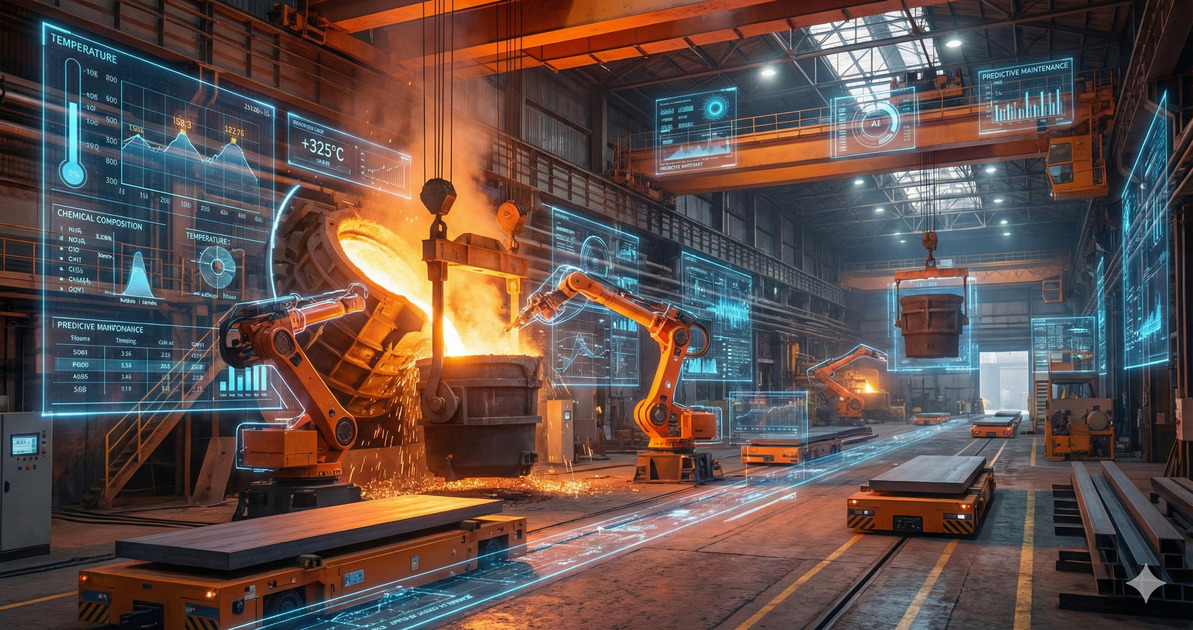
Controlling robots using AI makes it possible to reduce costs and significantly increase productivity. One of Japan’s largest steel manufacturers, JFE Steel, has deployed a robotic system for automatic grinding of small seamless pipes at its Chita Works plant. The robot independently determines the position of the part, detects defects, and optimizes movements, which has increased processing speed by 60% compared to traditional methods.
- Digital twins
The virtual model of the physical system is synchronized with real-time data, enabling behavior modeling, failure prediction, and process optimization based on analytics. This technology has long been used successfully by many steel companies.
ArcelorMittal has implemented digital twin technology at several European plants, achieving a 12% reduction in energy consumption, an 8% increase in productivity, and a 30% reduction in unplanned downtime.
- Development of new materials
The use of AI significantly reduces R&D time and costs. This has enabled ArcelorMittal to reduce the development time for certain grades of automotive steel from 3–5 years to less than 1 year.
- Business process optimization
AI can help manage marketing, logistics, warehousing, and document flow. This makes it possible to automate processes, reduce human error, and cut costs.
Brazilian steel company Gerdau implemented an AI-based demand forecasting system, which increased forecasting accuracy by 10% and reduced inventory storage costs.
Increasing labor productivity and energy efficiency, reducing costs, downtime, and defects through the widespread use of AI is key to reducing costs and increasing competitiveness. This is what all steel companies strive for.
Tata Steel, ArcelorMittal, POSCO, and Baosteel can be considered global leaders among steel producers in terms of AI implementation in production and operations.
Baosteel’s “Darkness”
In terms of the potential and capabilities of the latest technologies, the ideal solution for a steel company’s economy is not so much to transfer individual projects and processes to AI. Rather, it is to build the entire production cycle on its basis.
“Dark” factories are enterprises that can operate almost entirely without personnel and do not require lighting in their workshops. This production concept involves the complete or near-complete automation of all operations, round-the-clock operation, minimal involvement of employees, and the widespread use of various AI technologies.
It is difficult to imagine something like this in metallurgy. However, Chinese genius in production automation has reached this area as well, creating a fully automated “smart” factory with minimal human intervention.
Baosteel, part of the Baowu Group, launched fully automated production at a steel mill in Shanghai back in 2019. The facility is a cold-rolled steel production line. Production is based on fully automated equipment, AI technologies, industrial robots, and the Internet of Things. Bridge cranes, for example, are completely autonomous—they independently locate and move coils.
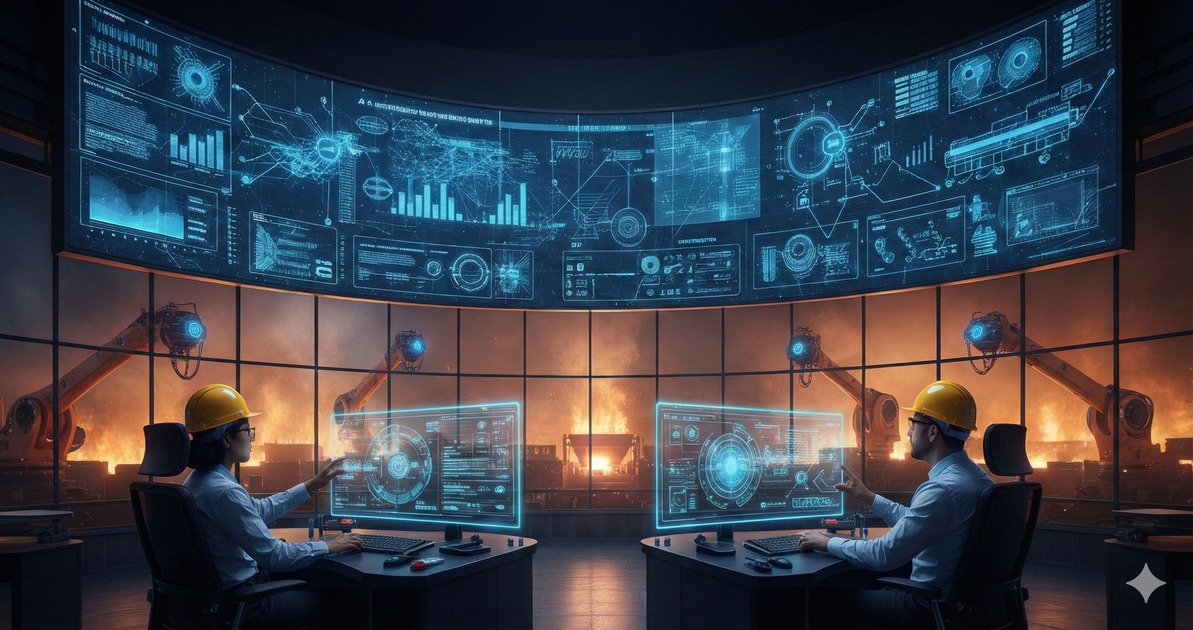
Human control consists of a small group of operators monitoring screens with real-time data, but almost no personnel are needed to directly service production. AI has reduced the need for human intervention from every three minutes to once every half hour.
The results of Baosteel’s “dark” factory are impressive:
- a 30% reduction in emissions per ton of steel;
- a 30% increase in productivity;
- a 20% increase in production capacity;
- a 15% reduction in energy consumption per ton of steel;
- a 10% reduction in processing costs.
There are other examples:
- Tata Steel’s digital plant. The Kalinganagar plant (India) was built from scratch. It operates a single data management platform that integrates information from ore extraction to shipment. Artificial intelligence (over 260 algorithms for real-time decision-making) is used at the plant to plan charge composition and furnace modes, analyze heating and energy consumption parameters, control quality using computer vision, and perform predictive maintenance.
- POSCO’s “smart” blast furnace. Artificial intelligence analyzes video from cameras, temperature readings, and charge composition in real time, automatically adjusting blast and fuel supply. The furnace’s daily productivity has increased by 240 tons of pig iron, while fuel consumption has decreased.
- Smart Mill at Big River Steel (part of U.S. Steel). One of the world’s first “smart” steelmaking complexes, where artificial intelligence is integrated directly into the technological process, was launched at the plant in Ossyol (Arkansas, USA). The main role is played by an AI platform that receives real-time data from 50,000 sensors that collect information about equipment parameters, the steel smelting process, temperature, pressure, composition, and energy consumption. The system determines the optimal production parameters, optimizes energy and raw material consumption, and predicts equipment breakdowns. The Learning Mill concept is implemented here—artificial intelligence continuously learns from production data and applies the knowledge gained to improve efficiency and product quality.
Ukrainian AI realities
Although Ukrainian metallurgy is in the early stages of implementing artificial intelligence into production processes, this is already an important signal – Ukrainian companies are looking for ways to attract the latest technologies despite the fact that the war has been going on for four years and there is a catastrophic shortage of investment.
Among the projects involving the use of artificial intelligence at Metinvest Group enterprises, the following can be highlighted:
- AI quality control at Zaporizhstal. Metinvest Group has implemented the ForgeCheck AI system at the enterprise. Computer vision analyzes images and detects defects in slabs. The economic effect reaches up to $250,000 annually.
- Automation and intelligent processes. Metinvest actively uses AI in the following areas:
- Implementation of over 500 solutions based on various intelligent automation technologies, which made it possible to automate approximately 200,000 working hours.
- myOCR intelligent document processing system (saves approximately 20,000 working hours per year).
- SPAIS computer vision system (integrated into industrial video surveillance) for detecting safety violations and monitoring equipment. Detects employees in hazardous areas or without personal protective equipment, helps to find damage in hard-to-reach places in production facilities by analyzing video from drones.
Interpipe uses predictive equipment maintenance, automated product quality control, AI algorithms for inventory management, digital twins, material cost forecasting models, and machine learning in document management in its production processes and production management.
Ferrexpo is actively focusing on production automation and the electrification of quarry transport. The company uses semi-autonomous drilling rigs and began industrial operation of unmanned dump trucks even before the war began. These technologies include elements of AI optimization of routes and equipment behavior. Ferrexpo became the first company in Europe to introduce autonomous dump trucks in open-pit mining.
Ukrainian steel companies are more focused on computer vision, machine learning, industrial internet, automation, and digitalization of production than on classic AI technologies such as neural networks or generative artificial intelligence.
The full-scale implementation of AI is part of the long-term strategy of Ukrainian mining and steel companies. It is clear that AI will be a key element of future green metallurgy.
«Metallurgy is at the top of the green agenda. The technologies have long been developed in steel industry, and it is now impossible to make a major breakthrough. The system can only be gradually improved, and this is where digitalisation and AI come in. This is what can make the industry not only more environmentally friendly, but also more efficient and competitive,» said Yuriy Ryzhenkov, CEO of Metinvest.

-

OpinionsTechnologiesmacroeconomics
28 May 2026
08 January 2025
31 March 2021
10 December 2020