





Posts Infrastructure gas 1328 10 November 2025
Not only does the state fail to encourage a reduction in the cost of energy resources for industry, but it also continues to increase tariffs
The Ukrainian energy and gas production sectors are experiencing one of the most difficult periods in recent years. Systematic rocket and drone strikes on critical infrastructure have created unprecedented pressure on the country’s energy system and gas production, threatening the stability of electricity and gas supplies to industrial consumers. Along with the growing energy shortage, electricity and gas prices are rising sharply, which is critically affecting the competitiveness of Ukrainian businesses. For their part, the Ukrainian authorities are limiting themselves to raising tariffs, without taking any steps to alleviate the situation.
The energy situation for industry
The autumn intensification of rocket and drone strikes on Ukraine’s energy infrastructure, particularly on power generation facilities, has increased the likelihood of electricity shortages and has already led to restrictions on electricity supplies to the population and industry.
The National Bank expects that in the fourth quarter of this year and in the first quarter of 2026, the electricity deficit will be at the level of 4–6%. The average annual estimate of the deficit in 2026 has been raised to 3%. The NBU’s previous forecast was based on assumptions of a slight electricity deficit of about 1% in both the fourth quarter of this year and the average annual deficit in 2026.

Due to increased shelling of energy infrastructure, it has become necessary to increase electricity imports. According to industry resource ExPro, electricity imports to Ukraine in October of this year increased 2.5 times to 360,000 MWh, while exports fell by 85% month-on-month.
Restrictions on energy supplies to industry will have a negative impact on the Ukrainian economy. According to NBU estimates, the growing electricity deficit will slow GDP growth by approximately 0.1 percentage points in 2025 and 0.2 percentage points in 2026. The NBU recently lowered its forecast for Ukraine’s economic growth in 2025 to 1.9% y/y from the previously expected 2.1% y/y, and for 2026 to 2% y/y from the previous 2.3% y/y.
According to the Market Operator JSC, the BASE electricity price index on the day-ahead market (DAM) in October this year increased by 42.7% compared to September and amounted to UAH 5,987.71/MWh. The weighted average purchase and sale price of electricity on the DAM for this period is UAH 6,395.70/MWh (41.4% of the September level). Overall, demand on the DAM in October increased by 44.6% compared to September, while supply increased by 19.7%.

Industrial situation with gas
Along with shelling energy facilities, the enemy has launched numerous attacks on gas production infrastructure. According to Bloomberg, the first shelling in September knocked out about 60% of Ukraine’s domestic gas production.
Although as of the end of October, Ukrainian underground storage facilities had accumulated 13.2 billion cubic meters of gas (or 8.6 billion cubic meters excluding “buffer gas”), the attacks made it necessary to import an additional 4.4 billion cubic meters of gas (almost 20% of annual consumption) to get through the heating season. The cost of financing these additional volumes is estimated at €2 billion, but as of today, €750 million still needs to be found.
However, the good news is that the situation with gas prices and reserves in Europe is not a cause for concern. As of the end of October, according to Gas Infrastructure Europe, European storage facilities are more than 82% full. In September–October, the European TTF benchmark remained at a plateau of approximately $400 per 1,000 cubic meters with acceptable daily volatility. This indicates that there will be no “price rally” before the start of the heating season in Europe. Therefore, there are resources for import, and their price is conditionally acceptable for Ukraine in the current conditions.
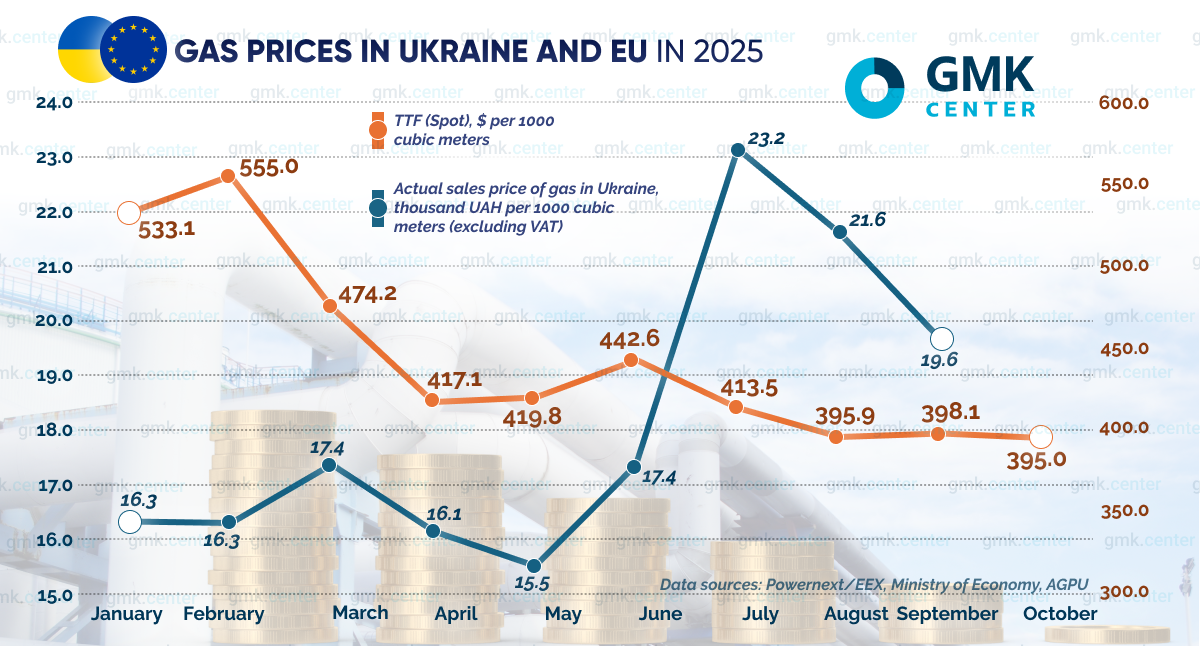
According to Artem Petrenko, executive director of the Association of Gas Producers of Ukraine, the situation on the Ukrainian market is also stable, but we are seeing moderate growth in the second half of October. While in September the cost of gas was 20,000 UAH per thousand cubic meters, by the end of October, quotations for November had risen to 21,000–21,500 UAH.
«Currently, prices for this resource are stable and transparent in both the EU and Ukraine. There are no signs of a shortage, and the price on the TTF hub remains stable without any abnormal fluctuations. Given that Ukraine has successfully carried out a campaign to pump resources into underground gas storage facilities during the off-season, the accumulated reserves and available capacity for further imports should not lead to significant price jumps,» notes Artem Petrenko.
No price reduction
The Ukrainian government is ignoring proposals from businesses to curb the rise in electricity prices for industry, which has already become a critical negative factor for the competitiveness of enterprises. Not only has nothing been done in this regard, but a new increase in tariffs for business customers is also being prepared.
At the beginning of this month, the NEURC approved a draft resolution proposing to increase the electricity transmission tariff for 2026 by 14.6% to UAH 786.74/MWh. The final decision will be made at the end of December.
Similarly, there is no reason to reduce gas prices for industrial users. Businesses expected the government to abolish the PSO in September, opening up the domestic market to national producers. Instead, the Cabinet of Ministers extended the mechanism until March 2026.
«This decision has once again created a domestic gas shortage. Traders are selling at the TTF price plus their premium. ArcelorMittal Kryvyi Rih is a large consumer of natural gas, and purchasing at a premium to the European price further reduces our competitiveness in the domestic and export markets. The rise in gas prices has already led to additional costs of more than UAH 100 million per month,» said Mauro Longobardo, CEO of ArcelorMittal Kryvyi Rih.
Instead of conclusions
The problem for Ukrainian businesses is often not the availability of energy resources, but their price. In the current environment, energy prices are having an increasingly strong impact on production costs and product competitiveness.
Despite all the challenges and constant shelling, Ukrainian energy and gas companies continue to operate and provide the population and industry with energy resources. For its part, the state is doing absolutely nothing to reduce the cost of energy resources for industry, and there are no signs or attempts to do so.
At the same time, in October 2025, the European Commission presented a package of coordinated measures to reduce energy prices and support the competitiveness of industrial consumers, combining short-term measures (targeted aid, interventions in the wholesale market) with medium and long-term measures (acceleration of renewable capacity, long-term direct contracts, infrastructure development). Similar measures are being taken by the governments of individual EU countries.
In Ukraine, on the contrary, state monopolies continue to raise their tariffs amid a lack of any attempts to curb their own “appetites” and find internal sources of efficiency improvements. In such conditions, Ukrainian businesses have no choice but to reduce production or completely or partially shut down their facilities.
In general, the situation with energy and gas supplies and the size of the energy deficit in the autumn-winter period of 2025-2026 depends on new missile attacks and possible damage to energy infrastructure, weather, and the dynamics of restoring damaged facilities. However, the available information indicates that the damage is quite serious and that restoration may take a long time. Therefore, the situation with electricity and gas for industry will be difficult, although the deficit will be covered by imports, which will be more expensive.

-

OpinionsInfrastructuresteel consumption
13 July 2026
18 March 2026

29 January 2026
20 January 2026