





Market participants have adapted to the new operating conditions
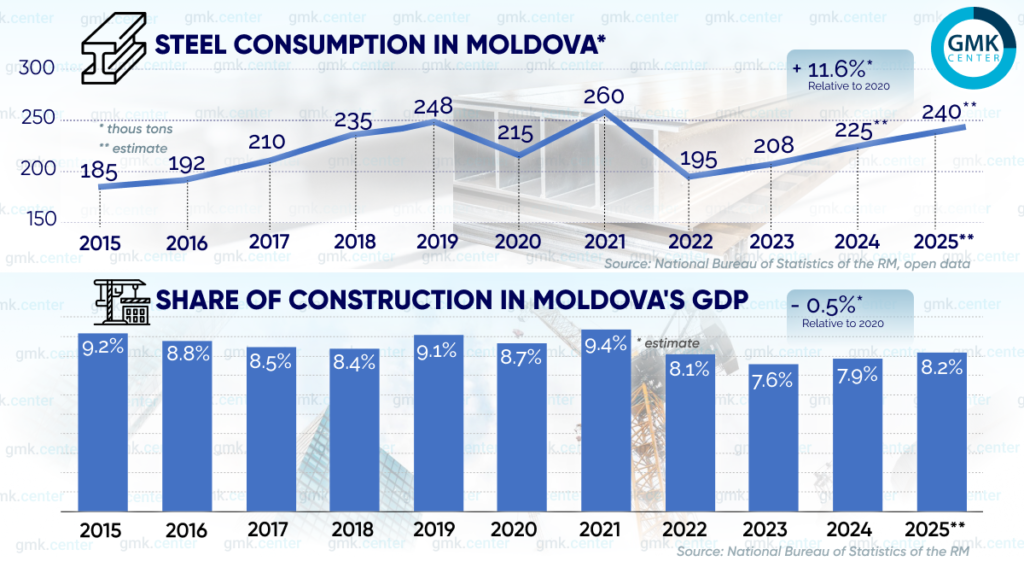
The war in Ukraine caused Moldovan demand for finished steel to plummet in 2022-2023 due to the collapse of the previous supply structure and the associated price increases. However, the same military factor proved to be a powerful stimulus for the development of logistics in Moldova. It has become an important hub for the transit of goods from and to Ukraine. As a result, steel consumption has almost returned to pre-war levels in 2024-2025. However, its structure has changed significantly.
Market profile
The capacity of the region’s only producer, Moldovan Steel Plant (MMZ), is capable of meeting the needs of the entire country several times over. However, it is more profitable for the company to sell steel to the EU and other countries. Therefore, its share of the local market was between 10% and 15% until 2021. Up to 70% was occupied by the Ukrainian plant ArcelorMittal Kryvyi Rih and Russian suppliers.
Due to the war, imports from Ukraine and Russia ceased, and Moldovan builders partially replaced them with MMZ products. Its share in 2022-2023 increased to 25-30%. However, this company only produces rebar, wire, and wire rod. Shaped rolled products began to be imported from neighboring Romania and Turkey. In 2024-2025, MMZ’s presence in the local market decreased to 20%.
Firstly, supplies from Ukraine have resumed (worth $105 million in 2024). Secondly, there are political risks. Legally, MMZ is a Moldovan enterprise. But in fact, it is located in the unrecognized Pridnestrovian Moldavian Republic.
Any deterioration in relations between the official Chisinau and the self-proclaimed authorities in Tiraspol threatens to halt the steel trade. Therefore, Moldovan consumers prefer to diversify their steel imports. Flat and shaped rolled products now come mainly from Romania, while rebar comes from Turkey.
The domestic market in Moldova mainly consumes rebar, wire rod, and shaped rolled products. Therefore, the dynamics of steel sales and construction volumes in the republic are practically identical.
Demand for flat rolled products
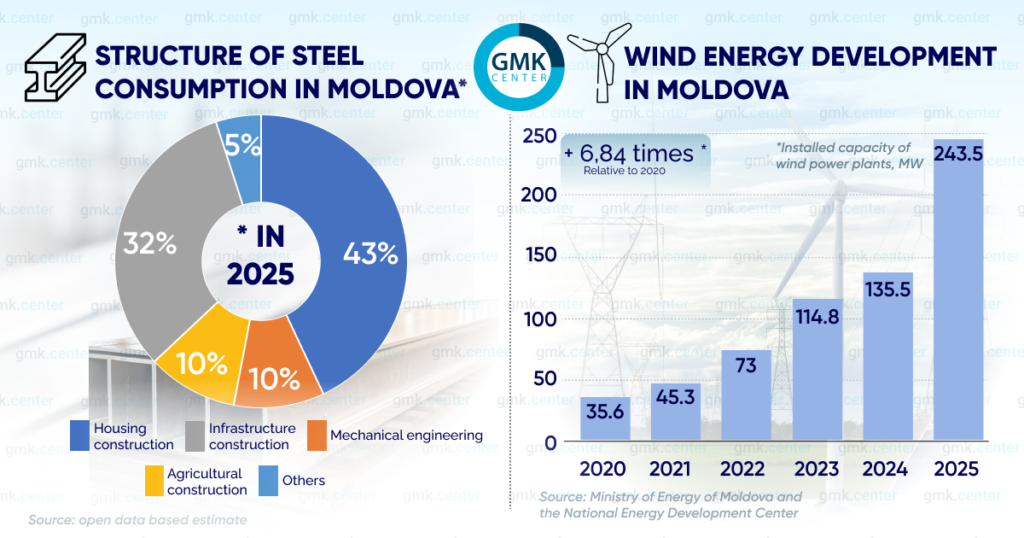
Machine building, the main consumer of flat rolled products, accounts for an insignificant share of total steel sales. In Soviet times, the Chisinau factories Vibropribor and Schetmash consumed thousands of tons of steel per month. But today, the industry is focused on the production of high-tech components with low steel content. Or large-scale assembly. For example, at MTZ Lider, which receives ready-made MTZ tractor kits from Belarus.
Major consumers include:
- Moldagrotehnica (Bălți) and Agrotehnica (Chișinău) agricultural machinery factories. They account for 4-5% of total steel consumption (estimated).
- Hidrotehnica (Chișinău) factory, manufacturer of vacuum pumps and hydraulics – 3%.
- Electromash factory (Tiraspol), manufacturer of electric motors – 2%;
The development of wind energy is increasing demand for flat rolled products in Moldova. Over the past five years, the capacity of operating wind farms here has increased tenfold. The country has good wind potential, which provides an opportunity to reduce dependence on electricity imports from Ukraine and Romania.
Demand for long rolled products
An important difference between the construction industry in Moldova and that in European countries is that the main driver here is the housing segment. In 2018, the government launched the Prima Casa («First Home») program. It provides compensation for 30-70% of the cost of mortgage loans. Thanks to this, a housing boom began in the country in 2019. It contributed to the growth of construction volumes and steel consumption.
The COVID crisis caused a slowdown in the industry. However, this was due to the freeze on commercial projects, while residential construction continued. Record figures were achieved in 2021 thanks to the resumption of activity in the commercial segment.
The subsequent decline in 2022-2023 is explained by the aforementioned market transformation and its reorientation towards new suppliers of building materials, including rolled steel. According to representatives of construction companies, deliveries from former contractors in Ukraine and Russia have doubled in price, as they are now carried out via Romania. Plus, the cost of borrowing has increased. The average mortgage rate in Moldovan banks in 2022-2023 was 15-18% in lei. Construction of many projects has stopped.
Growth in 2024-2025 is not just a “rebound” from the low comparative base of the previous period. It is an adaptation to new directions in steel imports. In addition, starting in 2024, the government has updated the terms of the state program to the Prima Casa Plus version.
In particular, the maximum amount of the mortgage loan to which it applies has been doubled to $146,600. The loan term has been extended from 25 to 30 years. This has further stimulated demand for new housing, and construction and steel consumption have returned to growth.
The share of infrastructure construction in total production continues to increase. This is due to funding from the European Union (through the European Bank for Reconstruction and Development, the European Investment Bank, and direct budget support in the form of grants). Among the significant projects are:
- Construction of the Isaccea–Vulcanesti–Chisinau power line;
- Reconstruction of the M3 Chisinau–Giurgiulesti and M5 Balti–Chisinau–Tiraspol highways;
- Modernization of border bridges with Romania: Leuseni–Albita, Sculeni–Sculeni, Giurgiulesti–Galati;
As a result, the share of infrastructure construction in steel consumption increased from 20-25% in 2022-2023 to 32% (estimated) in 2025.
It is important to note that these projects are largely related to the restructuring of Ukrainian logistics to Romanian ports. In particular, the reconstruction of the M3 and M5 highways includes the construction of bypass roads and bridge junctions for heavy goods vehicles (primarily grain trucks). The reconstruction of bridges involves modernizing and strengthening structures to increase vehicle traffic flow and expand capacity.
Steel consumption outlook
Flat steel consumption will increase slightly in 2026. According to forecasts by Moldova’s Ministry of Economic Development, industrial production will grow by 3.5%. The share of mechanical engineering in this volume is only 6-8%.
The construction of wind farms will expand. In October 2025, the government held a tender for the construction of wind energy facilities with a total capacity of 60 MW. In 2026, a tender for another 165 MW will be launched. The revival of the sector is linked to the arrival of European investors. In particular, the French company Qair announced in 2025 that it would build a 27.5 MW wind farm in Moldova.
This will increase consumption of flat rolled products. However, long rolled products remain in the lead. At the same time, the share of the housing sector in the total volume of construction work will continue to decline: in 2025, the number of permits for new housing construction fell by 9% to 2,955, according to the National Bureau of Statistics.
However, thanks to the increase in infrastructure construction, the industry as a whole will significantly improve its steel consumption figures. In particular, there are plans to build new bridges across the Prut River connecting Moldova with Romania: “Ungheni-Ungheni,” “Leova-Bumbata,” Stolnicieni-Fălciu, and Luncea-Bărboian.
These projects are designed to relieve congestion on major highways and increase the capacity of road transport between the two countries. Funding for these projects is being provided by the Romanian government and the European Commission through the Connecting Europe Facility program.
Another landmark project is the construction of the Iasi–Ungheni–Chisinau railway line from Romania to Moldova, with a European standard gauge of 1,435 mm. Preparatory work began in 2025, with the main purchase of rails and related railway hardware expected in 2026.
Also in 2026, work will continue on the modernization of the Bendery-Căușeni-Giurgiulești railway. This work began in 2025 and involves the replacement of turnouts, rails, and railway fastenings to accommodate heavy trains carrying grain from Ukraine. In 2025, steel structures were purchased for this project to reinforce the roadbeds.
Therefore, the Moldovan Ministry of Economic Development’s forecast of a 12% increase in construction volumes in 2026 seems realistic. Accordingly, the consumption of long rolled products will increase.
Conclusions
The transformation of Moldova’s steel market continues. First, the structure of consumption is changing, with infrastructure construction playing an increasingly important role, as in developed EU countries. Second, new changes in the geography of supplies can be expected in 2026.
Measures to close the EU to steel imports are leading to higher selling prices by European steel mills, including Romanian ones. In these conditions, offers from Turkey, Egypt, Algeria, and China are becoming more attractive to Moldovan consumers.

-

OpinionsStatesteel consumption
13 July 2026
30 June 2026

25 May 2026
26 January 2026