




Posts State Ukraine’s economy 289 30 June 2026
Following the conference, more than 160 agreements worth over €12 billion were signed
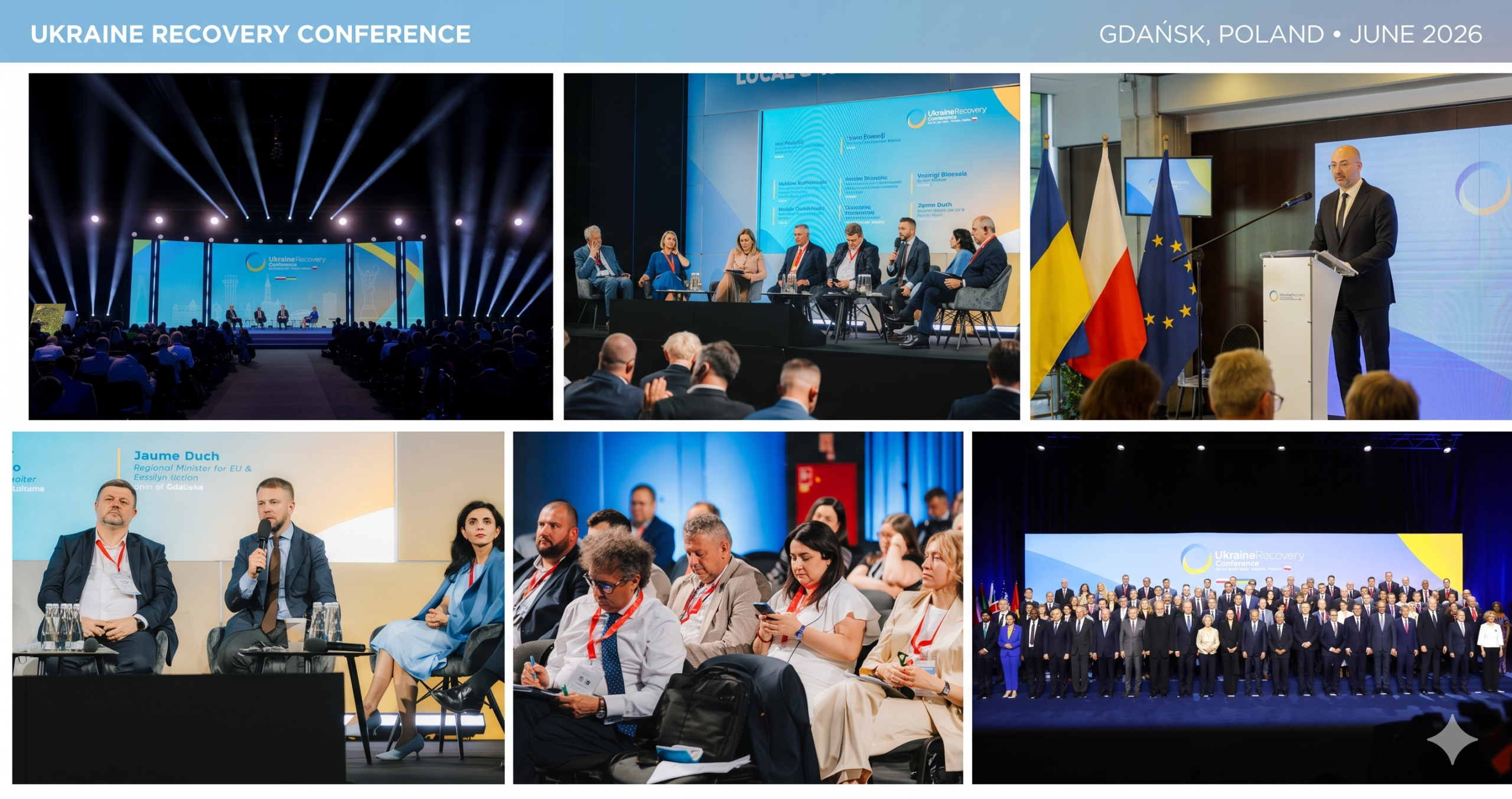
On 25–26 June 2026, Gdańsk in Poland hosted the fifth Ukraine Recovery Conference (URC 2026). The Minister for the Economy, Oleksii Sobolev, described it as “the most practical in all the years”. Over 160 agreements worth €12 billion, the first tranche of an EU loan worth €3.2 billion, agreements with the World Bank, the EIB and the EBRD, and new projects in the energy, infrastructure and steel sectors — GMK Center presents a summary of the two working days in Gdańsk.
The Fifth Ukraine Recovery Conference took place in Gdańsk on 25–26 June. The event brought together over 8,000 participants — almost twice as many as last year’s URC 2025 in Rome.
Among them were around 80 Ukrainian companies presenting projects to foreign investors, 220 enterprises taking part in the business fair, as well as delegations from over 70 countries and 38 international organisations.
The conference covered the following thematic areas:
- human capital,
- EU accession,
- economic recovery,
- security and defence.
For the first time, separate infrastructure and energy platforms were launched as part of the URC.
The event took place against the backdrop of strained Ukrainian-Polish relations due to a historical dispute, which affected the organisation of certain side events but did not significantly impact the final outcomes.
Conference results
Overall outcomes
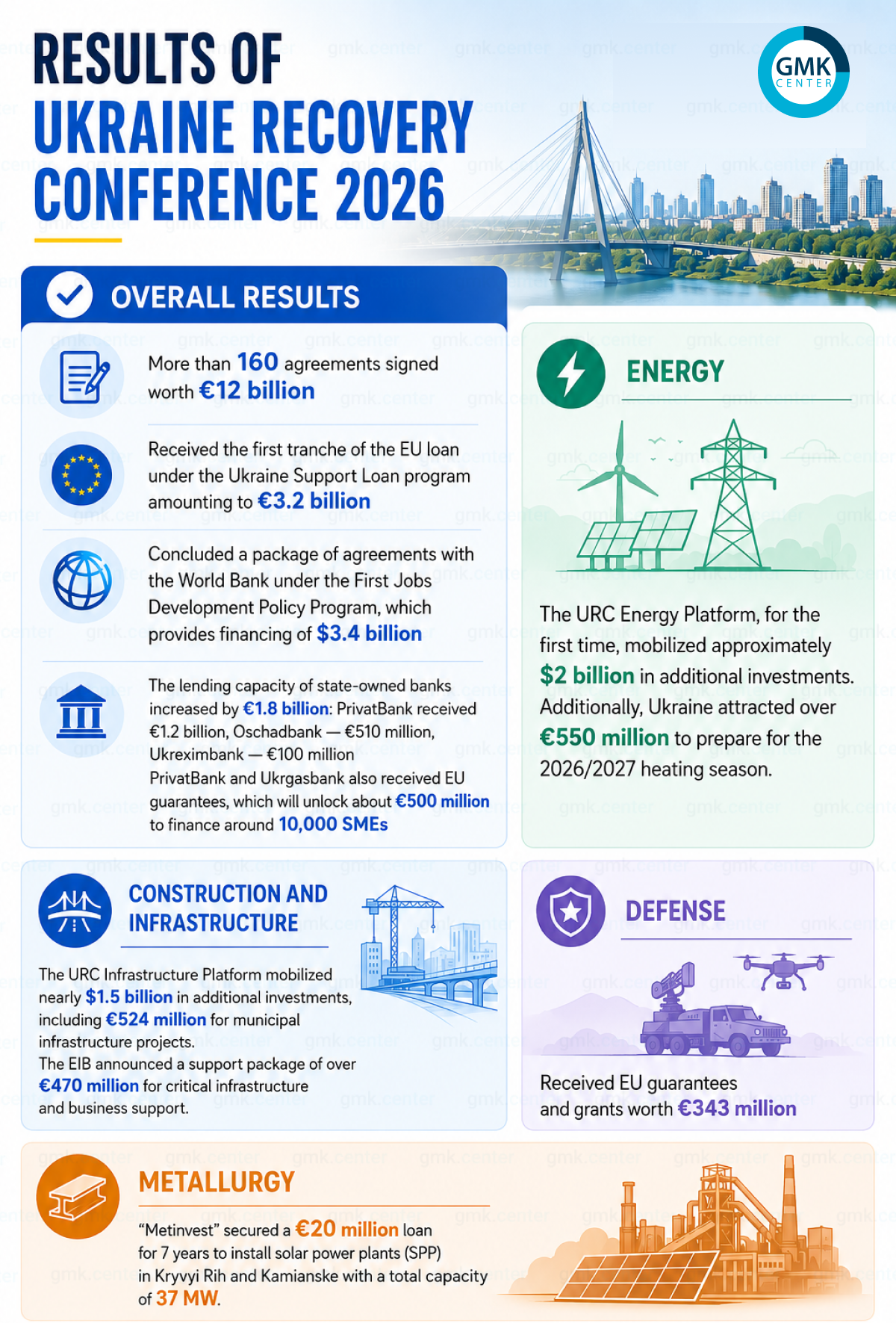
According to estimates by the Ministry of Economy, 160 agreements totalling over €12 billion were signed at URC 2026. A key outcome was the first tranche of the Ukraine Support Loan from the European Union — €3.2 billion.
The agreement with the World Bank under the First Development Policy Programme for Jobs and Private Sector Growth (DPO) provides for funding of $3.4 billion: a loan of $1.04 billion (with guarantees from the UK for $500 million and from Japan for $540 million) and grant funding for the F.O.R.T.I.S. Ukraine FIF fund amounting to $2.35 billion. The funds will be directed towards supporting macro-financial stability and financing priority budget expenditure.
Other key outcomes include the official launch of the Ukraine Flagship Fund — an investment fund for Ukraine’s recovery with an initial close of €220 million (capital from the European Commission and the governments of Germany, France, Italy and Poland).
“The aim is to reach a first close of €500 million in the coming months, and in the longer term to raise up to €1 billion in capital and mobilise up to €9 billion in investment in the Ukrainian economy. The priority sectors are energy, infrastructure and logistics, industry, and digital transformation,” notes Oleksii Sobolev.
The lending capacity of Ukrainian banks will increase thanks to this funding:
- PrivatBank has received €825 million (the first tranche being €265 million) from the EBRD and €357 million from the European Investment Fund.
- Oschadbank has received €510 million (the first tranche being €150 million) under a programme which, for the first time, includes a direct war risk coverage facility for micro, small and medium-sized enterprises (MSMEs).
- Ukreximbank secured a €100 million loan to finance energy efficiency projects for SMEs.
- PrivatBank and Ukrgasbank received EU guarantees, which will free up around €500 million to finance around 10,000 SMEs, including companies affected by the war.
Energy
The energy sector proved to be one of the busiest in terms of deals. The Ministry of Energy signed an agreement with the UK government on state guarantees for a £210 million loan — the funds will be used to ensure stable supplies of enriched uranium from Urenco to Ukrainian nuclear power stations over a two-year period.
The EBRD will provide NPC Ukrenergo with a €90 million loan for anti-drone protection of substations. Ukrnafta has signed a €44.6 million grant agreement with the EBRD for the construction of 62 MW of distributed generation, which will supplement the €80 million in EBRD loans previously secured. The Naftogaz Group has signed a $300 million agreement with the US Export-Import Bank (EXIM Bank) to purchase American equipment for the purpose of restoring damaged oil and gas infrastructure.
The largest private-sector deals were:
- DTEK and GE Vernova agreed to build a new 650 MW combined cycle power station at a cost of €900 million.
- OKKO signed a €191 million loan agreement to build a 189 MW wind farm.
- Notus Energy secured a €65 million loan from the EBRD to finance a 120 MW wind farm.
In total, the URC energy platform, launched for the first time, attracted around $2 billion in additional investment. Furthermore, Ukraine raised over €550 million to prepare for the 2026/2027 heating season.
A separate landmark deal in the energy sector was the creation of a joint venture between DTEK, SCM and the British company Octopus Energy — the UK’s largest electricity supplier. The joint venture will implement the €100 million RISE project — an initiative to roll out solar panels and energy storage systems on the roofs of buildings across Ukraine. This is expected to drive growth in the consumption of steel structures for rooftop solar power plants (SPPs).
“Industry was clearly represented in the URC programme. […] Ukraine’s stand looked like that of a large, reputable company at an international exhibition. The state presented clear messages and tools to the outside world,” says Dmytro Kysilevskyi, deputy chair of the Verkhovna Rada Committee on Economic Development.
Construction and Infrastructure
The EIB Group has announced a new support package worth over €470 million for critical infrastructure and business support. It comprises:
- €524 million under the Ukraine Infrastructure Facility for the implementation of municipal infrastructure projects;
- €96 million for the repair of roads and bridges and the development of border infrastructure under the ‘Roads of Solidarity’ initiative (Tranche B);
- €80 million — an EIB investment in the European Flagship Fund for Ukraine’s Recovery, expected to mobilise over €1 billion;
- €50 million (grant agreement) for transport links — the construction of interchanges in the Kyiv, Lviv and Rivne regions;
- €120 million (framework agreement with a first tranche of €60 million) for the development of border crossing points and access roads in 2027–2029.
Ukraine has also secured around $18 million in international aid for Ukrzaliznytsia, which will be channelled towards protecting critical infrastructure, improving rail safety, modernising diagnostic systems and other measures.
Housing programmes deserve separate consideration. Ukraine has received €100 million (a €50 million loan plus a €50 million EU grant) for the construction of social housing in Kremenchuk, Kropyvnytskyi, Lviv, Mykolaiv and Zhytomyr (1,000–1,600 units in the first phase). Ukraine and the Council of Europe Development Bank (CEB) have also agreed on a new package worth €251+ million for housing programmes.
In total, the URC infrastructure platform has attracted nearly $1.5 billion in additional investment.
Defense and security
For the first time at the URC, the defence sector has been given its own dedicated thematic section. The agreements signed provide for €343 million in EU guarantees and grants, which are expected to attract over €700 million in investment in the development of dual-use technologies and the defence industry.
Results for the steel sector
Metinvest Group has signed a new loan agreement with the Black Sea Trade and Development Bank (BSTDB) for €20 million over a seven-year term. The funding will be used to strengthen the group’s energy resilience: specifically, to install solar power plants in Kryvyi Rih and Kamianske with a total capacity of 37 MW and to support critical energy infrastructure. At the same time, this will enable the company to reduce its carbon footprint.
It is also worth noting Metinvest’s participation in the ‘My Home. Ukraine’ housing project: six neighbourhoods, each comprising 3,612 flats for displaced persons from Mariupol, will be built according to the ‘Steel Dream’ concept — using steel frame technology, which ensures direct consumption of the group’s steel products.
Interpipe actively represented the industry’s position during panel discussions. Interpipe’s CEO, Luca Zanotti, delivered a keynote address at the conference on the EU’s trade policy towards Ukraine.
In his view, the EU’s protective barriers on steel imports are justified, but Ukraine cannot be equated with China: “There are no state subsidies in Ukraine. If the EU treats Ukraine fairly, everyone will benefit.”
Zanotti also raised the issue of smaller enterprises’ access to financial resources from major international institutions within the European market, calling for targeted support to be provided to them.

-
OpinionsStatesteel consumption
13 July 2026
25 May 2026
02 March 2026
26 January 2026