




Posts State war in Ukraine 1279 13 November 2025
The problems with reconstruction include inflated prices in estimates, low competition in tenders, and failure to meet deadlines
Over three years of full-scale war, Ukraine has spent approximately $20 billion on construction purchases. Nearly half of the damaged medical facilities and a quarter of schools have been restored, and more than $1 billion in compensation has been paid for destroyed housing.
However, reconstruction is lagging behind the pace of destruction: losses have already exceeded $80 billion, and needs amount to $190 billion. In addition, the effectiveness of reconstruction is significantly hampered by overpricing in estimates and low competitiveness in procurement procedures.
The Center for Economic Strategy (CES), the Institute for Economic Research and Policy Consulting (IER), and the Technologies for Progress NGO presented a study of reconstruction processes in 2023-2025.
Reconstruction figures
In 2023–2024, construction procurement amounted to approximately UAH 300 billion annually. This year, the same volume is likely to be achieved. Among the largest procurements over the three years are road repairs and maintenance in various regions, water pipelines for Kryvyi Rih, Marhanets, and Mykolaiv, restoration of educational and medical facilities, and protection of energy infrastructure.
This analysis is based on data on construction procurement from the Prozorro portal, which can be considered relevant to reconstruction in a certain way. At the same time, the list includes not only projects to recover from the effects of the war, but also regular infrastructure tenders. In particular, one of the largest projects is the construction of the Syretsko-Pecherska metro line in Kyiv, worth UAH 13.8 billion.
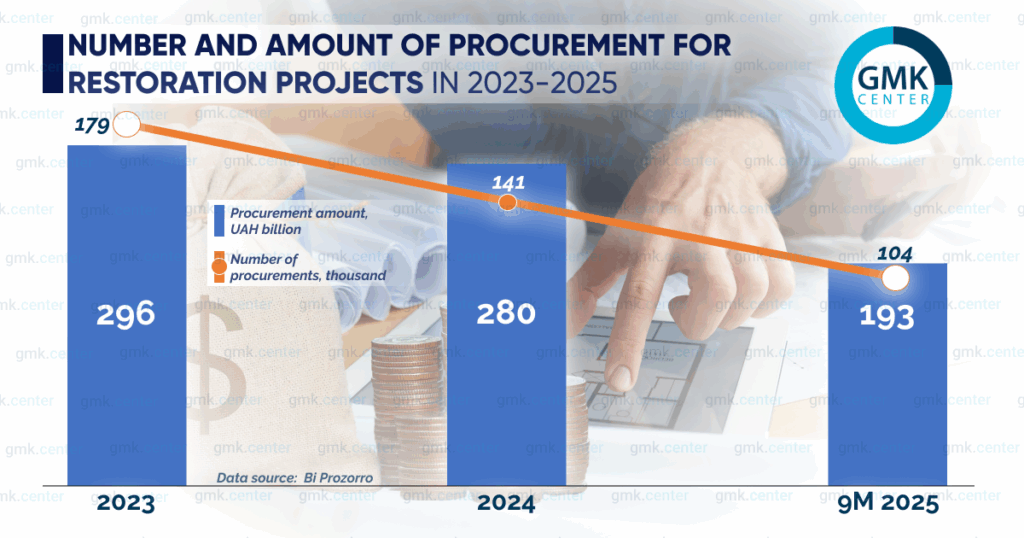
Kyiv and the Kyiv region are the leaders in terms of construction procurement volumes, but these are rarely reconstruction projects. Other leaders include the Vinnytsia, Dnipropetrovsk, Kharkiv, and Odesa regions. In particular, the Kharkiv region has suffered the greatest infrastructure losses, while in the Odesa region, significant funds are being allocated to the restoration of port infrastructure.
It should be noted that Ukraine currently has the following main sources of funding for reconstruction: the Fund for the Elimination of the Consequences of Armed Aggression, international financial organizations (the World Bank, the EIB, etc.), the reserve fund and other state budget programs, local budgets, Ukraine24 funds, the Ukraine Energy Support Fund, private charitable foundations, and technical assistance programs. With so many sources, there is no accurate-consolidated data on reconstruction costs in Ukraine.
Positive trends
Many participants in tenders is a prerequisite for a significant reduction in prices. There is a direct correlation: the more participants there are, the greater the price reduction.
«If there were many participants in tenders, Ukraine could save significant funds and direct them to the construction of additional facilities. After all, it is high competition that leads to lower prices. For example, in a tender for the development of project documentation for the repair of a motorway, which was held this year by the Infrastructure Restoration and Development Service in the Lviv region, the cost fell by 70% because 17 participants took part in this tender,» said Natalia Kolesnichenko, senior economist at the CES.
The level of problems with tenders is relatively low – only about 1% of procurements are appealed.
“The share of appeals is quite low and has been fairly stable over the past three years. Therefore, it can be said that both customers and companies participating in procurement are generally satisfied with this process,” added Natalia Kolesnichenko.
In 2023–2024, approximately 80% of tenders lasted less than two weeks and only 6% lasted longer than 50 days. In 2025, the duration of procurements lasting more than one month increased slightly.
Reconstruction challenges
War-related factors, traditional Ukrainian bureaucracy and corruption in procurement, as well as relatively new organizational and administrative procedures in the field of reconstruction have led to certain challenges. Analysts note the following:
- Corruption-inducing factors:
- inflated prices in estimates (after DASU audits, costs are often reduced due to revisions of estimates);
- more than 75% of public procurement for construction and restoration in Ukraine involves only one participant, i.e., without competition among potential contractors;
- artificial underestimation of procurement costs to circumvent procurement legislation requirements – approximately 80% of sub-threshold procurements are conducted partially outside the electronic system.
- Failure to meet deadlines and/or budgets. A quarter of projects were not completed within the originally planned timeframe, and the same number of projects saw their initial costs revised. The first problem is partly due to a shortage of personnel in the construction sector.
- Uneven spending. Every year, one-third of purchases are made in the fourth quarter, which is related to the specifics and procedures for spending public funds. During this period, everyone tries to use the allocated funds to the maximum so that at the end of the fiscal year, as little money as possible is returned to the state budget.
- Limited budgetary financial resources for reconstruction purposes due to the priority of military spending.
- Low involvement of the public and communities in planning and discussing recovery. Low level of awareness among aid recipients.
Due to bureaucracy, the low capacity of local authorities to quickly implement projects, and delays in public procurement, more than UAH 7 billion of the funds allocated for reconstruction were not utilized in 2024 alone.
«This is partly due to slow procurement. Sometimes funds are allocated at the end of the year, and customers do not have time to spend them. Also, for projects financed by IFIs, lengthy procedures and the low capacity of individual communities to prepare and implement projects are becoming problems. Problems with additional financing for communities are also arising. However, these problems will be partially solved within the framework of the reform of the public investment management system,» explained IER lead expert Oleksandra Betliy.
In addition to the problems in the field of reconstruction, hundreds of millions of hryvnias were wasted on the restoration of facilities in frontline regions, which were subsequently destroyed again.
Furthermore, the timely implementation of comprehensive protection of critical infrastructure would have been significantly cheaper than overcoming the consequences of intensified enemy attacks on energy and gas production infrastructure.
Ways to improve
According to the authors of the study, construction procurement for reconstruction reached $20 billion over three years. Forty-six percent of damaged medical facilities and 28% of educational institutions have been restored, and more than $1 billion has been allocated to compensate for the destruction of housing. At the same time, reconstruction lags behind the pace of destruction, in particular due to a lack of funding.
According to RDNA4 estimates, the total losses from the destruction of housing, educational and medical facilities, utilities, and municipal services exceeded $80 billion by the end of 2024, and the needs for reconstruction amounted to $190 billion. Moreover, this year, losses due to Russian shelling have increased rapidly.
According to Natalia Kolesnichenko, in order for reconstruction to be more efficient, higher quality, and cheaper for the state, the following should be taken into account:
- Increasing competitiveness in procurement, in particular by opening up estimates.
- Streamlining procurement procedures and control over them. Further development of a risk-based approach to procurement monitoring, unification of procurement classifiers, etc.
- Strategic planning. Budget expenditures should be spread over several years and planned in advance.
- Uniform financing of projects throughout the year, rather than a rush of funds at the end of the year.
- Taking into account the priorities of local communities and establishing clear priorities.
Stimulating demand
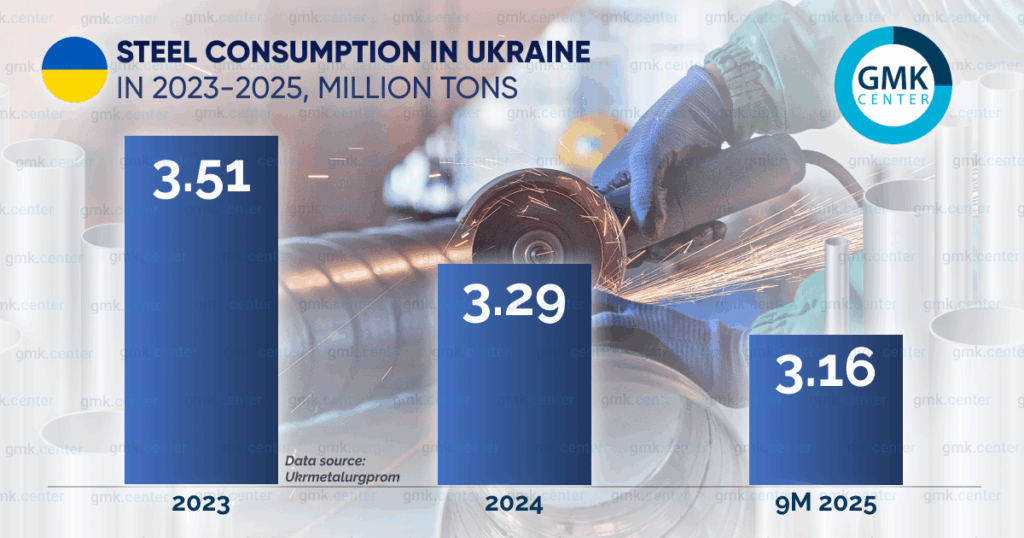
Reconstruction is already stimulating demand for building materials and steel products to a significant extent. However, post-war reconstruction will lead to rapid growth in demand for steel products.
According to some estimates, the construction industry accounts for approximately 70% of steel consumption in Ukraine. Of course, this varies across different segments of the construction industry, but even in wartime, the industry is undoubtedly the largest consumer of steel products.
Another problem for Ukrainian producers is protecting the domestic market from excessive imports, particularly from Turkey. Since the start of the full-scale war, the share of Turkish rolled steel on the Ukrainian market has tripled.
Turkish steel imports in 2024 accounted for approximately 52% of its total volume. At the end of the first 10 months of this year, the share was 49%. In particular, in January-October, Turkish long products accounted for 57.5% of imports to the Ukrainian market, flat products – 60%, and pipes – 48%.
In addition, at the end of 2024, Turkish steel products accounted for 23% of Ukraine’s steel consumption.
These figures indicate that our market is highly dependent on Turkish steel imports, which is already creating problems for Ukrainian factories that produce similar products. These issues will only intensify by the time post-war reconstruction begins.
At the same time, Ukrainian manufacturers can meet most of the demand for steel products within the framework of the country’s reconstruction. However, due to the growth of tariffs of state monopolies and prices for electricity and gas, as well as pressure from cheap imports, domestic steel mills may shut down.
For its part, the state is doing absolutely nothing to reduce the cost of energy resources for industry. On the contrary, in early November, the NEURC approved a draft resolution proposing a 14.6% increase in the electricity transmission tariff for 2026. This and similar decisions, or even inaction, threaten both the existence of the entire industry and the post-war reconstruction of the country.
Ukraine has enormous untapped potential for increasing steel consumption. According to Worldsteel, per capita consumption of finished steel products in Ukraine in 2024 was only 95 kg, compared to an average of 291 kg in the European Union. That is why rebuilding Ukraine is the best way not only to restore the country after the war on a qualitatively different technological basis, but also to do so using domestic materials and products.

-
OpinionsStatesteel consumption
13 July 2026
30 June 2026
25 May 2026

02 March 2026