




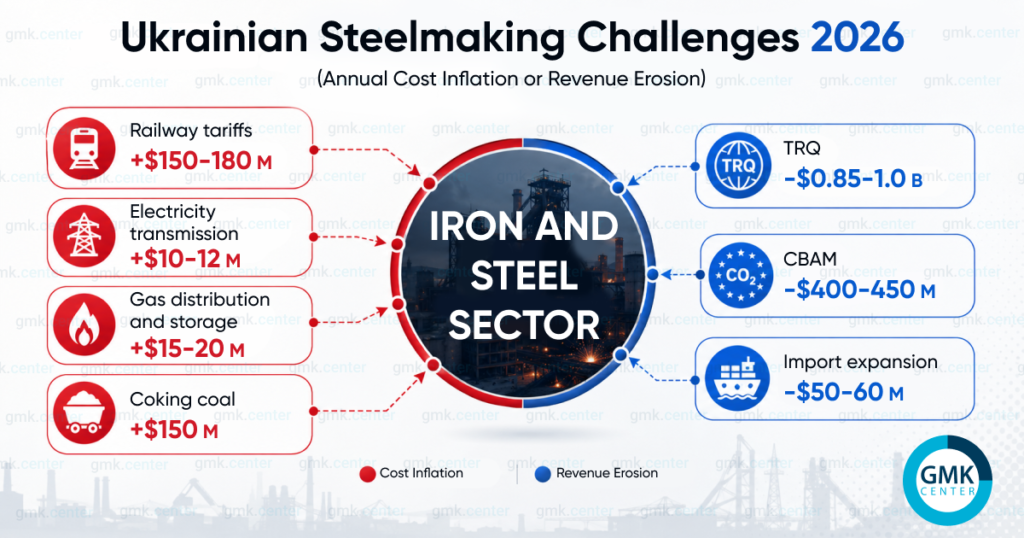
The sector’s costs could rise by $300–350 million, whilst sales could fall by $0.9–$1.1 billion
Ukraine’s iron and steel industry enters the second half of 2026 facing what can only be described as an existential challenge. This is more than just another difficult year in the cyclical pattern of downturns and recoveries the sector has experienced over the past decade. For the first time, it is being squeezed from both sides at once: costs are rising across virtually every major category, including electricity, natural gas, coal, logistics, and labor, while revenue is coming under pressure from multiple directions, including CBAM, the EU’s new steel import quota regime, and growing import competition in the domestic market.
According to Ukrmetallurgprom, steel production in Ukraine fell by 3.2% year-on-year in January–June 2026, but the toughest times for steelmakers lie ahead in the second half of this year. Below is a detailed look at each of these challenges.
Transport: Ukrainian Railways is raising fares at a time when the sector cannot cope
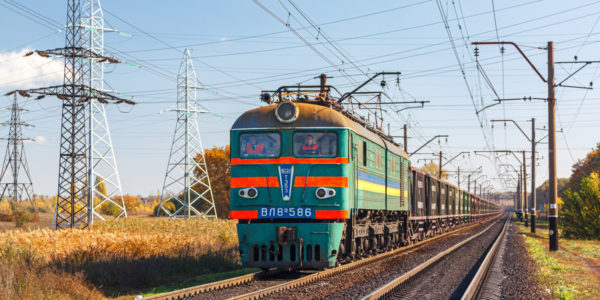
Ukrainian Railways plans to increase freight rates by 30% from August 2026, and by a further 15% from 1 January 2027. The cumulative increase could reach 45%, generating additional revenue of 26 billion hryvnias for the company. Separately, it is proposed to set a single coefficient (5.139) for empty wagons, regardless of the class of cargo from which they have been unloaded. This will raise the tariff for the empty run of wagons carrying Class 1 and Class 2 cargo by 60% straight away.
According to calculations by the Federation of Metallurgists of Ukraine, the planned 45% tariff increase in 2026–2027 will raise the production cost per tonne of steel by $20–25 due to rising logistics costs for both raw materials and finished products. In monetary terms, this will mean $150–180 million in additional costs per year for iron and steel companies (including supply chains).
Iron ore producers are proving to be the most vulnerable — margins in this sector are traditionally lower, and prices in China, the main export market, are falling in the second half of the year, meaning that rising transport costs are coinciding with a parallel decline in revenue. In the first half of 2026, iron ore exports from Ukraine had already fallen by 25% year-on-year.
Energy: the gap with EU prices has narrowed, but competitiveness is still being eroded
In early 2026, the sector saw a 13% drop in steel output in January–February due to a critical power supply situation caused by Russian attacks on the energy sector. The difference in electricity prices between Ukraine and the EU at that time stood at 40–50%. In May–June, the situation stabilised somewhat: the weighted average wholesale price of electricity in Ukraine in June was 8.5% higher than the average price in the EU and 13% higher year-on-year. For an export-oriented industry competing in foreign markets against producers with cheaper energy, this difference represents a systemic loss of competitiveness. For example, as of June, when compared with the EU: 78% of steel there is produced in countries with cheaper electricity.
Added to this is a regulatory factor: the NEURC has approved a 25% increase in Ukrenergo’s electricity transmission tariff from 1 August, bringing it to 928.45 UAH/MWh. For green EAF-based enterprises, the tariff could rise by 27%, to 563.26 UAH/MWh. In monetary terms, this means an increase in costs of at least 500 million UAH, or $10–12 million, per year.
Gas: the regional gas companies’ ageing infrastructure is being passed on to industry
At the same time, gas costs are rising — due to distribution and storage tariffs set by decisions of the NEURC. From 1 January and 1 April 2026, increased tariffs for gas distribution (services provided by regional electricity and gas companies) for non-household consumers came into force in stages. In several regions, transportation costs have risen by 1.5 to 2 times, largely due to war-related damage and the deterioration of transportation infrastructure. For steel producers, this means an additional $15–20 million in costs per year — a smaller amount compared to the energy or transport sectors, but one that adds to the overall burden at a time when there is no longer any financial buffer to absorb these new costs.
Coal: the loss of Pokrovsk has destroyed the industry’s vertical integration
With the loss of Pokrovsk, Ukraine has lost a source of coking coal — a critically important element that for decades ensured the vertical integration of the domestic steel sector. Producers are now forced to import coal: in 2025, imports totalled around 3.5 million tonnes. In the first half of 2026, coal prices rose by 27% year-on-year — from $188/t FOB Australia to $240/t. Based on estimated import volumes of 1.7 million tonnes for the half-year, this represents a cost increase of $85 million, rising to $150 million for the whole of 2026 — or $35 per tonne of steel. Dependence on import prices and the volatility of the global market is a new reality for domestic steelmakers.
Staff: plants near the front line are losing workers who cannot be replaced
Staff shortages are a problem across the entire Ukrainian economy, but the issue is particularly acute for the steel industry, as key plants are located near the front line: in Zaporizhzhia, Nikopol, Kryvyi Rih and Kamianske. When people leave these cities, there is virtually no one to replace them on the local labour market – it is simply not large enough.
The industry also faces persistent labor shortages due to military mobilization. At the five largest steel companies alone, approximately 15,000 employees, nearly 15 percent of the workforce, have been called up for military service. According to ArcelorMittal Kryvyi Rih (AMKR), its blast furnace operations are currently operating with a staffing shortfall of about 30 percent, a level that threatens the stability of a continuous production process. One potential policy response would be to grant iron and steel producers the same workforce retention provisions as critical infrastructure operators and defense enterprises, allowing them to defer military service for 100 percent of their permanent employees who are eligible for mobilization.
At present, however, companies are attempting to address the problem by retraining staff, attracting internally displaced persons by subsidising their rent, and, looking ahead, by engaging with students. All of this represents additional costs that are added to production costs, which are already rising steadily.
Domestic market: imports are driving out domestic producers
While the challenges discussed above primarily affect costs, the picture on the revenue side is equally concerning. Although Ukraine’s steel market is projected to grow by 3.6 percent year over year in 2026, domestic producers have seen little benefit, as imports continue to gain market share at the expense of local steelmakers.
In the first half of 2026, imports of flat steel increased by a modest 2.1 percent year over year, while long steel imports surged by 68 percent. As a result, domestic steelmakers’ shipments to the local market declined by 100,000 metric tons during the period. The primary reason is the industry’s weakening competitiveness relative to foreign suppliers, driven by the cost pressures discussed above.
The decline in domestic sales in 2026 could amount to $50–60 million.
CBAM: a wake-up call at the start of the year, and that’s not even the worst of it
CBAM came as a wake-up call for domestic steelmakers at the start of 2026. In the first half of the year, exports of long products from Ukraine fell by 42% year-on-year. The outlook for Ukrainian long products appears particularly challenging: with an average carbon intensity of 2.1 tonnes of CO₂ per tonne, Ukrainian exporters face CBAM levies of €58 per tonne — significantly higher than those faced by competitors using electric arc furnaces (€18 per tonne). This is a direct consequence of the industry’s production structure, which remains heavily dependent on BF-BOF route. That structure cannot be changed quickly and would require investments measured in billions of dollars.
Exports of hot-rolled coils are subject to CBAM charges that are €10–15/t higher than those faced by other importers, although rising prices for flat steel have partially offset these costs. However, the key factor that deterred European buyers was not the cost of the CBAM itself, but the uncertainty surrounding the actual carbon intensity data for imports: it is economically unviable to operate using default figures, and verified actual data will only become available in the first half of 2027. In other words, for almost a year and a half, the market is essentially operating in the dark.
The long-term outlook is even more challenging: in 2029–2030, pressure on Ukrainian flat steel exports to the EU will intensify as the supply of low-carbon products on the European market increases and CBAM payments are further raised. It is estimated that the reduction in exports of ferrous steel products from Ukraine due to the CBAM in 2026 could amount to $400–450 million.
TRQ: a blow that overshadows even the losses from the CBAM
However, these losses pale in comparison to another issue — the EU’s revised tariff quota (TRQ) system, which came into force on 1 July 2026. Under the new system, the volume of duty-free import quotas will be reduced by 46% to last year’s import levels, whilst the duty on shipments exceeding the quota will rise from 25% to 50%.
For Ukraine, the consequences have proved to be among the most severe of all the EU’s trading partners. Individual quotas for Ukrainian suppliers are, on average, 60% lower than the actual volumes of exports in 2025, which is far greater than the overall reduction in quotas. However, the relevant law and regulation on the determination of individual quotas explicitly state the need to take into account the interests of Ukraine as ‘a candidate country for EU accession facing an exceptional and extraordinary security situation’.
According to GMK Center’s estimates, this means an annual reduction in steel exports of 1.3–1.5 million tonnes and a loss of between $850 million and $1 billion in foreign exchange earnings. Flat steel products will be hit hardest, with 35–40% of production volumes under threat, which represents an unprecedented challenge. It is impossible to redirect these volumes to other markets. In the long products segment, production losses could reach 25%.
The EU regulation remains in force only until the end of 2026, after which it will be replaced by another, leaving a window for dialogue. However, the next six months will be a test for the Ukrainian steel industry, which has been left without a significant portion of its output and sales markets. The sector’s future remains highly uncertain.
The cumulative effect: a deadly combination
If we simply add up the figures that have been explicitly stated, the picture is as follows: on the expenditure side — at least $300–350 million per year in additional costs (transport, coal, gas, energy), not including the as yet undetermined costs of maintaining and training personnel under mobilisation conditions. On the revenue side — losses in the range of $0.9–1.1 billion per year (domestic market, CBAM, TRQ). Moreover, the rise in costs is not an isolated problem: it undermines competitiveness and narrows the range of markets accessible for exports, which in turn threatens a further reduction in exports themselves.
This is no longer merely a crisis — it is a systemic collapse. The sector is simultaneously losing:
- revenue — due to CBAM, TRQ and the decline in the domestic market;
- profit margins — due to rising Ukrainian Railways tariffs, energy prices and the cost of imported coal;
- competitive advantages — due to rising production costs and increased administrative regulation;
- staff — due to mobilisation and the inability to replace them.
The long-term outlook is no better. Ukraine is critically dependent on exports to the EU, which last year accounted for 50% of total domestic steel output. In the context of the CBAM and changes to the country’s own carbon pricing system, multi-billion investments in decarbonisation are needed to preserve the industry. However, the current business environment not only limits companies’ ability to generate the capital required for these investments but also erodes investor confidence in the industry as a whole.
In broad terms, the picture is this: a growing number of industry experts, market participants, and steel executives have warned publicly that Ukraine’s steel industry may be approaching a tipping point. Under this scenario, steel plants could begin shutting down one by one. Only five steelworks remain in operation today, and all are running below capacity. Unfortunately, such an outcome cannot be ruled out
But I believe in the future of Ukraine’s iron and steel sector — it has unique strengths: its own sources of iron ore, coking coal and ferroalloys, a unique production culture, a skilled workforce and a strategic location for exports.
Can the current catastrophic situation be turned around? Absolutely. Most of the challenges outlined above are regulatory in nature. As a result, their resolution depends largely on policy decisions by the Ukrainian and European authorities, which in turn are shaped by diplomatic engagement at the highest level. We need to ensure fair, non-discriminatory trading conditions with the EU, avoid undermining our own competitiveness through unilateral tariff decisions, and maintain room for dialogue. And the issue of affordable energy in Ukraine must become key to the country’s economic development. Incidentally, the EU’s industrial and steel sectors face exactly the same challenge, so we can tackle it together, just as we can with most of our strategic challenges — such as decarbonisation and attracting investment.

-
OpinionsIndustrysteel consumption
13 July 2026
16 July 2026
24 June 2026
18 June 2026