




Infographics macroeconomics 1510 31 July 2025
GDP growth slowed down, but industrial production and construction are already showing negative dynamics
The growth of the Ukrainian economy began to slow down in the second quarter of 2024, and based on the results of the first half of 2025, it can be stated that, according to certain indicators, it has already entered a state of recession. There are practically no growth drivers left, the Cabinet’s economic policy does not contribute to the emergence of new ones, and the ongoing war is leading to a deterioration in existing business conditions.
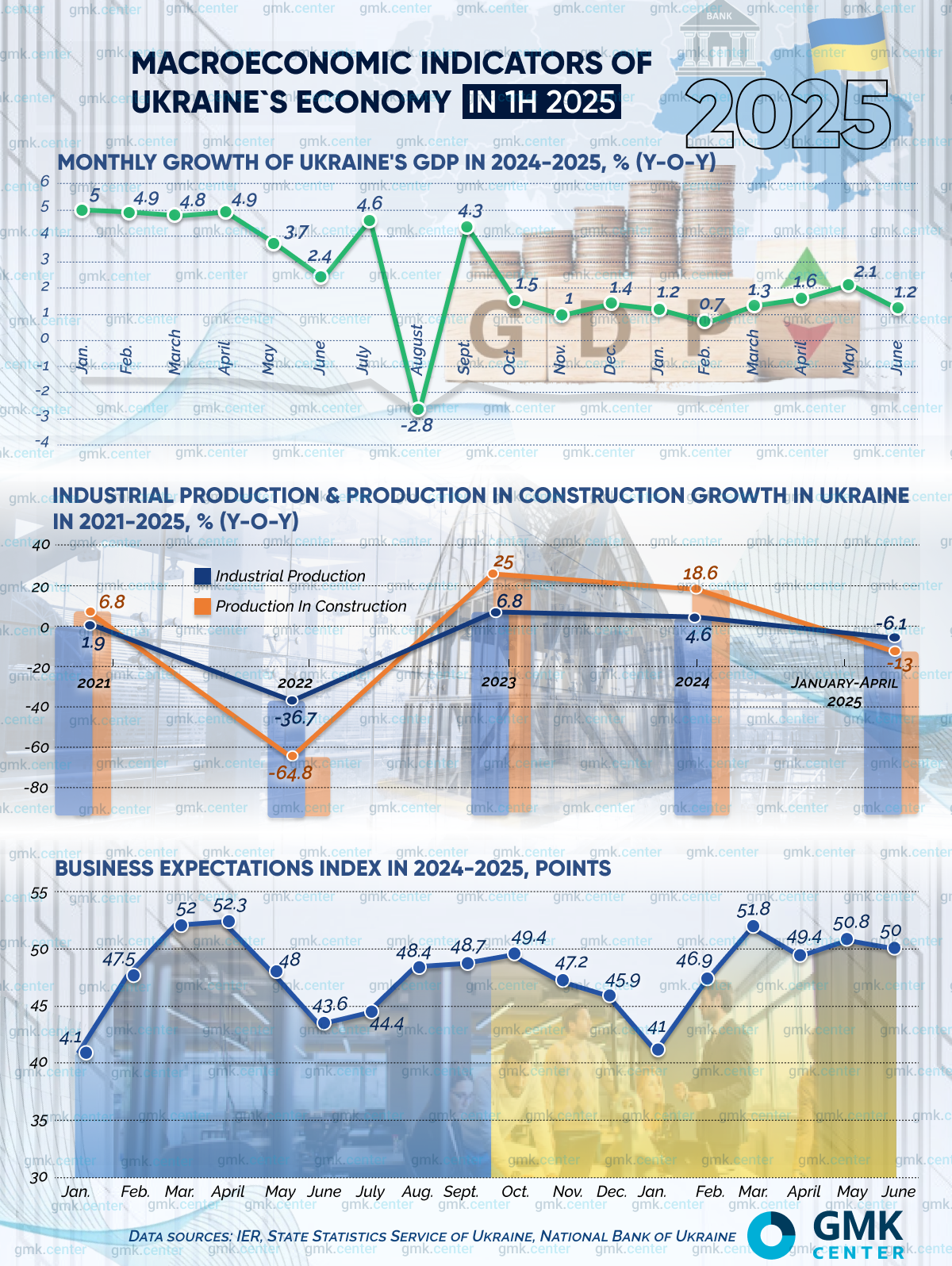
All this has led to a slowdown in GDP growth. According to preliminary estimates by the Institute for Economic Research and Policy Consulting (IER), Ukraine’s GDP grew by 1.3% year-on-year in the first half of the year. This still looks like a fairly high figure against the backdrop of 0.9% year-on-year economic growth in the first quarter, as calculated by the State Statistics Service. It should be recalled that GDP growth at the end of 2024 was 2.9% year-on-year.
Other important economic indicators showed a slowdown in growth at the end of last year, and in 2025, a decline is clearly visible. Thus, the decline in industrial production in Ukraine in January-April 2025 amounted to 6.1% y/y, while last year there was a slowdown in growth to 3.6% y/y. In essence, the only drivers of growth remain the defense industry and related segments, as well as industries that cater to consumer demand.
The situation is similar in the construction industry. In January-April, the volume of construction work completed in Ukraine decreased by 13% y/y after growing by 15.5% y/y in 2024. The situation has deteriorated significantly due to a decline in the construction of engineering infrastructure. One of the main reasons was the cessation of funding for the construction of energy facilities through US aid via USAID.
At the same time, assessments of the business climate are balanced between minimal optimism and neutrality. Since the beginning of the year, the business activity expectations index (BAEI) has risen by 9 points (p.), but since March it has fluctuated within a narrow range around the neutral level of 50 p. Its latest move was a decline to 50.0 p. in June from 50.8 p. in May. All this points to moderate business optimism, but these assessments are inherently very fragile in the current environment.
In any case, analysts are already revising their GDP growth forecasts for 2025 downward. The National Bank has lowered its economic growth expectations to 2.1% from 3.1%, and the ICU investment group to 2.5% from 3.0%. The main reasons for the deterioration in economic growth estimates are: worsening harvest expectations, trade wars that negatively affect external demand, high gas and electricity prices due to infrastructure strikes, a consistently significant labor shortage, and the high cost of borrowed capital.
Continued increases in state monopoly tariffs, the unresolved issue of postponing the CBAM, the cancellation of preferential trade with the EU for Ukrainian agricultural products, and the risks of intensified shelling of critical infrastructure and production facilities are creating the conditions for a deterioration in the country’s economic situation. Against this backdrop, there are no new drivers of growth, and the government’s economic decisions remain insignificant in scale and unsystematic in nature.
-

02 July 2026

06 July 2026

01 July 2026
22 June 2026