




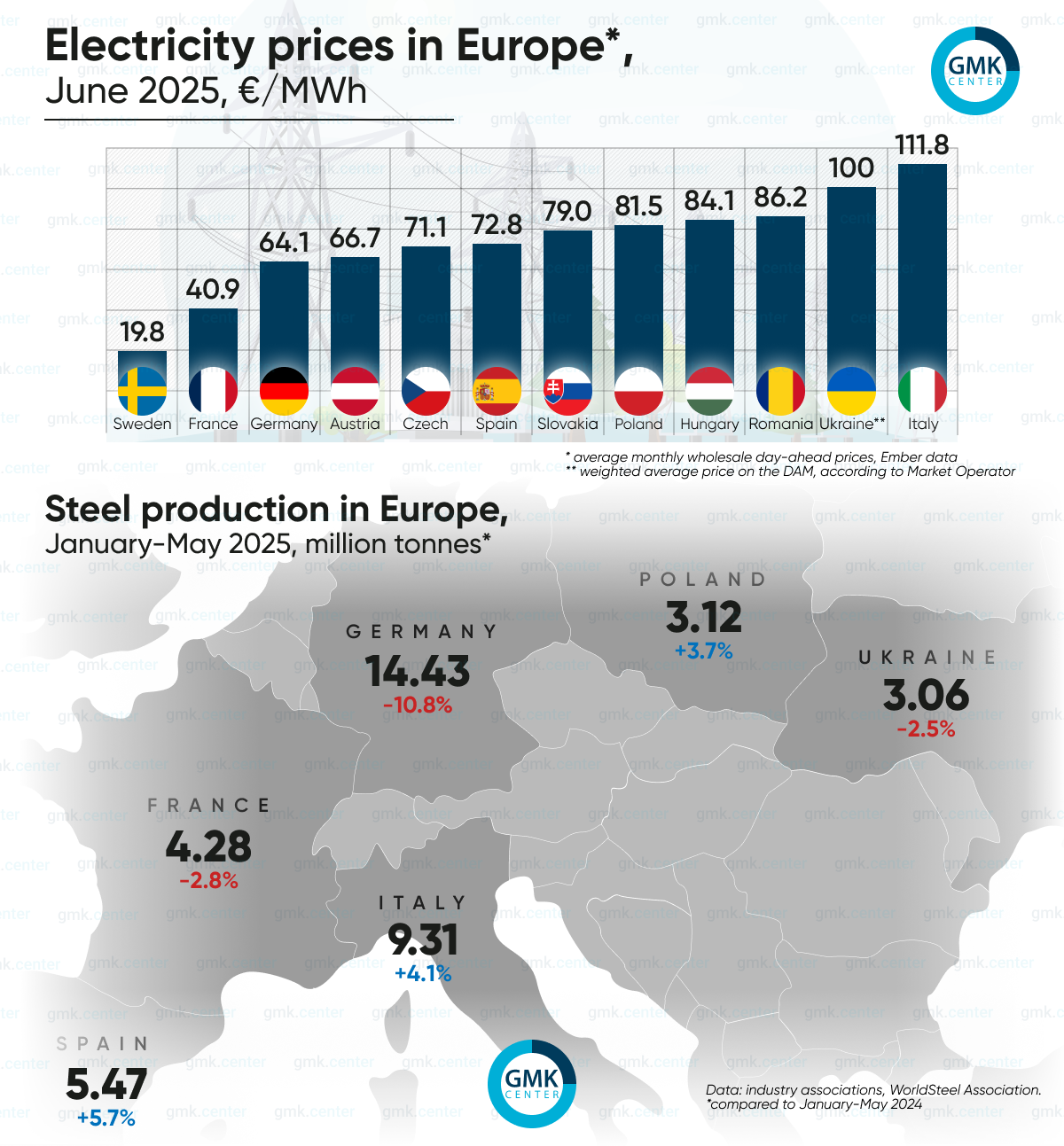
Infographics electricity prices 6115 08 July 2025
In Ukraine, the weighted average price for day-ahead trading last month was €100/MWh
In the EU, average monthly wholesale prices for day-ahead trading in June 2025 showed mixed trends, depending on the market.
According to Ember (as of July 4, 2025), they were as follows:
- Italy – €111.77/MWh (+17.4% month-on-month);
- France – €40.9/MWh (+2.1 times);
- Germany – €64.14/MWh (-3.9%);
- Spain – €72.88/MWh (+4.6 times);
- Sweden – €19.83/MWh (-45.6%).
Last month, the average monthly wholesale price for day-ahead electricity in Poland was €81.5/MWh, in Slovakia – €78.98/MWh, and in Hungary – €84.13/MWh.
In the first half of the month, average weekly electricity prices in most European countries exceeded €50/MWh, and in the third week of June – €70/MWh. At the same time, in the British, Iberian, and Italian markets in the second half of June, prices reached daily values of over €100/MWh.
The situation last month was influenced by gas prices (in particular, on June 19, the price of TTF futures for the month ahead on the ICE exchange was fixed at €42/MWh), fluctuations in the cost of CO2 emission allowances, hot weather in Europe and the resulting increase in demand, as well as the generation mix. At the same time, European markets also recorded negative hourly prices during the period, both during the day and at night.
Overall, AleaSoft Energy notes that in the first half of the year, the average price on most major European markets, except for Nord Pool for the Scandinavian countries, exceeded €60/MWh, and on several of them it was the highest since the second half of 2023.
According to the AGSI platform, European gas storage facilities were 59.4% full on July 1, 2025 (compared to 77.6% on the same date in 2024).
European decisions
The cost of energy in June was once again the focus of attention for European industry.
On June 25, the European Commission adopted a new state aid system to support the Clean Industry Agreement (CISAF), which will remain in force until the end of 2030. It simplifies the rules for such support in five key areas.
In particular, according to CISAF, member states can provide support for electricity prices to companies operating in sectors that are particularly open to international trade and are energy-intensive. In exchange, companies will be required to invest in decarbonization.
The UK has also announced steps to reduce electricity costs, which are a key measure of the government’s Industrial Strategy, unveiled on June 23.
According to the strategy, from 2027, large electricity consumers (aerospace, automotive, and chemical companies) will be exempt from paying several green fees, which will reduce their electricity bills by 25% — this applies to more than 7,000 companies.
The government is also increasing support for companies in sectors such as steel, chemicals, and glass. This will include an increase in the discount on network usage fees to 90% from 2026 (currently 60%). This will help about 500 companies that meet the requirements.
The European steel sector insists on the urgency of decisions on energy carriers. Thus, the German Steel Industry Association (WVStahl), commenting on CISAF, noted that it is important to implement the German aid measures announced in the government’s coalition agreement without delay. WVStahl also welcomed the statement by the Minister of Economy and Energy on the presentation of a specific concept for industrial electricity prices in the near future.
The urgency of the issue was highlighted by ArcelorMittal’s decision to abandon plans to convert two German plants — in Bremen and Eisenhüttenstadt — to carbon-neutral production due to the country’s excessive energy costs. The company refused a €1.3 billion state subsidy for these projects. Thyssenkrupp, in turn, said it was sticking to its plans to build a €3.5 billion green steel plant in Duisburg, but stressed that the right market conditions were needed for a successful transformation.
The issue of electricity costs was also raised in early July by Polish steelmakers’ unions. They announced their intention to intensify protests in the fall due to the lack of real support for the industry from the government, as they consider the recently presented action plan for the sector to be ineffective. Among their demands are a single electricity rate of €60 per MWh for all energy-intensive industries in the EU and a review of the Green Deal (especially the ETS).
The situation in Ukraine
For Ukrainian steelmakers, as for European ones, the cost of electricity remains a crucial condition for production stability. In particular, ArcelorMittal Kryvyi Rih called for fair pricing in this market.
As Serhiy Lavrinenko noted, deputy general director for steel production at the enterprise, in 2021, the share of electricity in the selling price of the steel plant’s products was 7%, and in 2025, this figure reached 20% due to uncontrolled tariff changes. At the same time, the company cannot raise prices for steel products for consumers, as their cost is determined by world markets.
Lavrinenko cited the lack of a full-fledged electricity market and access to cheaper imported electricity as the reasons for high prices for Ukrainian industry.
The highest electricity price in Europe could shut down ArcelorMittal Kryvyi Rih, the company warns. In May, it exceeded €94 per MWh for the Kryvyi Rih steel plant.
ArcelorMittal Kryvyi Rih CEO Mauro Longobardo later noted that the ArcelorMittal group, having invested more than $1 billion in Ukrainian enterprises during the war, is paying a very high price to remain in the country. And the more than tenfold difference between the price at which electricity is sold to the company and the cost of electricity produced by energy companies is unacceptable. Therefore, the government must intervene in the pricing situation.
In June 2025, the weighted average purchase and sale price of electricity on the DAM in Ukraine, according to the Market Operator, increased by 3.12% month-on-month to UAH 4,783/MWh (€100/MWh at the average monthly hryvnia-euro exchange rate).
Last month, according to ExPro Electricity monitoring, the country increased electricity imports by 5% month-on-month to 203.8 thousand MWh. Compared to June 2024, electricity imports decreased by more than 4 times.
Electricity exports from Ukraine in June increased 2.5 times compared to May, to over 237 thousand MWh.
In early July, the Ministry of Energy reported that the maximum capacity of electricity exports from Ukraine and Moldova to EU countries had increased to 900 MW. This should facilitate the balancing of the Ukrainian power system and enable domestic power plants to generate additional revenue and allocate additional resources to eliminate the consequences of Russian shelling and prepare for winter. Exports will be carried out only if there is a surplus of capacity in the power system.
-

Opinions Industry steel consumption
13 July 2026

20 July 2026
06 July 2026
01 July 2026