




Posts Industry construction 904 21 April 2026
Current plans for industrial real estate construction already exceed pre-war levels
As a result of Russia’s full-scale aggression, the industrial infrastructure has suffered enormous losses. According to World Bank estimates, as of the end of 2025, direct losses to Ukrainian industry due to the war amounted to approximately $16 billion. However, in the relatively safe western and central regions of Ukraine, industrial investors have resumed activity as early as 2023: initially through the relocation of existing production facilities, and later through new construction.
The total floor area of industrial buildings and warehouses at the pre-construction stage now exceeds the pre-war level of 2021 by 35%. This trend is driven by the large-scale development of industrial parks.
Resumption of industrial construction
Following the onset of full-scale aggression, the commissioning of industrial space predictably declined sharply but subsequently began to recover. As of January–September 2025, the commissioning of industrial space increased by 23% year-on-year—to 852,500 square meters. It should be noted that by the end of 2024, this figure had increased by 16% year-on-year—to 987,000 square meters. This is only 12% less than in pre-war 2021.
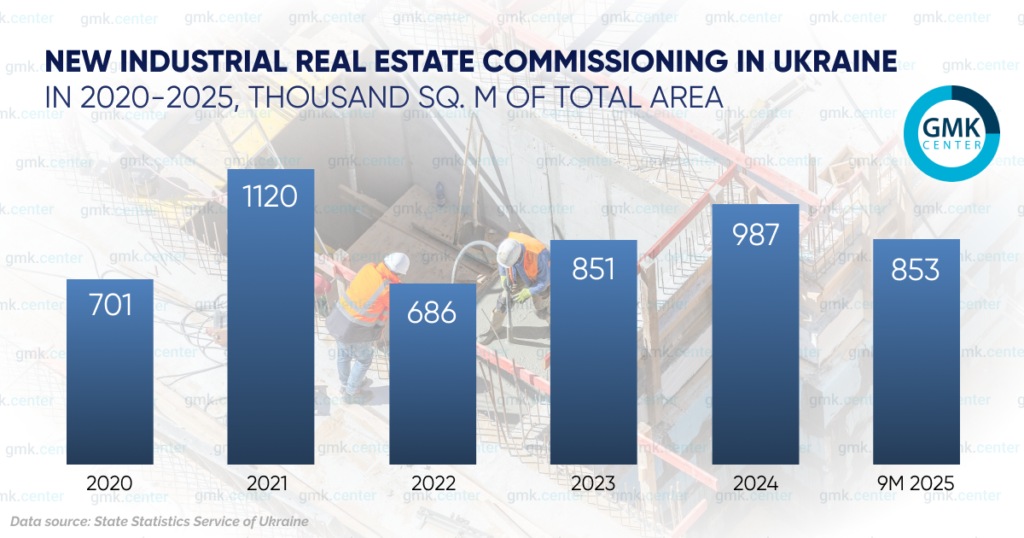
Industrial construction has become the core of the industry, overtaking infrastructure. By the end of 2025, non-residential construction, which grew by 27.4% year-on-year, became the driver of the entire construction sector, overtaking the civil engineering segment (3.6% year-on-year). At the same time, industrial construction became the driver of the entire non-residential segment. The share of industrial real estate commissioning in the total volume of non-residential real estate commissioning increased significantly—to 37% in 2024–2025 from 20–22% in the pre-war years of 2020–2021.
This indicates that investors are increasingly favoring investments in Ukraine’s manufacturing sector. It is important to note that the projects for 2024–2025 involve new construction, rather than the relocation of existing facilities, which was the driver of demand for industrial real estate in 2022–2023.
Among the major industrial facilities commissioned in 2025, the Avesterra Group’s chicken processing plant in the Volyn region with €60 million in investments, the Nestlé pasta production plant in Volyn worth €42 million, and the Bakery Food Investment frozen bakery products facility opened in the Zakarpattia region for 400 million UAH.
The general characteristics of all production projects (sample size: 81 projects) launched in 2022–2025 are as follows:
- The median investment is $10–25 million. Six large projects (Kronospan, Kernel, Kingspan, Knauf, and others) are driving the average up to $50–70 million, but a typical project is worth $1 million.
- The leading sectors are the food industry (18 projects), followed by the defense industry (16), building materials production (10), and energy and machinery manufacturing (9 each).
- About 60% of projects are financed with Ukrainian capital. Foreign investors are investing in building materials production (Ireland, Germany, Austria) and licensed manufacturing (Czech Republic, Norway, USA). Direct participation by international financial institutions (EBRD and IFC) has been recorded in four projects (Astarta, NovaSklo, and others).
Another distinctive feature of the Ukrainian industrial construction market is the lack of transparency. The locations of newly established enterprises fulfilling military contracts are often not disclosed, even in detail.
Regional trends
The trend toward the construction of new industrial real estate in the western and central regions of Ukraine emerged even before the war. Full-scale aggression has only intensified this trend. Among the leaders in the commissioning of industrial facilities based on the results of the first nine months of last year were Kyiv (32.3%), Lviv (19%), Zakarpattia (7.1%), Odesa (5.4%), and Poltava (5.1%) regions. The largest increase in the share of this indicator for the first nine months of 2025 compared to pre-war 2021 was recorded in the following regions:
- Kyiv – up to 32.3% from 23.5%;
- Zakarpattia – up to 7.1% from 2.5%;
- Lviv – up to 19% from 16.5%.
These figures clearly show that Ukraine’s western regions—which are relatively safe amid the war—are becoming hubs for industrial construction and industrial development. New logistics hubs and manufacturing centers, geared specifically toward exports, are emerging in the western regions.
“The main demand comes from private clients (commercial construction). Last year, logistics centers, warehouses, grain elevators, and sugar factories were actively being built—all by private clients. Among our main clients are steel structure plants that supply the private construction sector in western Ukraine,” Vitaliy Prytula, director of Eurometall, a company that sells imported steel products, previously told GMK Center.
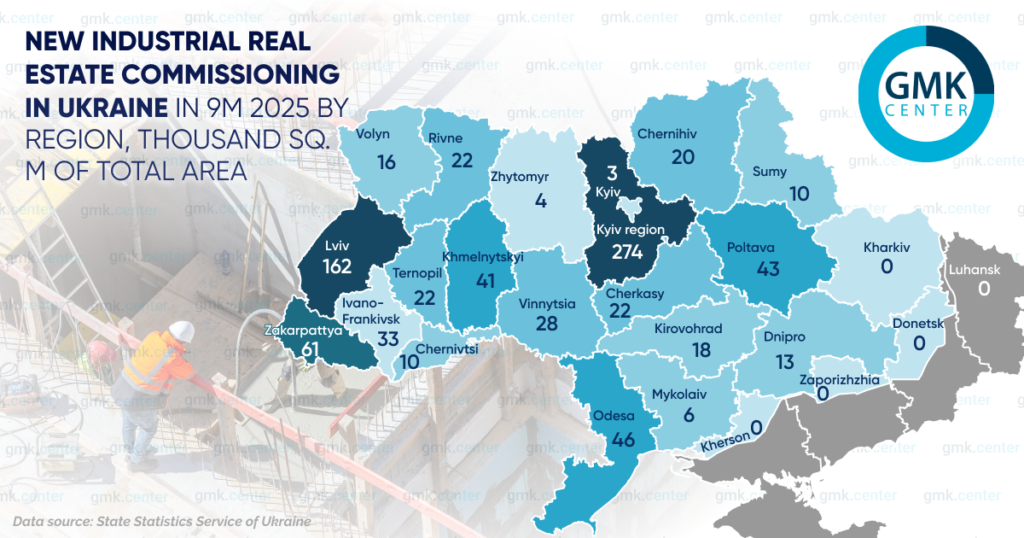
Previously, the industrial regions of Kharkiv and Zaporizhzhia were among the leaders, but due to war-related risks, they are now reporting zero new industrial facility completions. The Dnipropetrovsk region has significantly lost ground: based on January–September figures from last year, its share fell to 1.5% from 8% in 2021. At the same time, the Odesa region, despite constant shelling, remains an attractive region: its share of new industrial real estate commissioning for the first nine months of last year stood at 5.4%.
Ambitious plans
The total floor area of industrial buildings and warehouses in the pre-construction phase in January–September 2025 decreased by 29% year-on-year, to 1.18 million square meters. At the same time, by the end of 2024, this figure had nearly doubled—to 2.3 million square meters from 1.2 million square meters in 2023. As early as 2024, the volume of planned industrial construction was 35% higher compared to 2021 levels. In other words, current plans for industrial real estate construction exceed pre-war levels.
Among the publicly announced industrial projects, the following are worth noting:
- Kingspan’s campus comprising seven building materials production facilities in the Lviv region, with investments totaling €280 million;
- the Ukrainian NovaSklo project in the Kyiv region—a €240 million glass manufacturing facility;
- the “Potato Agro” plant for producing French fries in the Cherkasy region, valued at $110 million.
A significant portion of new production facilities and warehouses are being built or opened in industrial parks. Some companies locate their production there due to tax and customs incentives, while others do so because of the availability of engineering and other infrastructure. Additionally, new production facilities and warehouses are already being constructed with certain elements of backup power supply.
The western regions—Lviv (20) and Zakarpattia (12), as well as Kyiv (15)—led in the number of registered parks as of the end of last year.
The trend in the construction of new production facilities in industrial parks is positive. By the end of last year, 37 plants were under construction or had already been completed, whereas by the end of 2024, this figure stood at 25 enterprises.
“As of the end of 2025, 37 industrial enterprises had been built or were under construction in industrial parks. Of these, 22 plants have been commissioned, while another 15 are still under construction. These are enterprises in the fields of agricultural processing, food production, the furniture and woodworking industries, machine building, and others,” says Valerii Kyrylko, CEO of the Industrial Parks of Ukraine Group of Companies.
One of the points of attraction for industrial capital is the Bila Tserkva Industrial Park. Currently, the Bila Tserkva is home to 20 tenants, including both Ukrainian producers and foreign companies In 2025, production facilities were commissioned for a Ukrainian producer and the Finnish company Peikko, with areas of 3,200 sq. m and 2,353.5 sq. m, respectively. According to the management of the Bila Tserkva Industrial Park, three plants and an educational hub are currently under construction in the park, with plans to open the hub in 2026.
Thus, the Ukrainian industrial construction market is demonstrating strong recovery momentum despite the ongoing full-scale war. The annual growth in the commissioning of industrial space, the exceeding of pre-war figures in terms of planned construction volume, and the active development of industrial parks point to significant prospects for the Ukrainian industrial sector.

-

OpinionsIndustrysteel consumption
13 July 2026
24 June 2026
18 June 2026
15 June 2026