




Posts Green steel green steel 2465 29 July 2025
GCC countries can play an important role in decarbonizing global steel industry
The absence of BF-BOF capacities allows companies in the Gulf Cooperation Council (GCC) countries to already produce low-emission steel, with average emissions of 1.13 tons of CO2 per ton of finished product. And they have everything they need to transition to completely low-carbon production: huge investment resources plus enormous potential for renewable energy. If anyone in the world is going to be the first to succeed, it will be the GCC countries.
But they can do even more. And they can do it now. Cheap electricity plus virtually free natural gas, which reserves are incredible, is what allows the Gulf states to take the lead in global DRI production. The main sales market could be the European Union, where, after the introduction of CBAM, replacing pig iron with low-carbon raw materials for steelmaking will become acute issue.
Step 1: complete transition to renewable energy sources
Despite similar starting opportunities, the pace of decarbonization in the GCC countries varies significantly. Saudi Arabia and Bahrain have declared their intention to achieve zero CO2 emissions in their economies by 2060, while the UAE and Oman aim to do so by 2050. Qatar and Kuwait, on the other hand, have set more modest targets: a 25% and 7.4% reduction in emissions by 2035, respectively.
The volumes of planned investments also vary. Saudi Arabia’s Vision 2030 national strategy has earmarked $186.5 billion for renewable energy production and distribution projects by 2030. Meanwhile, the UAE government will spend $63 billion on these goals by 2050.
Accordingly, steel companies in the GCC are developing roadmaps based on national guidelines. Currently, the Gulf’s steel industry consists entirely of EAF plants, which mainly use DRI for steelmaking. Even flat products at the Saudi Arabian Al-Ittefaq Steel Co. (ISPC) are produced from electric steel.
The absence of coal in the technological chain results in low CO2 emissions. Saudi Arabia’s ISPC and Hadeed emit 1.4 tons per 1 ton of finished steel, Qatar Steel emits 1.34 tons, Emirates Steel has 0.67 tons (Scope 1 and Scope 2), and Oman’s Jindal Steel Sohar has 1.05 tons. This allows GCC steelmakers to present their products as green. Given the global average of 1.37 tons for the DRI-EAF process, they are in a pretty good position. But there is still room for improvement.
Emirates Steel’s extremely low carbon footprint is due to the fact that the company uses 86% of its electricity from renewable sources (RES). Qatar Steel, on the other hand, has not yet used them in its production. And the company’s roadmap for 2022-2026 does not even include any plans in this regard. Hence, the twofold difference in emissions. Meanwhile, it is clear that a complete transition to RES is a task for the near future for all GCC steel producers.
This does not seem to be a difficult task, given the enormous financial resources in the Gulf countries and their natural potential. The level of solar radiation in the region is 2,200-2,500 kWh/m2, one of the highest in the world. It is an ideal combination for the development of solar energy. And it is developing. But everywhere in different ways.
- The capacity of renewable energy sources in Saudi Arabia in 2024 was 4.5 GW. By the end of 2026, the construction of 11 more solar power plants with a total capacity of 11.4 GW is planned to be completed. By 2030, the share of renewable energy sources in the overall energy balance should reach 50%. One of the largest projects under development is the Al Shuaiba 2 solar power plant with a capacity of 2.03 GW.
- The capacity of renewable energy sources in the UAE in 2024 was 6.3 GW, accounting for 27.8% of the energy balance. By 2030, this figure will grow to 32%. However, it could increase even more if the authorities ensure the implementation of landmark projects: the construction of two solar power plants in Abu Dhabi, each with a capacity of 1.5 GW, and the sixth phase of the MBR solar park with a capacity of 1.8 GW.
- In April this year, Qatar opened a complex of two solar power plants with a total capacity of 0.875 GW. The project cost $630 million. As a result, the total renewable energy potential reached 1.675 GW. By 2030, it should increase to 4 GW, mainly due to the construction of the 2 GW Dukhan solar power plant. It is scheduled for completion in 2029. After that, the share of renewable energy in Qatar’s energy balance will increase to 35%.
- In Oman, two solar power plants, each with a capacity of 500 MW, began operating this year. The share of renewable energy in the energy balance has reached 10%. In June this year, the country’s Ministry of Energy announced the launch of two projects to build two wind farms (Oman is the only country in the region with the potential to develop wind energy) with a total capacity of 2 GW. They are scheduled to be commissioned at the end of 2027. By 2030, the share of renewable energy sources should grow to 30%.
- Bahrain’s National Renewable Energy Action Plan envisages reaching 5% of renewable energy sources in the energy balance in 2025 thanks to the construction of the Shams Al-Dour solar power plant. This is the first such facility in the kingdom. By 2035, this figure will increase to 10%. For now, Bahrain’s energy sector is 100% gas-powered.
- In 2022, Kuwait received only 0.3% of its electricity from renewable energy sources, with a target of 5%. Meanwhile, by 2030, it should reach 15%. Currently, the country has only one 30 MW solar power plant in Al-Jahra, which only began operating this year. The media reported on a proposal by a group of investors to build a 5 GW solar power plant complex in Kuwait. However, the initiative did not find support from the authorities.
Thus, there are clear leaders in the region in the field of decarbonization of steel indudstry, and there are laggards. This is directly related to government policy on the development of renewable energy.
Step 2: transition to hydrogen
The raw materials for DRI production in the Gulf countries are imported iron ore and local natural gas, of which there are enormous reserves. Therefore, the region is a world leader in this field.
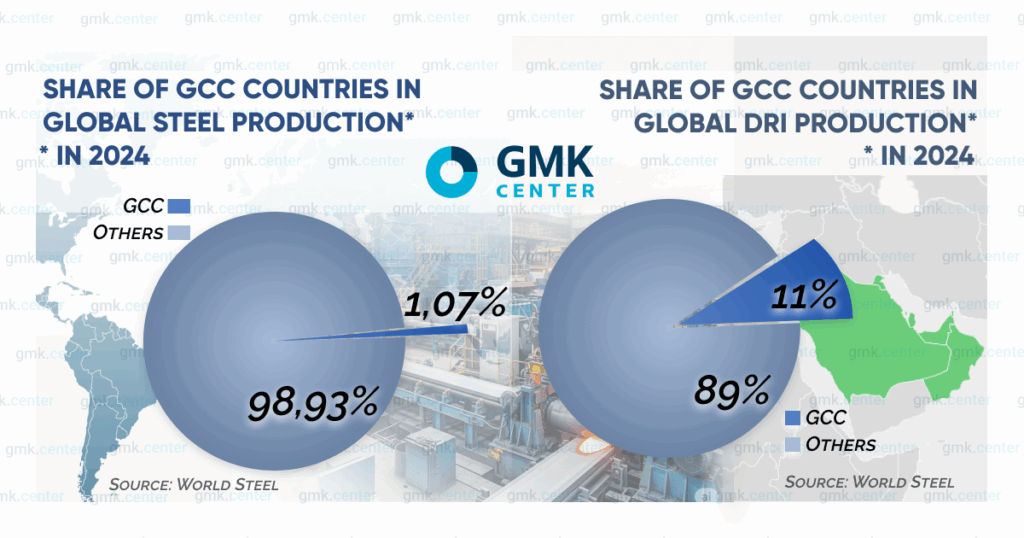
Accordingly, a significant share of CO2 emissions in the countries’ steel production comes from DRI production – 0.89 tons per ton. Therefore, the next stage of decarbonization will be the replacement of natural gas in heating furnaces with hydrogen.
Currently, Saudi Arabia, the UAE, and Oman have officially approved roadmaps for the development of hydrogen infrastructure. The latter holds regional leadership in H2 production: it is home to 5 of the 10 largest existing and future plants in the Middle East, which are to be commissioned by 2030.
The Oman Vision 2040 program envisages $140 billion in investments in the hydrogen economy by 2050. This will enable the production of at least 1 million tons of green hydrogen per year by 2030, up to 3.75 million tons by 2040, and up to 8.5 million tons by 2050. In this way, the sultanate will not only meet the needs for the complete decarbonization of its industry, including steel sector, but will also be able to export this resource. First and foremost to the European Union.
The UAE plans to produce 1.4 million tons of H2 per year by 2031, with production growing to 15 million tons by 2050. By 2031, the construction of two hydrogen plants powered by renewable energy sources will be completed there. By 2050, the number of plants will increase to five.
Saudi Arabia intends to produce 1.2 million tons of green hydrogen by 2030. By 2050, the kingdom has a much more ambitious goal: to cover 37% of global demand for H2. The first project to decarbonize industry is currently being implemented there.
However, it does not relate to steel sector, but to the production of mineral fertilizers. We are talking about the $5 billion NEOM project, which includes a 4 GW green energy complex and plants for the production of green H2 and green ammonia. The first products are expected to hit the market in 2027.
There is currently no H2 production in Bahrain and Kuwait, while Qatar has an annual capacity of 1.2 million tons, but this is gray hydrogen, without carbon capture.
Step 3: CO2 capture and new projects
The GCC has enormous potential for CCUS. We are talking about depleted oil and gas wells, which are convenient for storing solid carbon after CO2 capture and utilization. There is no need to spend money on setting up special storage facilities. However, this is not yet a very attractive option for the local steel industry. The reason for this can be seen in the example of the largest regional economy.
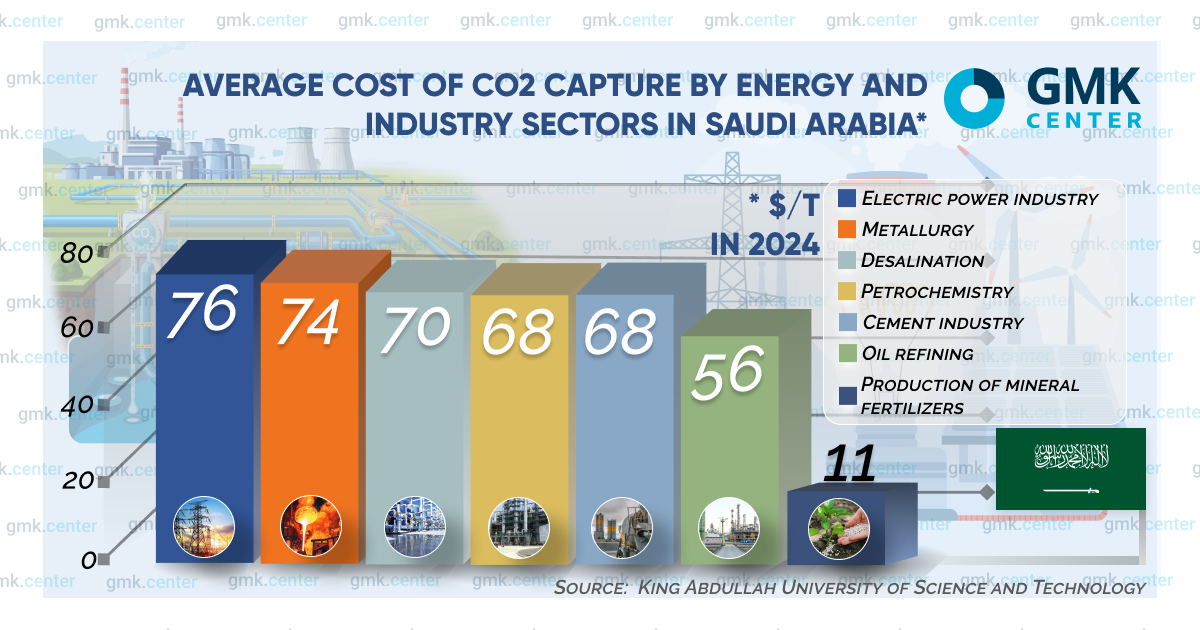
Such a wide range, from $11 to $76/t, is explained by the varying degrees of CO2 concentration in flue gas. It is highest in the production of mineral fertilizers. Therefore, its capture is not particularly difficult. In contrast, during steelmaking, CO2 is produced in a very dilute form. Accordingly, this entails additional costs for its collection.
Therefore, there is currently only one active CCUS project in the regional steel industry. It is being implemented by Emirates Steel in conjunction with the oil and gas corporation ADNOC. The CCU facility is located at the Al-Reyad steel plant and can capture up to 800,000 tons of CO2 annually. The carbon obtained is then transported for burial at ADNOC’s oil fields in Rumaythah and Bab.
The next project is expected to be that of Oman’s Jindal Shadeed, which will begin in 2023. It involves the construction of a facility for capturing and processing CO2 into solid carbon with a capacity of 2,700 tons per year. This will neutralize 700,000 tons of greenhouse gas emissions annually. The equipment is scheduled to reach its design capacity in 2027.
It is also worth noting that, unlike India, where the principle of “build first, decarbonize later” applies to steel capacities, all new steel mills in the GCC are immediately designed with carbon neutrality in mind.
– Jindal Shadeed is building a plant to produce 5 million tons of green steel per year in Dukma. The production will use green H2 and renewable energy sources. Construction is scheduled for completion in 2026.
– Saudi Aramco and the Saudi Arabian Public Investment Fund, together with China’s Baosteel, are building a plant with a capacity of 1.5 million tons of steel sheet per year. Its equipment (EAFs and DRI modules) will be compatible with hydrogen without the need for additional modification;
– Brazil’s Vale will build a large complex in Saudi Arabia to produce 12 million tons of CBI per year in the Ras-al-Khair industrial zone. In January of this year, Vale signed an agreement with local authorities to lease land for this purpose. Initially, production will run on natural gas, and later on H2.
– Bahrain Steel plans to increase DRI production to 24 million tons by 2028, compared to 12 million tons in 2019. Of this additional volume, 4 million tons are intended for the future steel mill of India’s Essar Group in Ras-al-Khair. The company also plans to build a plant with a capacity of 5 million tons of DRI per year.
– Emirates Steel is set to launch a new plant with a capacity of 2.5 million tons of DRI per year in 2027. Construction was initially planned to be completed by March 2026. The deadline was then pushed back, likely at the request of the Japanese side. It is expected that about 50% of future production will be supplied to the new JFE Steel plant in Japan.
Challenges and risks
At the end of May this year, Bloomberg reported on NEOM’s difficulties in selling its products. According to its sources, the operating company has only managed to contract half of its future production volume. In this regard, the launch date for commercial operation of the project will most likely be postponed to a later time.
Obviously, finding buyers for green steel is no easier than finding buyers for green ammonia. This explains the caution of local steel companies in promoting hydrogen technology.
So far, it is only operating in the pilot stage at the Emirates Steel plant in Abu Dhabi. Electrolyzers with a total capacity of 2.1 MW are installed there. They produce 350.4 tons of green H2 per year. The product is immediately fed into the furnaces, where the DRI process takes place. This is the only project of its kind in the MENA region. And at the moment, there are no prerequisites for its scaling.
The GCC steel market is characterized by a high degree of openness. The only protective measure in place is a 10% anti-dumping duty on rebar in the UAE. This means that local producers of low-emission steel have to compete with cheaper products from Southeast Asia, produced at BF-BOF plants. And they cannot withstand this competition.
In the first half of July, Saudi mills’ offers for commercial billets were at $496/t EXW (after a $16/t decrease compared to June). Meanwhile, Chinese importers were ready to supply at $456-465/t SFR. Therefore, if anyone needs to urgently introduce CBAM, it is the GCC, not the European Union. In this case, the green transformation of the Gulf’s steel sector could accelerate significantly. The situation could also change dramatically if Saudi Arabia (and other GCC countries following suit) manages to achieve its goal of reducing the cost of producing green H2 to below $2/kg by 2030.
Igor Vorontsov
-
OpinionsGreen steelsteel consumption
13 July 2026
10 November 2025

16 October 2025
14 October 2025