




Infographics electricity prices 1631 19 January 2026
Last year, Ukrainian energy prices were higher than those for European consumers
Due to constant Russian shelling of energy and gas production infrastructure, electricity and gas prices for Ukrainian industrial consumers rose significantly in 2025. Prices for both commodities were significantly higher than for industrial consumers in the EU.
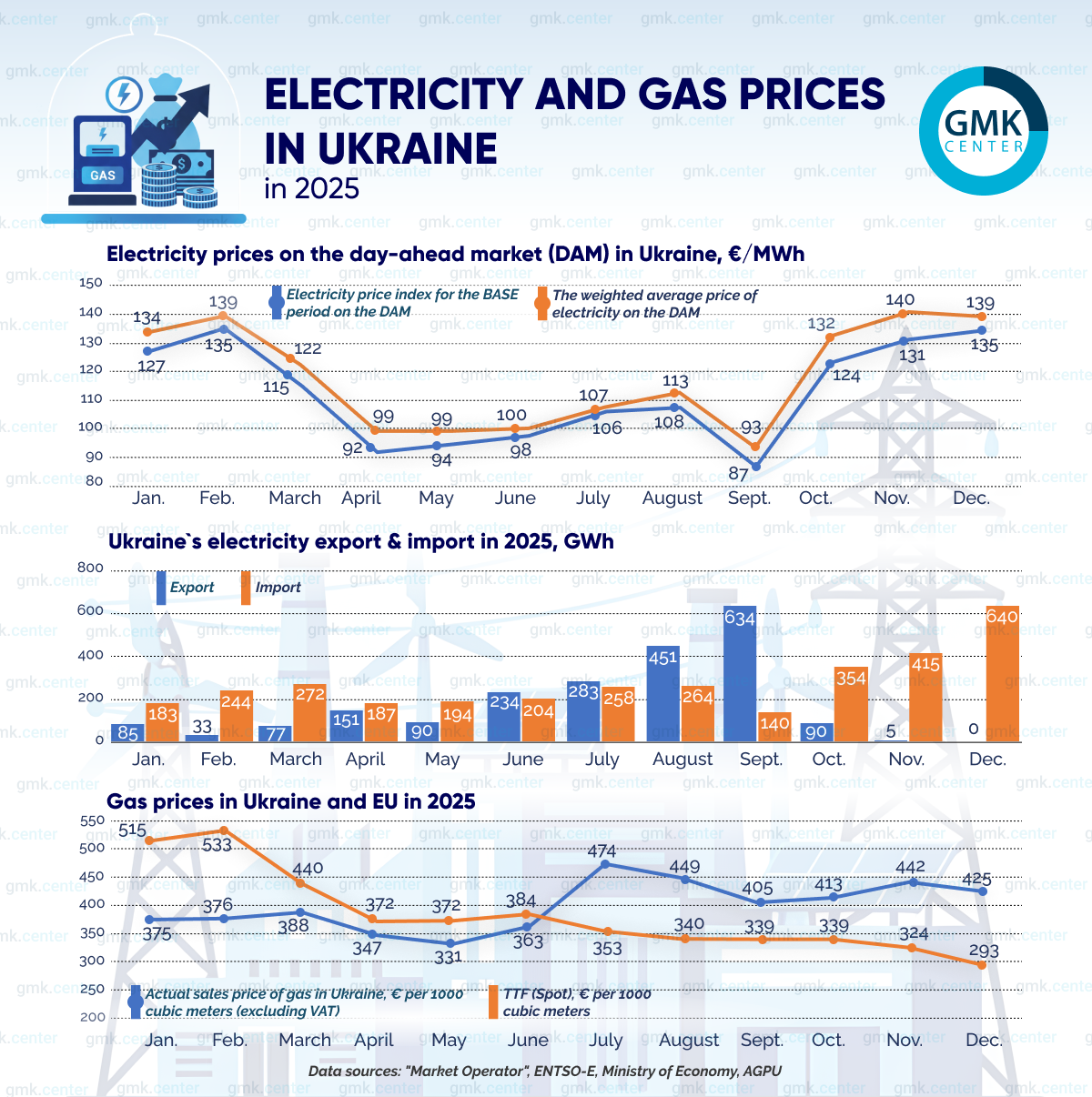
Last year, electricity prices on the day-ahead market showed volatile dynamics with two peak periods. After a relatively stable spring-summer period (4600–5400 UAH/MWh), there was a sharp jump in October–December to 6900 UAH/MWh. The weighted average purchase and sale price reached UAH 6,881/MWh in December, compared to UAH 5,548/MWh at the beginning of the year.
The key reasons for the increase were: a generation deficit following damage to or destruction of energy facilities, an increase in the share of high-cost gas generation, growing dependence on imports, and the need to cover peak loads in winter using more expensive sources of generation.
The balance of electricity exports and imports changed completely during the year. Thanks to the absence of systemic attacks on energy infrastructure and the operation of solar power plants in June–September, Ukraine was a net exporter (peaking in September with 634 GWh of exports). However, the situation changed dramatically in October. Russia began to systematically attack all types of energy facilities, resulting in a generation deficit and limited electricity transmission capabilities. Since then, imports have begun to prevail, reaching 640 GWh in December with zero exports. This is the highest figure for 2025, although it does not exceed the record set in the summer of 2024 (858 GWh in June).
It should be noted that since January 2026, the capacity of interconnections between the EU and Ukraine has increased from 2,150 to 2,450 MW, which allows for an increase in electricity imports. In addition, electricity imports from the EU to Ukraine will become more predictable. In December, Ukraine held its first monthly auctions for the distribution of interconnection capacity at the borders with Slovakia, Hungary, and Romania.
Gas prices in Ukraine followed a different trajectory. After falling to $373 per 1,000 cubic meters in the spring, Ukrainian prices (excluding VAT) rose to $498 per 1,000 cubic meters at the end of the year. At the same time, in Europe, after a January peak ($555 per 1,000 cubic meters on TTF), there was a steady decline in prices to $343 per 1,000 cubic meters in December.
This discrepancy is explained by the fact that Europe was systematically filling its underground storage facilities, while the Ukrainian gas industry faced massive shelling of production infrastructure and storage facilities, which led to the need for more expensive imports (6.5 billion cubic meters in 2025). This is what caused gas prices in Ukraine to be significantly higher than in Europe for most of last year.
For industry, this meant a simultaneous price shock for both gas and electricity, especially in the fall and winter of 2025. The iron and steel complex is one of the most energy-intensive industries, which is why steel companies are actually the largest importers of electricity to ensure stable operation. Thus, D.Trading and Dniprostal-Energo, affiliated companies of Metinvest and Interpipe, respectively, ranked first and second in terms of electricity imports in November last year.
-

Opinions Industry steel consumption
13 July 2026

06 July 2026

01 July 2026

22 June 2026