




Infographics decarbonization 1102 09 January 2026
Countries intensify efforts to launch national CO2 trading schemes
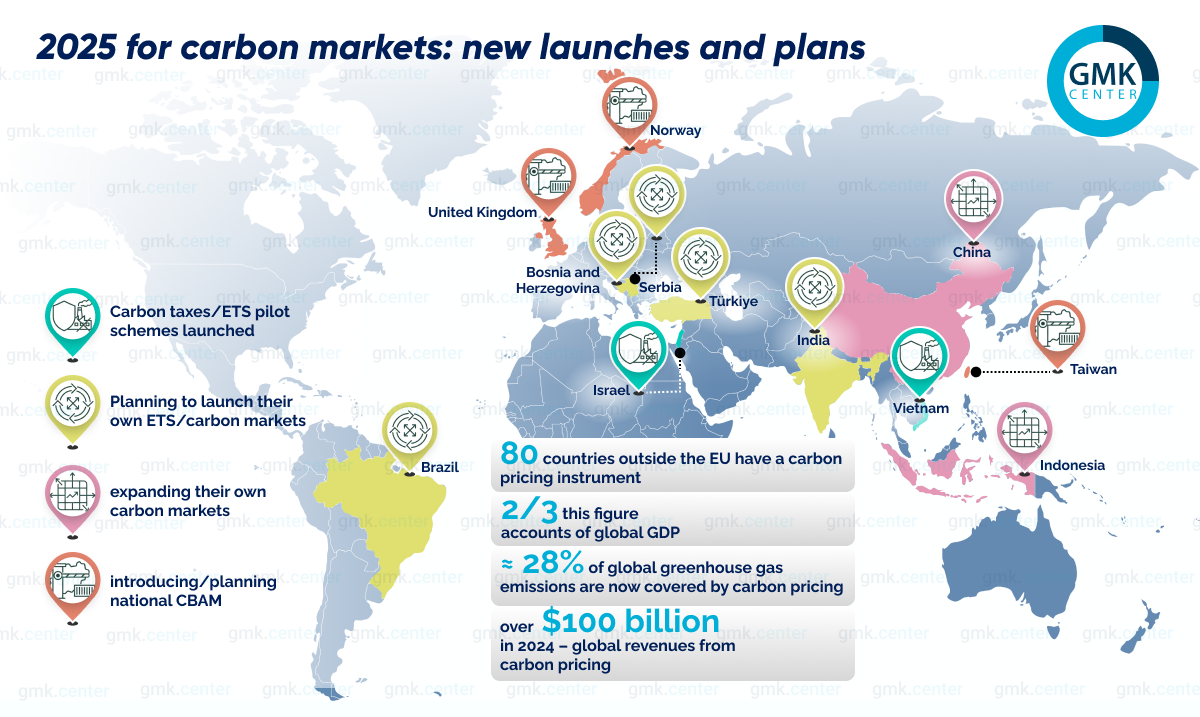
This year, with the final implementation of the European CBAM approaching and countries striving to meet their own climate targets, various countries have intensified their efforts to introduce their own carbon markets or analogues of this mechanism and improve existing schemes.
The introduction/improvement of carbon mechanisms is one of the means of creating conditions for carbon payments to remain in the exporting country rather than going to the EU. In addition, some countries are laying the groundwork for trading carbon credits on the international market.
In the fall, China announced the expansion of its national mandatory carbon quota market through a pilot system for the steel, aluminum, and cement sectors. In addition, Beijing has begun preparations to include the chemical, petrochemical, aviation, and paper sectors in order to cover all major industrial polluters by 2027.
Vietnam officially launched the pilot phase of its emissions trading scheme in June 2025. Under the scheme, steel, cement, and thermal energy producers will be required to purchase permits to cover the amount of CO2 generated per unit of output. The new scheme will cover about 50% of the country’s total carbon emissions during the first phase, which will last until 2029. It will then be extended to other sectors. The scheme also allows companies to offset up to 30% of their emissions by purchasing credits from low-carbon projects within the country or abroad.
Serbia will introduce national carbon taxes in 2026. On January 1, laws on taxes on greenhouse gas emissions and imports of carbon-intensive goods will come into force in the country. Both taxes will be levied at a rate of €4 per ton of CO2 equivalent.
The first of the two taxes applies to large industrial polluters in the cement, fertilizer, iron and steel, aluminum, and electricity sectors, which are required to have a license for their emissions. At the same time, the law on the tax on imports of carbon-intensive products will apply to goods from four groups (iron or steel, cement, fertilizers, and aluminum) and businesses that import five or more tons of certain products per year.
In October this year, following discussions, the Indian government announced the final targets for the first four sectors to be covered by the national Carbon Credit Trading Scheme (CCTS) compliance mechanism. This was a step towards the introduction of the country’s domestic carbon market. At the same time, eight methodologies for the domestic voluntary market were approved in the spring. The CCTS is expected to start trading in 2026.
Norway plans to introduce its own carbon border adjustment mechanism in 2027. It is designed to ensure fair pricing for greenhouse gas emissions in industrial production. This means that imported products from countries with less stringent environmental standards will also be subject to a carbon tax, as will goods produced within the EU and Norway.
A carbon tax came into force in Taiwan on January 1 this year. It applies to the electricity and manufacturing industries, with a rate of $9/ton. Companies will make their first payments in May 2026 based on emissions generated in 2025, with the funds going to a special climate fund. At the same time, at the end of December, the government proposed allowing the steel, cement, and other export-oriented sectors to reduce their taxable emissions by up to 80%. Taiwan is also developing its own CBAM, planning to launch it on a trial basis in 2027.
Turkey approved plans to launch its own carbon market this summer. On July 2, the country’s parliament passed its first-ever climate law, which, among other things, provides for the creation of a national ETS. The pilot phase of the ETS will run from 2026 to 2027 and will cover installations that emit more than 50,000 tons of carbon annually. It will include the production of electricity, cement, iron and steel, aluminum, fertilizers and ceramics, the chemical industry, and oil refining. Full implementation is planned between 2028 and 2035 and will include annual reporting cycles and free allocation based on benchmarks.
Brazil plans to launch a national carbon registry in 2026, which is to become the basis for the future emissions trading system (ETS) – Brasileiro do Comércio de Emissões (SBCE). Among other things, it will play a central role in the country’s efforts to participate more actively in international carbon markets, allowing credits to be traded worldwide.
-

02 July 2026

06 July 2026
01 July 2026

22 June 2026