





Posts Global Market electricity prices 2532 08 August 2025
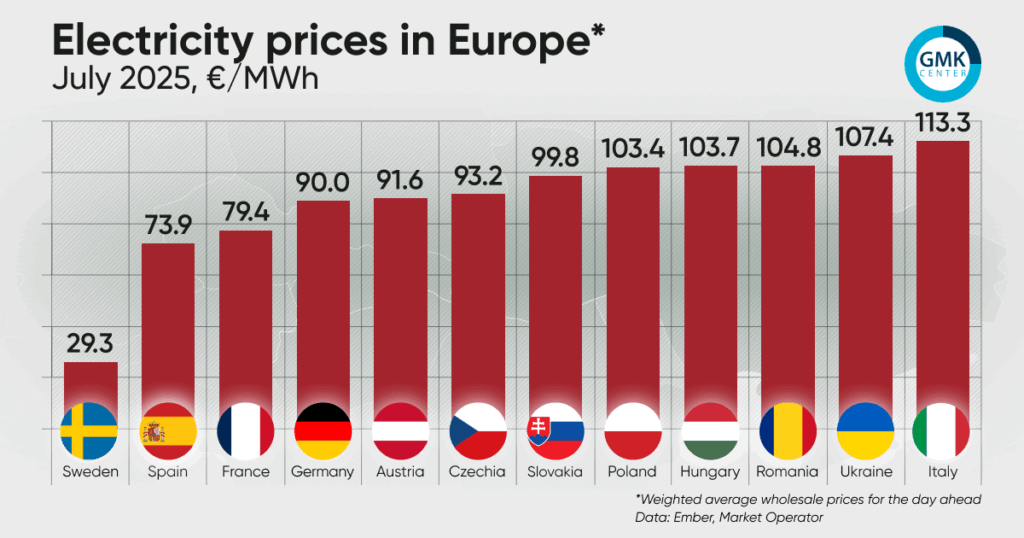
The weighted average DAM price in Ukraine last month amounted to €107.4/MWh
In the EU, the average monthly wholesale day-ahead prices were higher than in June, which was, in particular, caused by weather conditions in the region at the beginning of the month.
According to Ember data (as of August 5, 2025), they were as follows:
- Italy – €113.33/MWh (+ 1.4% m/m);
- France – €79.38/MWh (+ 1.9 times);
- Germany – €90.03/MWh (+ 40.3%);
- Spain – €73.94/MWh (+ 1.5%);
- Sweden – €29.27/MWh (+ 47.6%).
In Poland last month, the average monthly wholesale day-ahead price amounted to €103.37/MWh, in Slovakia – €99.81/MWh, and in Hungary – €103.68/MWh.
Trends in Europe
In July, average weekly electricity prices in European markets mostly exceeded €75/MWh. According to AleaSoft, at the beginning of the month, the heat in the region led to their growth, which resulted in increased demand, as well as a drop in wind generation and a reduction in solar generation in some countries. In the first week of July, daytime prices in most European countries reached above €100/MWh several times.
The fall in electricity prices in Europe was further driven by an increase in renewable energy generation. During the month, European markets also recorded negative hourly prices.
The beginning of July was marked by a large-scale blackout in the Czech Republic. On the afternoon of July 4, the eastern and northern parts of the country, including parts of the capital Prague, were suddenly left without electricity for several hours, which, among other things, affected the operation of transport and businesses. In the evening of that day, the Czech operator ČEPS blamed a technical malfunction.
However, according to the Czech press, the exact reasons for the large-scale power outage remain unclear even a month after the incident. According to ČEPS, the investigation is ongoing at several levels, and the results will be known in a few weeks or months. At the same time, extraordinary inspections of the network have been completed, and no serious faults have been found.
According to the Czech operator, the outage is also being investigated by an expert group of the European Association of Transmission System Operators for Electricity (ENTSO-E). The preliminary report is expected within six months from the start of the review, i.e. by mid-January 2026, and the final report – by mid-July 2026, said ČEPS spokesman Lukáš Hrabal. It should be noted that a few months ago, a large-scale power outage occurred on the Iberian Peninsula.
The situation in Ukraine
In July 2025, the weighted average price for the purchase and sale of electricity on the DAM in Ukraine, according to Market Operator, increased by 9.7% compared to the previous month to UAH 5247.4/MWh (€107.4/MWh at the average monthly exchange rate of UAH to EUR). At the same time, it fell by 11.7% in hryvnia terms compared to the same period of the previous year.
Demand for DAM increased by 11.93% m/m, while supply increased by 7.95% m/m.
Last month, according to preliminary data from ExPro monitoring, Ukraine increased electricity imports by 24.7% m/m to 257.7 thousand MWh. Compared to the same period in 2024, its volumes decreased threefold. The largest share in the import structure continues to belong to Hungary (almost 41%).
Electricity exports from Ukraine in July increased by 16% compared to the previous month, to 282.2 thousand MWh.
At the end of July, the National Energy and Utilities Regulatory Commission (NEURC) increased the price caps on the electricity market during evening peak hours (from 17.00 to 23.00) by 1.6 times, from UAH 9 thousand/MWh to UAH 15 thousand/MWh. The resolution came into force on July 31.
Fullness of gas storage facilities
According to the AGSI platform, as of August 1, 2025, European gas storage facilities were 68.9% full (as of the same date in 2024, the figure was 85.2%).
In mid-July, the EU Council approved the extension of gas storage rules until 2027, meaning that the current regulation requiring member states to maintain sufficient stocks through the winter will remain in effect for another two years.
The EU extended the requirement to fill gas storage facilities to 90% before the heating season, but introduced more flexible conditions. Member states can now reach this target at any time between October 1 and December 1 (the previous deadline was November 1). In addition, it is envisaged that the bloc countries may reduce the volume of gas injected into storage facilities by up to 10% in difficult circumstances, and the European Commission may grant an additional 5% reduction in case of unfavorable market conditions.
In July, gas prices in Europe remained in a narrow range. The futures price of the Dutch TTF (contract for September) last month, according to the ICE exchange, was in the range of 34-35/ MWh. According to Bloomberg, the region continues to fill storage facilities well and has high LNG reserves. Currently, the continent is receiving stable flows, and supplies from Norway are close to maximum capacity before seasonal maintenance, which will begin later in August.
At the same time, the management of Norwegian Equinor warns that the gas market in Europe may become tense before the winter season. This was stated by CEO Anders Opedal. In particular, he noted the growing competition from Asia for LNG cargoes, which could exacerbate the situation in the fall and winter.

-

OpinionsGlobal Marketmacroeconomics
28 May 2026
27 May 2026

20 May 2026

14 May 2026