




Posts Green steel Canada 1607 01 October 2025
Decarbonization of the industry in the country is based on four components
Canada has significant advantages for the green transition in steel industry. First of all, it has vast reserves of iron ore – about 6 billion tons. They make it possible to produce carbon-free raw materials for steelmaking. And not only for our own needs, but also for export.
The country ranks 6th in the world in terms of generation of energy from renewable energy sources (RES), which is necessary for emission-free steel production. Canada’s RES potential can be called colossal. It is mainly hydropower and wind power.
Finally, investment opportunities of steel companies and state support of decarbonization in Canada are at a rather high level. Adding up these factors, one would expect the local steel industry to move quickly towards net zero. But how is this actually playing out?
Industry summary
Over the past few years, steelmaking in Canada has been holding at roughly the same level. On the one hand, this indicates the stability of the industry and a fairly strong defense of the domestic market against imported steel products. On the other hand, it may indicate stagnation.
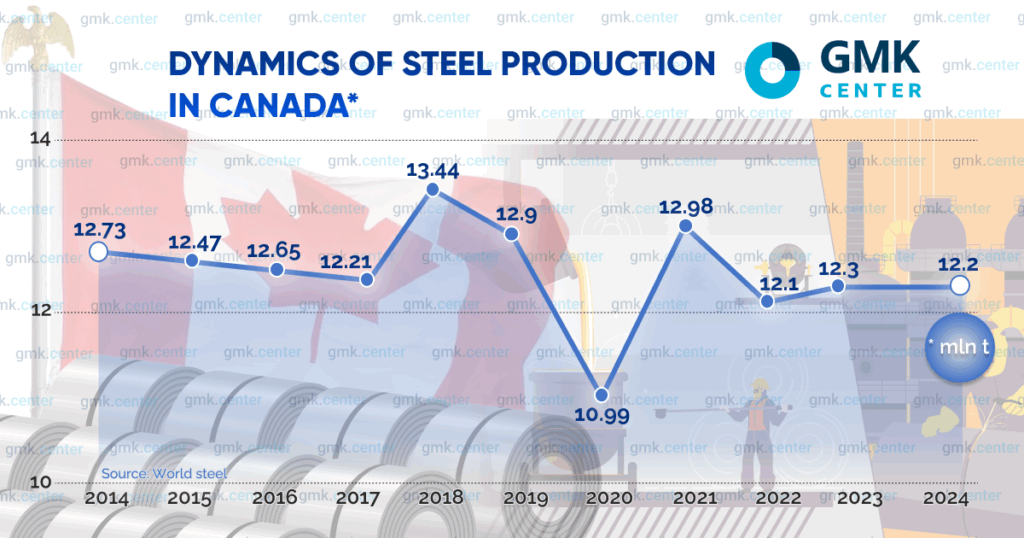
In addition to the iron ore reserves mentioned above, the country has large coal deposits, 6.58 billion tons. This predetermined the emphasis on the BF-BOF model for local stee sector. Despite this, its contribution to the total greenhouse gas emissions of the Canadian industry and economy can be assessed as insignificant.
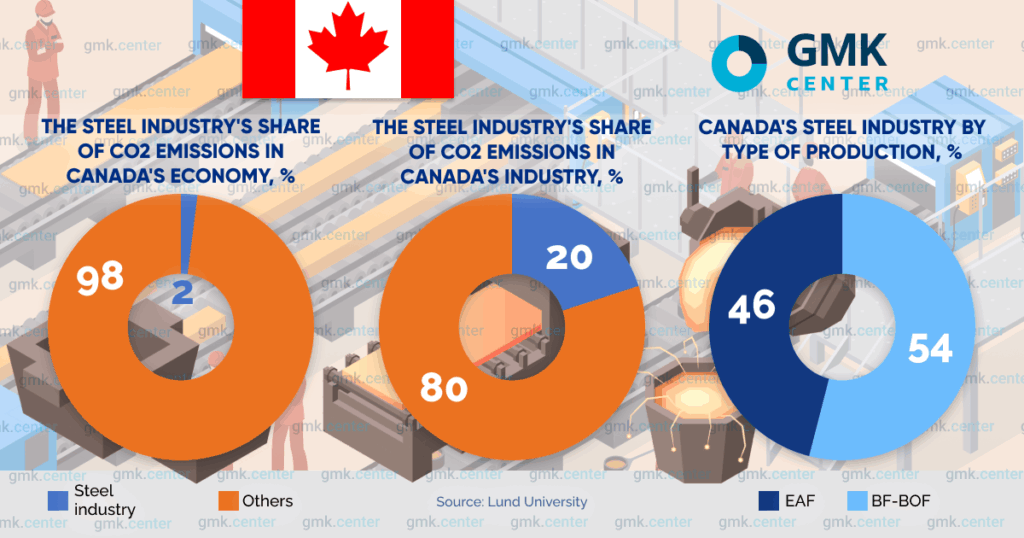
Almost all major CO2 emitters are located in the province of Ontario. They are integrated BF-BOF mills ArcelorMittal Dofasco, Canada’s largest steel producer with an annual capacity of 4.05 million tons, Algoma Steel, Canada’s leading producer of hot-rolled and cold-rolled steel with a capacity of 3.2 million tons and Stelco with a capacity of 2.5 million tons. Only Rio Tinto’s small 0.6 million tons plant is located in Quebec.
Of these, ArcelorMittal Dofasco and Algoma Steel have opted for the H2-DRI-EAF model, while Stelco is still undecided on a strategy. Nevertheless, in accordance with Canada’s international commitments and the federal government’s plans, all steel companies must achieve zero greenhouse gas emissions by 2050.
Company plans
ArcelorMittal’s $1.8bn decarbonization project at Dofasco’s Hamilton mill starts in October 2022, with a 2.5m tpa DRI plant and a 2.4m tpa EAF. The equipment will be supplied by Italy’s Danieli&CSpA and Tenova SpA.
As part of the project, the old coke battery No. 1 was dismantled at the plant. A new production complex is being built in its place. The modernization of the existing EAF and CCBM is also envisaged. After that, the mill’s capacity will be reduced to 3.57 million tons of steel.
Completion of the works was previously planned for 2026. However, this year the local media reported about some delays in the progress of the project. However, it envisages a transition phase until 2028, during which BF and EAF are to be operated in parallel.
And the ArcelorMittal Dofasco decarbonization roadmap envisages only a 25% reduction in emissions by 2030. Whereas full implementation of the EAF transition at Hamilton will yield a 60% reduction. Thus, we can now say that the company is not out of the planned schedule.
The process is going faster at Algoma Steel in Sous-Saint-Marie. In July of this year the first unit of the new EAF, which will replace the blast furnace production, started its commercial operation. However, the Algoma project started a little earlier, in 2021, while ArcelorMittal started work in January 2023.
A total of two EAFs with a capacity of 250 tons each are to be built at Sous-Saint-Marie, with Danieli also acting as equipment supplier. Once the EAF is fully operational, the mill’s CO2 emissions will be reduced by 70%. This should happen by 2030. It is worth noting that the pace of construction is constrained by the grid capacity of the local power industry.
The remaining 30% comes from the heating furnaces of the plate rolling complex, as well as leveling furnaces. These emissions will be reduced by converting the units from natural gas to electricity and synthetic biogas.
It is worth noting that both facilities are connected to the Ontario power grid, where e/e is already 93% carbon-free. Thus, Canadian steelmakers, unlike their counterparts in most countries, do not need to invest in building their own renewable energy capacity. This means their path to net zero is much faster and shorter. And cheaper.
As noted above, Stelco is the only major producer with BF-BOF capacity that does not have an approved decarbonization roadmap. That said, the company did replace liners and modernize BF in 2020. This is a significant investment and blast furnaces can typically operate for up to 20 years after lining replacement. It follows that Stelco does not plan radical decarbonization measures until 2040, only BAT.
Also, 2 ArcelorMittal Montreal plants in Quebec with a total capacity of 2.4 million tons of steel per year do not have a roadmap with target benchmarks. But since these plants operate on the EAF, there is really no hurry with their final “greening”. The same applies to Evraz Regina Steel Works in Saskatchewan with a capacity of 1.2 million tons of steel per year and Gerdau in Whitby (Ontario) with a capacity of 1.1 million tons.
Given the small steelmaking volumes at Rio Tinto Iron&Titanium (RTIT) in Quebec, the decarbonization strategy for this facility is optimal. Rio Tinto will convert its furnaces from conventional steel coal to biochar. Rio Tinto, together with the US Aymium, is building a plant for its production here in Quebec on the site of a former pulp and paper mill. It is scheduled to be commissioned by the end of this year.
This will reduce RTIT’s emissions from steel production by 70%. The remaining 30% should be absorbed by Blue-Smelting technology, which provides for preheating of material before melting and utilization of steel gases. At present, a pilot plant with a production capacity of 40 thousand tons per year is already in operation at the mill.
Resources for decarbonization
Local steelmakers have no problems with scrap supply. The volumes of scrap harvested exceed current needs. And Canada can even afford to export scrap – 4.9 million tons in 2024, 4.8 million tons in 2023. But that’s for now. Once the EAF transition at Dofasco and Algoma mills is completed, the demand for this resource will increase dramatically. Therefore, we can expect restrictions on its export in the next year or two.
Speaking about DRI-EAF technology, only ArcelorMittal has working plans to build a DRI plant in Canada.
The only operating plant also belongs to this concern. It is ArcelorMittal’s Port-Cartier plant located in Quebec with a capacity of 10 million tons of iron ore pellets and 1.65 million tons of DRI. It currently uses natural gas, with a future switch to green or blue H2 envisioned.
Canada’s annual H2 production is currently at 3 million tons. But it is mainly gray hydrogen. The country’s largest plant for the production of green H2 with a capacity of 11,000 tons per year was supposed to start operating in 2023. However, the project operator, the provincial state-owned company Hydro-Québec, has not yet moved to its implementation.
Nevertheless, approved in 2020. Canada’s Hydrogen Strategy assumes that by 2050 the country will produce more than 20 million tons of H2. Moreover, the authorities emphasize that it can be not only green but also blue H2 produced from oil and natural gas – resources that the country has at its disposal in large volumes.
In any case, Canada intends not only to fully cover the needs of its economy in hydrogen, but also to establish its large-scale export. The government expects that by 2050 it will exceed $50 billion in monetary equivalent at an estimated production and transportation price of $1500-3500/t. It is now in the range of $5000-12000/t in Canada. Therefore, widespread commercial application of H2 is still quite far away.
The development of H2-DRI production and EAF transition will require additional volumes of green power. In 2023, Canada’s RES capacity was 20.4 GW. At the end of 2025. The Canadian Renewable Energy Association (CanREA) forecasts an increase to 26 GW, by 2050. – To 58 GW. Therefore, as noted, clean energy is something Canadian steelmakers need not worry about.
Green public policy
A judicious mix of incentives and regulation. This is how the Canadian government’s green transition policy can be summarized. In 2018, the country adopted the Greenhouse Gas Emissions Pricing Act, which, among other things, introduced a CO2 emission fee for industrial enterprises. It entered into force in 2019.
In parallel, from 2022, the government provides manufacturers with a tax credit of 60% of the cost of new equipment for capturing CO2 from the air, and 50% for all other equipment for capturing harmful emissions. A 37.5% tax credit is allocated for new low-emission equipment for transportation and storage of products.
However, the Canadian authorities have not decided to introduce the SWAM, a duty on imports of products with a high carbon footprint. In late September 2024, then Prime Minister Justin Trudeau discussed this issue with the head of the European Commission Ursula von der Leyen. But there has been no progress since then.
The reason is the fear of spoiling the already difficult trade relations with the United States, the main foreign economic partner. According to the Canadian Ministry of Finance, 76% of the exports of local companies with high CO2 emissions go to the US. Therefore, Ottawa does not unreasonably believe that Washington’s retaliatory measures will prove too painful for the national economy.
A very important nuance is the targeted use of funds received by the budget from enterprises as payment for emissions. This is the main difference between Canada and Ukraine, where the money from the environmental tax goes partly to the state budget and to the State Energy Efficiency Fund, where it is not, of course, spent on decarbonization. In Canada, on the other hand, the authorities invest the proceeds from emission fees exclusively in decarbonization projects. For example, the above-mentioned EAF-transition of the ArcelorMittal Dofasco mill, which cost $1.8 billion. Of this amount, $400 million is allocated by the federal government and $500 million is given by the Ontario authorities.
That is, the government’s share in this project is 50%. This is quite a lot. For comparison, the declared share of government financing of the EAF transition for the British steel mill Port Talbot is 40%, for the Australian Whyalla Works – 23%. Largely due to this, decarbonization of steel industry in Canada is progressing more successfully than in other countries.

-

OpinionsGreen steelsteel consumption
13 July 2026
10 November 2025

16 October 2025
14 October 2025