





News Industry decarbonization 1960 01 April 2026
Most companies are still investing in blast furnaces
Leading global steel producers are lagging behind in decarbonization efforts despite their stated long-term goals. This is evidenced by the first corporate scorecard released by the international non-profit organization SteelWatch.
SteelWatch assessed 18 leading steel companies operating in 29 countries. The organization’s corporate ranking includes SSAB, thyssenkrupp, ArcelorMittal, Ternium, JSW, Cleveland-Cliffs, NLMK, US Steel, Gerdau, Tata Steel, Baosteel, JFE, MMK, Oyak, POSCO, Hyundai Steel, Nippon Steel, and HBIS. It is based on publicly available data, primarily annual reports published in fiscal year 2025, which contain figures for fiscal year 2024.
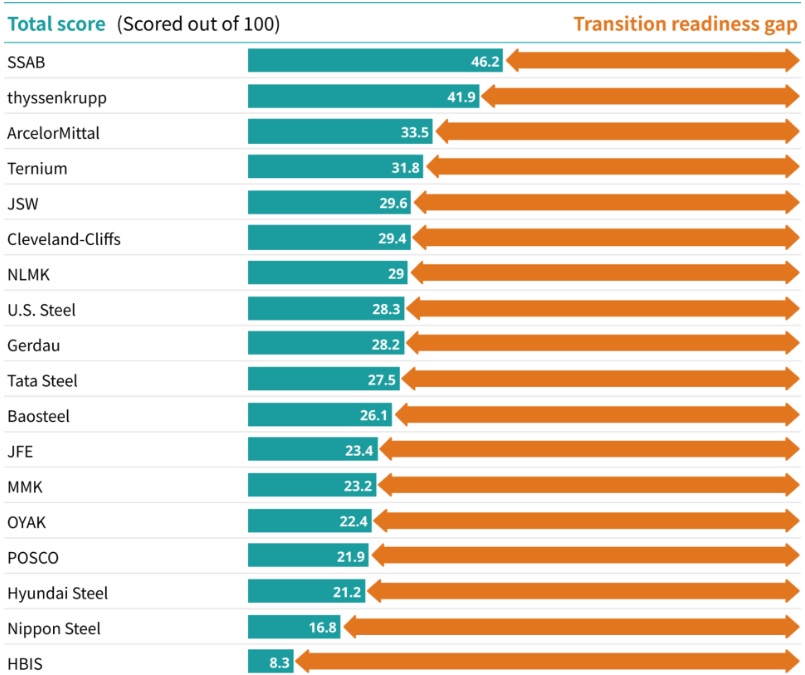
The new assessment showed that none of the 18 steel producers is sufficiently prepared for the transition to near-zero-emission production.
“Unfortunately, no steel producer scored more than 50 out of 100, and even those at the top of the list need to bridge significant gaps before they can claim to be acting responsibly regarding the climate crisis,” noted Caroline Ashley, executive director of SteelWatch.
According to her, investments this decade to reduce dependence on coal and scale up clean technologies are crucial to avoiding worsening climate problems in the future.
The steel industry accounts for about one-tenth of global CO2 emissions.
One of the key findings of the assessment is the “readiness gap,” which refers to the discrepancy between the actions needed to achieve a reliable transition to near-zero emissions and the actual steps companies are taking.
Among the companies assessed in the report are Baosteel, Nippon Steel, POSCO, Tata Steel, ArcelorMittal, thyssenkrupp, and Cleveland-Cliffs. All of them continue to rely on coal-based blast furnace technology, which accounts for up to 90% of emissions in the sector.
At the same time, the average score for scaling up green iron production and using renewable energy sources is less than 1 out of 25.
As for the leaders of the transformation, SSAB took the top spot, followed by thyssenkrupp, scoring 46.2 and 41.9 out of 100, respectively. These two companies have plans to produce green iron and decommission blast furnaces without reinvesting in or recently upgrading coal-fired assets, which is typical of their competitors. Both still need to accelerate the implementation of their decarbonization initiatives.
Rounding out the list are South Korea’s Hyundai Steel, Japan’s Nippon Steel, and the Chinese conglomerate HBIS, with overall scores of 21.2, 16.8, and 8.3 out of 100, respectively. These companies’ reliance on coal-based blast furnace production, limited progress or reporting on renewable energy, and the lack of confirmed actions during this reporting period regarding the development of green steel represent missed opportunities to bridge gaps in transition readiness, notes SteelWatch.
Despite this, there are signs of progress. Most of the steel producers covered by the study are not currently building blast furnaces. SSAB has a significant share of renewable energy consumption, and some companies have a measurable share of direct reduction iron production capacity that could be repurposed for near-zero emissions.
Overall scores were calculated based on results across 21 indicators, grouped into five categories: coal phase-out, environmental scaling, climate performance, targets and transparency, and social and environmental responsibility.
It is worth noting that the cost of producing green steel in the EU calls its competitiveness into question, according to a study by Fastmarkets experts.
-

Opinions Industry macroeconomics
28 May 2026
03 June 2026
03 June 2026
03 June 2026