




Infographics macroeconomics 1036 11 February 2026
Supporting factors included $52.4 billion in international aid, development of the agro-industrial complex and defense industry
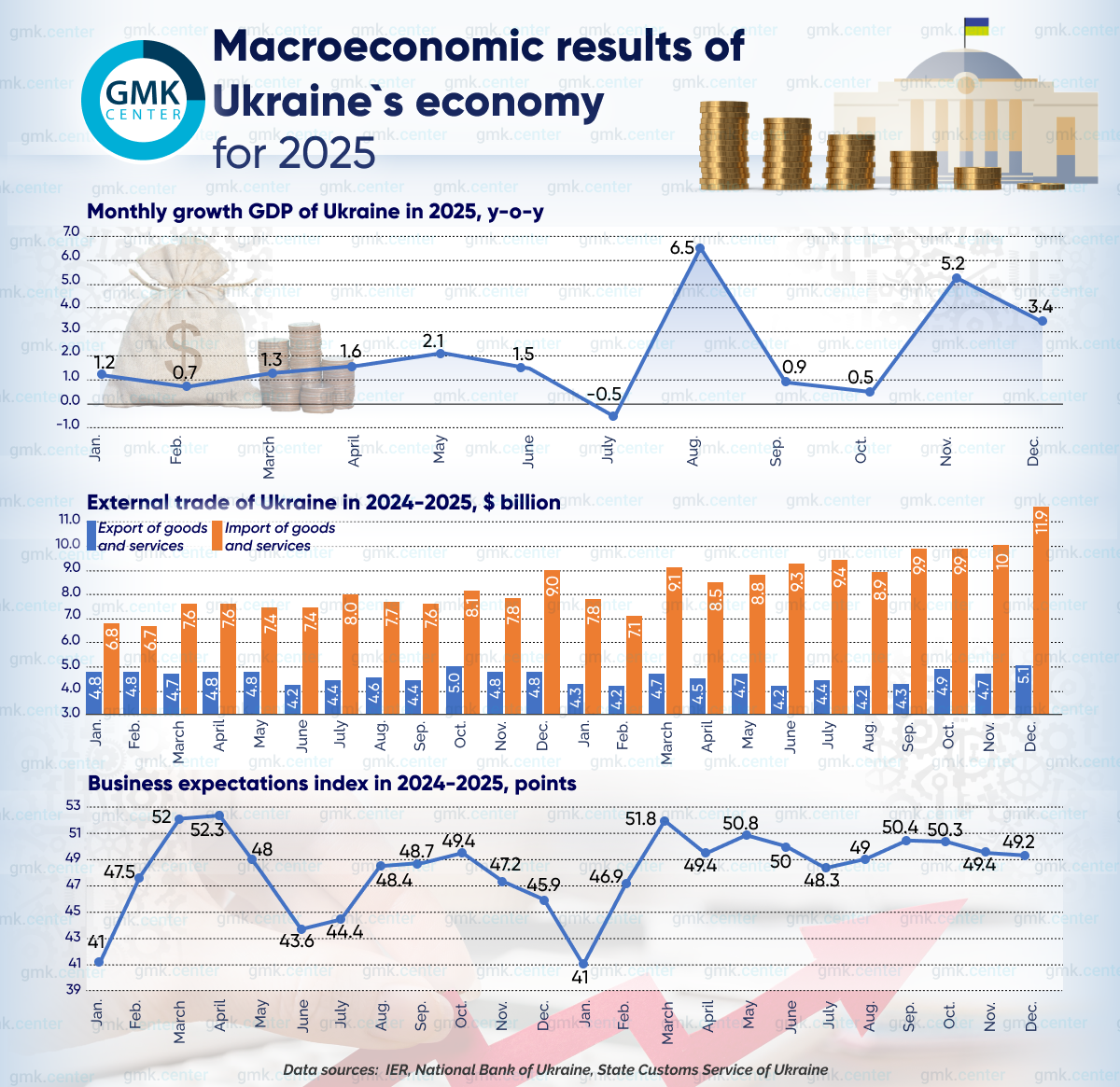
After Ukraine’s real GDP grew by 2.9% y/y in 2024, the Ukrainian economy slowed down. According to the results of 2025, the National Bank estimates the growth of the Ukrainian economy at 2% y/y, the Ministry of Economy at 2.2% y/y, and the Institute for Economic Research and Policy Consulting (IER) at 1.8% y/y.
Positive GDP dynamics in 2025 were largely supported by the following factors:
- International aid. In 2025, Ukraine received $52.4 billion in external financing, which made it possible to support consumer demand.
- Agriculture. In August and November last year, this sector enabled monthly growth rates of over 5% y/y. The restoration of EU quotas on exports of Ukrainian agricultural products and unfavorable weather conditions had a negative impact on the agro-industrial complex.
- Defense industry. In 2025, the total volume of weapons and equipment produced reached UAH 180 billion, compared to UAH 122 billion in 2024.
The overall economic situation remained difficult due to systematic shelling of energy and gas production infrastructure. The stability of energy supplies had to be maintained through imports of electricity and gas. Due to expensive imports and rising domestic tariffs, the cost of energy resources for industrial consumers in Ukraine was higher than in Europe.
Railways and ports were constantly under attack. The maritime corridor, which was a driver of growth in 2024, served only as a supporting factor last year. The vulnerability of maritime exports to missile and drone attacks became apparent at the end of the year. According to Bloomberg, due to increased attacks on port infrastructure in December, wheat and corn exports fell by 25% and 13%, respectively.
According to the IER, the five main obstacles to doing business in December 2025 were as follows:
- labor shortage – 62%;
- unsafe working conditions – 57%;
- interruptions in energy supplies – 42%;
- rising prices for raw materials and supplies – 42%;
- declining demand for products – 20%.
The growing energy deficit hampered activity in a number of industrial sectors. Ukraine’s industrial production index fell by 2.4% year-on-year in 2025. Growth was observed in the defense, pharmaceutical, and metallurgical industries.
The situation was slightly better in the construction sector. The volume of construction work completed in Ukraine grew by 12% y/y at the end of last year.
The industry only turned positive in the summer of 2025, as construction dynamics were still negative in January-May (-7.5% y/y). Positive dynamics in the industry were driven by non-residential construction in the western regions of the country and the allocation of significant funds for the protection of energy facilities in the second half of the year.
In 2025, Ukraine imported goods worth $84.8 billion (+20% y/y), which is more than before the war. In 2021, imports amounted to $73.3 billion.
The negative trade balance in goods amounted to $44.3 billion, or 21% of GDP. Ukrainian exports fell by 3% y/y last year to $40.5 billion. The deterioration in the trade balance is due to imports of products and materials needed for the economy and defense, in particular the growth in supplies of coal and gas, and energy equipment.
Business activity assessments at the beginning of last year rose rapidly until March (to 51.8 points) but declined after the serious consequences of Russia’s intensified attacks on energy infrastructure became apparent. From April onwards, business activity expectations fluctuated between 49 and 50 points, depending on the economic situation and energy shortages.
Assessments of the business climate in 2025 varied between moderately pessimistic and cautiously optimistic, with a neutral level of 50 points.
-

02 July 2026

06 July 2026

01 July 2026
22 June 2026