




Posts Industry steel consumption 32 27 July 2026
Steel trading companies have generally recorded a 10–20% increase in sales in volume terms
In 1H2026, consumption of rolled steel in Ukraine rose by 5%, although quarterly trends varied: a poor start to the year was followed by a marked recovery in demand in Q2. The GMK Centre has analysed developments in the Ukrainian rolled steel market between January and June.
Overall market trends
In 1H2026, steel consumption in Ukraine had increased by 5% — following a 12% rise in 2025. According to estimates by Metinvest-SMC, the capacity of the Ukrainian steel products market during this period reached 1.73 million tonnes (excluding polymer-coated rolled steel, stainless steel, seamless pipes and tinplate). At the same time, steel trading companies surveyed by GMK Center reported an average increase in sales of steel products in volume terms of 10–20% for the first half of the year.
Steel consumption trends were mixed during the first half of the year. The Q1 saw a significant drop in sales – of around 20–30%. January and February are traditionally months of low demand, but this year the seasonal effect was significantly exacerbated by prolonged power cuts and the resulting reduction in economic activity (industrial enterprises were shutting down en masse or scaling back production), unseasonably cold weather (which, in particular, led to construction sites being suspended) and a lack of funding for major infrastructure projects.
Construction work began to pick up in the second quarter. According to Serhii Kovalenko, Commercial Director at Vartis, the slump in sales in the first quarter was offset in the second quarter thanks to rising consumption driven by the launch of infrastructure projects and strong demand for construction in the western regions.
The biggest impact on the market in the first quarter came from the outbreak of war in Iran, which led to a rise in prices for oil and petroleum products and, consequently, to higher logistics costs. These factors, along with the depreciation of the hryvnia and general uncertainty, led to a rise in prices for steel products in Ukraine — by an average of 10–15%.
At the same time, the situation in niche segments differed from the general market trend. In 1H2026, sales volumes at TAKT Metal, which specialises in steel for the engineering industry, fell by 10–15% in volume terms, although the company managed to maintain sales volumes at the same level as in the second half of 2025.
“The main reasons for this outcome were delays in funding for defence industry enterprises – which are among the key consumers of engineering steel – as well as the enemy’s constant attacks on critical infrastructure and industrial facilities, which had a negative impact on production activity, investment decisions and overall market sentiment,” — said Ihor Udovychenko, CEO of Marketing and Sales at TAKT Metal, in a comment to GMK Center.
Market trends
Steel traders highlight the following as key market trends in the first half of this year:
- Declining profit margins across many segments. According to Vitaliy Prytula, CEO of Eurometal, net margins today rarely exceed 5–7%. This is due to the fact that the market operates in a highly competitive environment, where buyers’ choices depend primarily on the price of steel products.
- Overcrowded warehouses at the start of the year. Towards the end of last year, most steel trading companies built up substantial stocks, anticipating strong demand. However, due to a sharp fall in demand, these volumes effectively oversaturated the market, leading to a fall in prices in the first quarter and even to losses for steel traders. By the end of the first half of the year, these stock levels had been sold off.
- Rising logistics costs and complexities. Due to the rise in oil product prices following the outbreak of hostilities in the Middle East in March, costs for international logistics and road transport increased significantly. This also led to longer delivery times and made it more difficult to plan imports of raw materials and steel products. Road haulage costs have now fallen, but rail freight tariffs have also risen significantly since the start of the year.
- A sharp rise in imports of welded pipes. According to Vitaliy Prytula, this is due to a significant increase in the number of orders placed in anticipation of the introduction of duties following the launch of the relevant anti-dumping investigation. This has led to Turkish factories being overwhelmed with orders from Ukrainian buyers.
- Worsening labour shortages. This problem is not being addressed at either the state or corporate level, and the overall situation is showing signs of deteriorating.
- Rise in imports of steel products. According to data from the Ukrmetallurgprom Association, in the first half of 2026, imports of rolled steel products rose by 22.8% y/y, whilst the share of imports in the structure of steel consumption increased by 6.8 percentage points to 43.8%. This is the highest figure recorded since Ukraine gained independence. Turkey and China remain the main importing countries.
- The engineering steel market is highly dependent on the situation in the defence industry, as well as on the timely funding of state and international programmes. Any delay in funding almost immediately affects order volumes throughout the entire supply chain.
- There is a temporary shortage of a number of items. Due to the rapid growth in demand in the second quarter, the market experienced a slight shortage of reinforcing bars, pipes and other products required for the construction of energy facility protection and defensive structures.
“Deferred demand and delays in the arrival of imports from China led to a 35% increase in apparent market capacity in the second quarter compared with the first quarter,” said Olexander Vedernikov, Head of the Analytics and Pricing Department at Metinvest-SMC, in a comment to GMK Center.
Demand by type of steel product
Demand trends for individual types of steel products vary significantly depending on the situation in the consumer segments.
According to Metinvest-SMC, capacity in the rebar segment rose by 26% in January–June, to 447,000 tonnes. The main drivers of this growth were infrastructure projects and the construction of protective structures for energy facilities.
The second sub-group of the construction product range – shaped rolled steel – also showed growth. Consumption of beams, angles and channels increased by 14% – to 112,000 tonnes. According to Oleksandr Vedernikov, the rise in angle imports was driven by the expected introduction of duties as part of an anti-dumping investigation initiated by ArcelorMittal Kryvyi Rih.
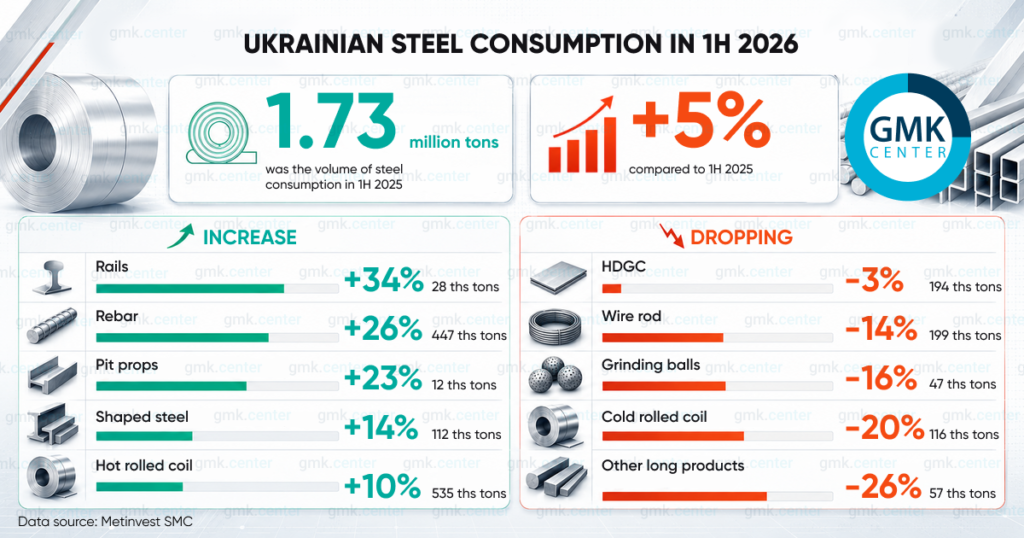
Consumption of railway rails and mine props also rose significantly — by 34% – to 28,000 tonnes and by 23% – to 12,000 tonnes, respectively. Supplies of railway rails are met through imports as part of donor aid. The market capacity for hot-rolled steel increased by 10% – to 535,000 tonnes, driven by a rise in the consumption of tubular steel, particularly for infrastructure projects.
According to Metinvest-SMC, consumption of certain types of rolled steel fell in the first half of the year:
- other shaped steel (round bars, flat bars, square bars) — by 26%, to 57,000 tonnes, due to a reduction in supplies to ‘Energostil’ for the production of grinding balls;
- cold-rolled steel — by 20%, to 116,000 tonnes;
- grinding balls — by 16%, to 47,000 tonnes, due to a fall in iron ore production;
- wire rod — down 14% – to 199,000 tonnes, due to reduced demand for steel products both on the domestic market and for export — linked to the launch of the CBAM in Europe from the start of 2026, and due to fierce competition;
- galvanised steel — down 3% – to 194,000 tonnes.
The situation was somewhat different in the engineering sector, which is the second-largest consumer of steel (after the construction sector). Products for defence industry enterprises and high-tech engineering remain in the highest demand — special steel grades, calibrated rolled products and products with high precision and quality requirements.
‘At the same time, demand for standard engineering rolled steel, used in the civilian sector, remains subdued. Companies are operating primarily on a made-to-order basis, minimising stock levels and taking a cautious approach to new procurement. We are also seeing steady growth in interest in aluminium alloys, which is why we added aluminium rolled products to our range in 2026 and view this sector as one with great potential,” noted Ihor Udovychenko.
Sectoral and regional structure of consumption
An analysis of the structure of demand by sector in the first half of the year (based on data from Metinvest-SMC) reveals the following changes compared with the same period in 2025:
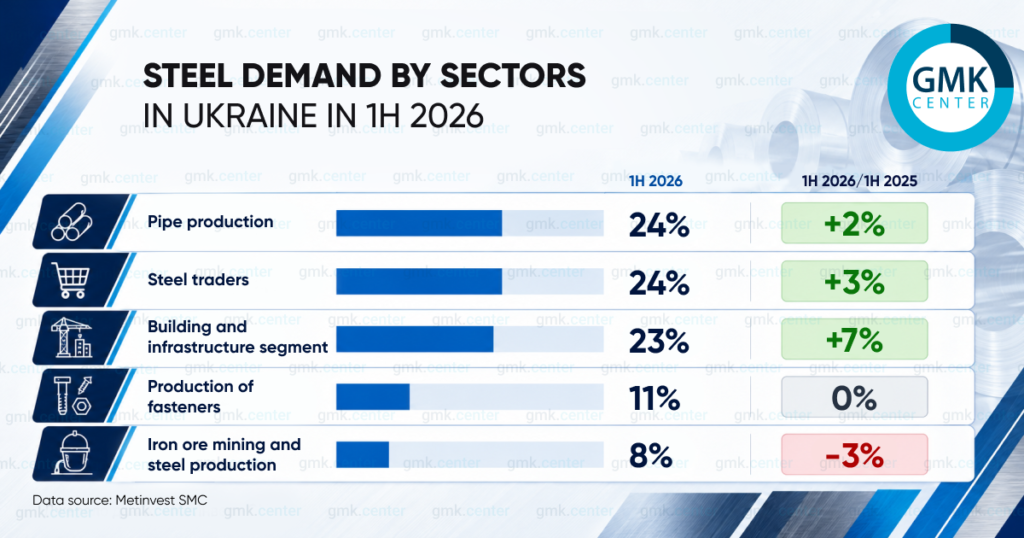
- The pipe industry became the largest consumer: its share of the total portfolio rose to 24% from 22%. This increase was driven by a 21% rise in sales of hot-rolled coils.
- Steel traders ranked second in terms of volume: their share of sales rose to 24% from 21% a year earlier.
- Construction companies — their share rose by 7 percentage points – to 23%.
- Iron and steel companies — their share fell by 3 percentage points – to 8%, due to a 15% decline in supply volumes in the first half of 2026.
- Retail customers (SMEs, private clients) — their share remained at 11%.
Other companies surveyed by GMK Center note that the main source of demand in the first half of the year came from the construction and development of various infrastructure projects — a trend driven by the traditional start of the construction season in March–April. Infrastructure demand was traditionally driven by the restoration of war-damaged facilities, the construction of protective structures for energy infrastructure, and the creation of various defensive and fortification structures.
Demand from the construction sector in the first half of the year was largely driven by commercial construction (factories, logistics terminals and warehouses, grain silos and other agro-industrial facilities) in the western regions of the country, as well as the development of leisure and tourism facilities in these same regions.
Residential construction is developing quite actively in the western regions, although there are grounds to expect an improvement in this situation in Kyiv by the end of the year. According to Serhii Kovalenko, work resumed in the second quarter on Kyivmiskbud sites, including those that had previously been transferred by Ukrbud.
Construction is the traditional driver of demand for steel products in Ukraine, accounting for 50–60% of total consumption. At the same time, official statistics indicate a decline in the sector since the start of the year. The volume of construction work completed in Ukraine in January–May fell by 6.5% year-on-year. Residential construction volumes fell by 7.4% year-on-year, whilst those in the non-residential and civil engineering segments fell by 11.5% and 2.5% year-on-year, respectively.
According to market experts, there were no significant changes in the regional structure of steel product sales during the first half of the year. The construction of infrastructure and defence facilities, which began at the start of the building season, took place in almost all regions. The only exception is the frontline regions, such as the Kherson, Sumy and Zaporizhzhia regions, where virtually no other construction activity is taking place apart from the construction of defence facilities.
Outlook for the rest of the year
By the end of the year, the market is expected to maintain a moderately positive but volatile trend. Demand will be supported by infrastructure and defence projects, as well as construction activity in the western regions. At the same time, the market will continue to face pressure from instability in energy supplies, the dependence of business activity on the military situation, labour shortages and fluctuations in the hryvnia exchange rate. Given the high base in the second quarter and the traditional seasonal slowdown in construction during autumn and winter, annual growth in rolled steel consumption is likely to remain in single figures, whilst traders’ margins will come under pressure from competition and rising logistics costs.

-

OpinionsIndustrysteel consumption
13 July 2026

21 July 2026
16 July 2026
24 June 2026