
Infographics CBAM 581 01 April 2026
The hardest hit will be the long products and billets sectors, while risks for flat products will rise sharply after 2029
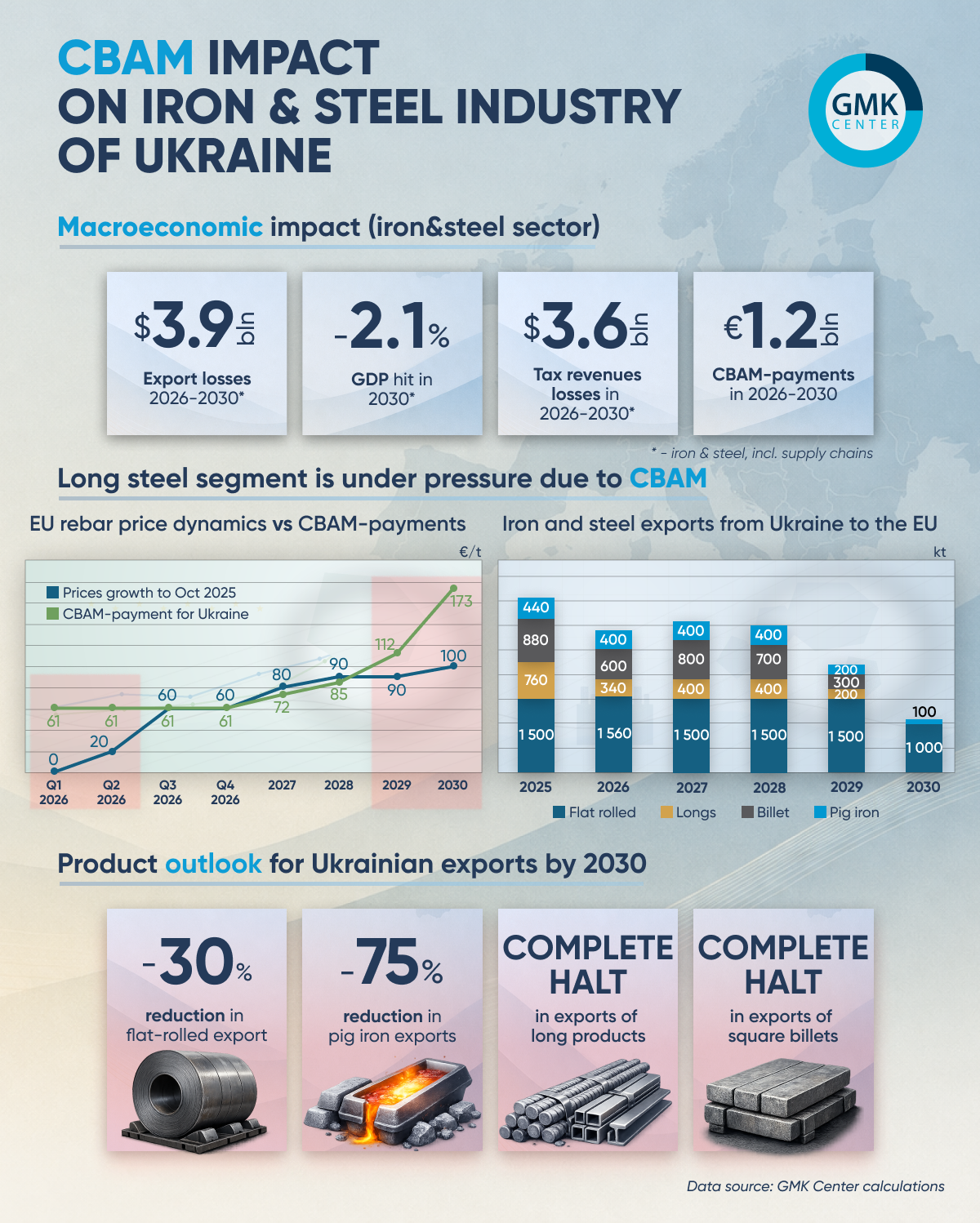
The EU’s Carbon Border Adjustment Mechanism (CBAM) has already become not only a climate policy tool but also a significant trade barrier for Ukraine’s steel industry. According to GMK Center estimates, the cumulative impact of CBAM on the ferrous steel sector and related supply chains alone could result in a loss of 2.1% of Ukraine’s GDP by 2030. This is significantly higher than the European Commission’s estimate of -0.01% of GDP.
The comprehensive study by GMK Center can be downloaded via the link.
The key issue lies in the structure of Ukrainian production. About 88% of steel production in Ukraine is via the blast furnace route (BF/BOF), which has a higher carbon intensity compared to electric arc furnace (EAF) production. For Ukrainian flat steel, it is estimated at 2.3 t CO2/t; for long steel and cast iron, about 2.1 t CO2/t; and for square billets, 1.9 t CO2/t. As a result, Ukrainian products are more vulnerable to the CBAM, especially in segments where EAF producers dominate the EU market.
The hardest short-term blow falls on long products. For Ukrainian BF/BOF producers, the average CBAM payment is estimated at €61/t, while for competitors using scrap, it is significantly lower. In January–February 2026, Ukrainian long product exports had already fallen by 64% year-on-year. GMK Center suggests that after 2029, exports of long products and square billets to the EU could come to a complete halt.
The situation with flat steel currently appears less critical. After October 2025, prices for hot-rolled coil in the EU rose by approximately €110/t, which partially offset importers’ current CBAM costs. This allows for maintaining supplies in the medium term. At the same time, after 2029–2030, risks for this segment will also increase due to stricter CBAM obligations and a rise in the supply of low-carbon steel.
In conclusion, without a CBAM deferral for Ukraine and a separate EU-funded decarbonization mechanism, the Ukrainian steel industry risks losing part of its production capacity, export base, and investment resources precisely at a time when the economy needs them most for recovery.