




Infographics electricity prices 583 04 June 2026
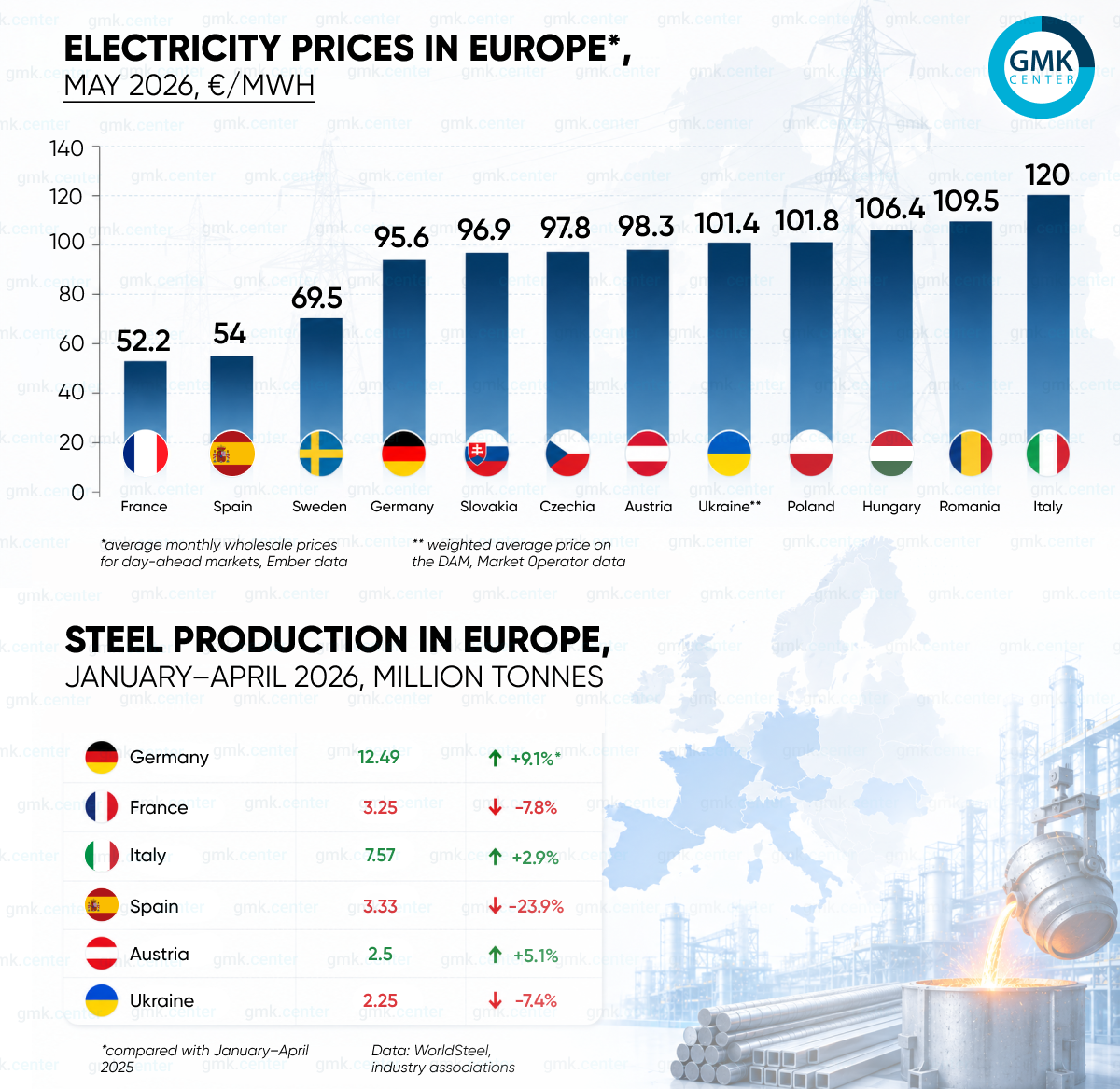
The spot price in Ukraine last month was €101.4/MWh
Average monthly wholesale day-ahead electricity prices in Europe rose in May 2026 compared to April.
May trends
According to Ember, as of June 2, prices were as follows:
- Italy — €120.05/MWh (unchanged from the previous month);
- France — €56.16/MWh (+42.3% MoM);
- Germany — €95.56/MWh (+18.7%);
- Spain — €54.05/MWh (+26.9%);
- Sweden — €69.5/MWh (+41.6%).
In Poland, the average monthly day-ahead wholesale price in May was €101.8/MWh, in Slovakia — €96.9/MWh, and in Hungary — €106.4/MWh, all of which were higher than in April.
The rise in prices on European electricity markets last month was driven by fluctuations in gas demand and prices (which in May reached March levels due to the protracted conflict in the Middle East), as well as a decline in renewable energy generation (particularly wind power) in a number of countries.
European decisions
In its spring economic forecast, the European Commission projected a slowdown in the bloc’s economic activity (slowing GDP growth and rising inflation) in 2026, as the conflict in the Middle East triggers a new energy shock that will once again fuel rising consumer prices and undermine economic sentiment. However, the situation is expected to improve somewhat in 2027, provided that tensions in energy markets ease. The updated forecast will be presented in the fall of 2026, as is customary.
A separate review notes that the volatility of the gas market continues to spill over into European electricity markets, as gas-fired power plants still frequently set the price cap for electricity. However, the growing share of renewable energy generation has lowered wholesale electricity prices while contributing to greater price volatility.
In May, five member states (Bulgaria, Finland, France, Poland, and Sweden) called for the creation of a European Energy Union based on coordinated regional systems rather than a fully centralized one. They believe that energy infrastructure is too complex, region-specific, and politically sensitive to be developed according to a single model.
Last December, the European Commission put forward a legislative proposal on reforming energy networks, which calls for closer coordination in revising EU legislation governing trans-European energy infrastructure, Euronews reports. However, the signatories do not reject European coordination entirely, supporting cross-border cooperation and the need for interconnected infrastructure to achieve decarbonization and energy security goals.
The situation in Ukraine
According to «Market Operator,» in May, the weighted average price of electricity trading on the Day-Ahead Market (DAM) in Ukraine fell by 9.8% month-on-month – to 5,222.67 UAH/MWh (€101.4/MWh at the average monthly exchange rate of the hryvnia to the euro). Demand on the day-ahead market last month decreased by 9.28% compared to April, while supply increased by 9.49%.
According to ExPro Electricity’s monitoring data, in May of this year, Ukraine reduced electricity imports by 29% compared to the previous month, or to 398,000 MWh. Compared to the same period in 2025, the figure increased by 3%. Hungary accounted for the largest share of imports (52%).
At the same time, last month Ukraine increased electricity exports by 2.8 times compared to April—to 94,000 MWh. Compared to May 2025, these volumes remained almost at the same level.
In May, the regulator—the National Commission for Energy and Public Utilities Regulation (NEURC)—approved an increase in tariffs for electricity transmission and dispatching effective July 1 of this year, a move opposed by the business associations “Ukrmetallurgprom” and ICC Ukraine. The draft is still subject to final approval following discussions. As a reminder, on May 1, the regulator raised the price caps for the day-ahead market (DAM), the intraday market (IDM), and the balancing market.
-

Opinions Industry steel consumption
13 July 2026
06 July 2026

01 July 2026

22 June 2026