




Posts Global Market Poland 1245 19 February 2026
Post-war economic cooperation between the two countries could become an important factor in the development of the entire region
Trade between Ukraine and Poland is showing steady growth despite periodic disagreements. In 2025, Ukrainian exports to Poland increased by 7.5% to $5.1 billion, while imports from Poland increased by 15% to $8 billion.
Poland has already reaped significant economic dividends from its partnership with Ukraine, and after the war, our country could become a new center of attraction for investment in Europe. Deepening cooperation is beneficial for both sides and the entire region.
Commodity flows
Imports of Polish goods to Ukraine are showing steady growth. According to the State Customs Service, this indicator increased by 5.4% and 15% year-on-year in 2024 and 2025. Ukrainian exports to Poland are more volatile due to Polish protectionist measures. Restrictions on agricultural exports led to a 1% y/y decline in 2024, but by the end of 2025, Ukrainian exports had increased by 7.5% y/y – to $5.1 billion.
For objectivity, we will provide Polish estimates of trade turnover. According to Eurostat, last year Poland exported $15.2 billion worth of goods to Ukraine (+2% y/y in euros), while Ukrainian customs recorded deliveries worth $8 billion. Polish data includes re-exports – goods from other European countries delivered to Ukraine from warehouses in Poland.
Ukrainian and Polish data fully coincide in their assessment of exports from Ukraine to Poland in 2025 – $5.1 billion (-3% y/y in euros). Ukrainian trade turnover data appear to be more accurate when assessing trade with a single country.
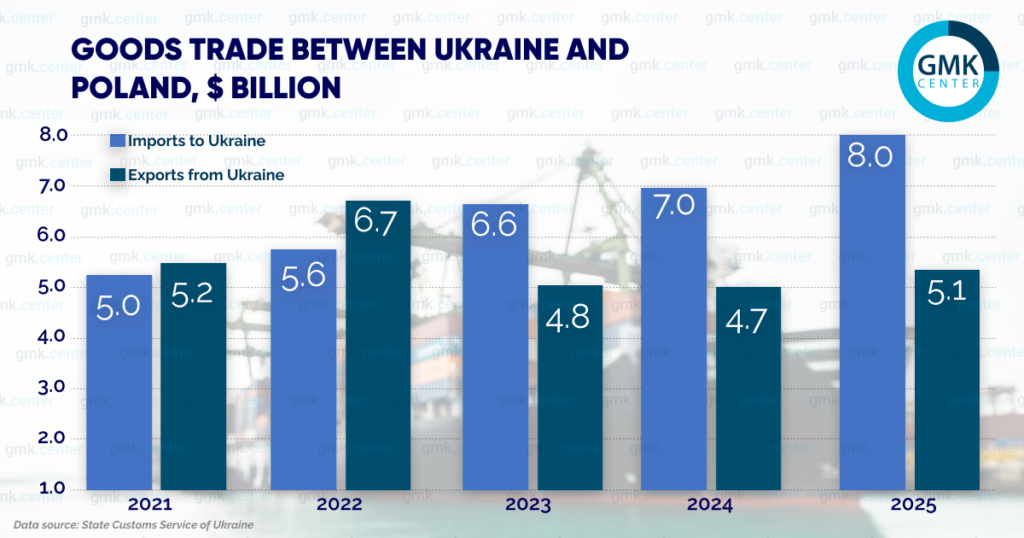
Polish exports consist of goods with high added value, while Ukrainian exports are largely raw materials. Polish restrictions on Ukrainian agricultural exports have led to an increase in the trade deficit, which reached $2.9 billion in 2025. The trade deficit with Poland does not pose a critical threat to the Ukrainian economy, as it is caused by military conditions and related factors.
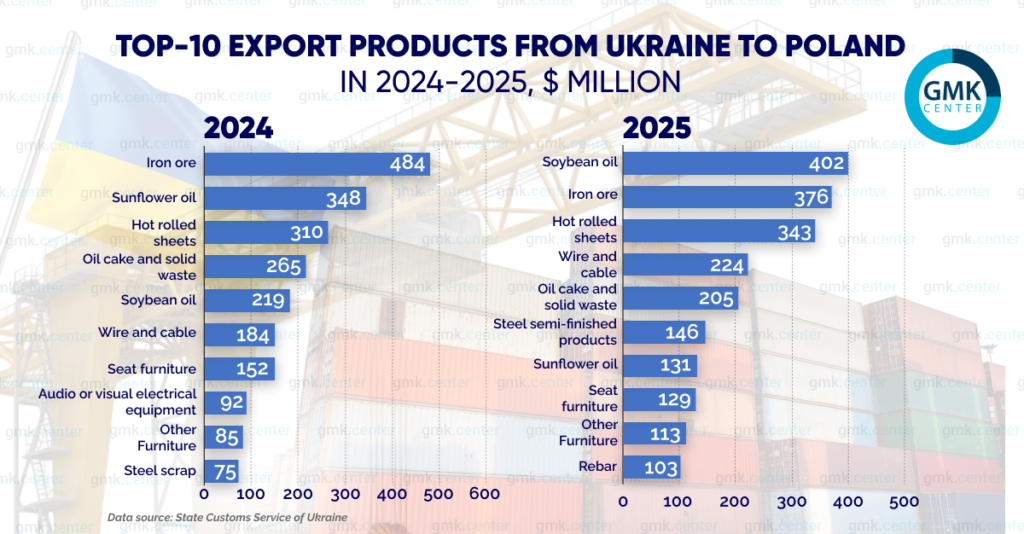
Ukraine mainly supplies agricultural products and industrial raw materials to Poland. The leading exports among agricultural and agro-processing products are sunflower, soybean, and rapeseed oils, as well as oilcake. Among export products with high added value, cable products, furniture and wood products, and steel products can be highlighted. In 2025, Ukraine increased its supplies of mining and steel products to Poland by only 9% year-on-year, to $1.35 billion, including $376 million worth of iron ore.
In recent years, the structure of Polish exports to Ukraine has changed significantly due to the intensification of the following areas:
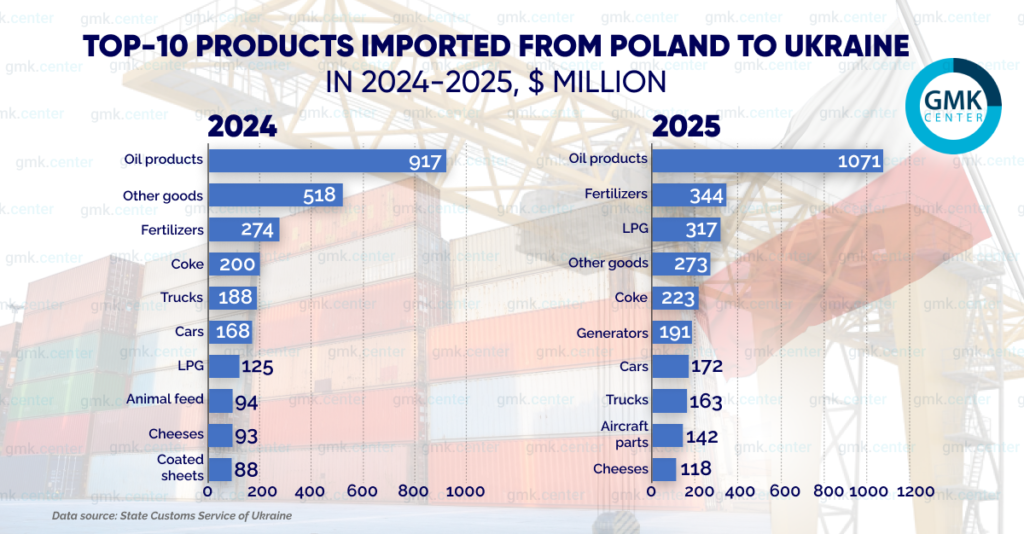
- Energy resources (petroleum products, liquefied gas, electricity). Poland meets Ukraine’s energy needs, which are critical after the destruction or damage of its own processing and generation facilities, as well as related infrastructure. At the end of 2025, energy supplies from Poland to Ukraine increased by 11% year-on-year to $1.5 billion. Last year, Naftogaz imported 600 million cubic meters of American LNG in partnership with the Polish company ORLEN. In 2026, 1 billion cubic meters are expected to be delivered.
- Industrial goods and raw materials. Poland increased supplies of products that are important for the Ukrainian economy and its individual sectors: vehicles and spare parts, machinery and various equipment, fertilizers and agricultural machinery, and steel coke. At the end of 2025, Poland supplied passenger cars worth $172 million and freight vehicles worth $163 million. Among industrial raw materials, last year’s supplies of mineral fertilizers (715,000 tons worth $344 million) and coke (658,000 tons worth $223 million) are noteworthy. Poland ranks third in terms of imports to Ukraine for all groups of steel products (flat and long rolled products, pipes) after Turkey and China.
- Consumer goods. Poland supplies food, clothing and footwear, household chemicals, and other consumer goods to Ukraine.
- Military products and weapons. In 2024, Ukraine purchased equipment and materials worth almost €2.5 billion, not including military aid supplies.
Economic cooperation
Ukrainian-Polish economic cooperation is not limited to trade in goods: Poland is one of the largest direct investors in Ukraine. According to the NBU, in the first nine months of 2025, direct investment from Poland to Ukraine increased by 63% year-on-year to $215 million, and in 2024 by 21% year-on-year to $231 million. The cumulative volume of direct investment as of September 30, 2025, amounted to $1.46 billion.
The reverse flow remains insignificant. The volume of Ukrainian direct investment in Poland does not exceed $5 million, which indicates significant unrealized potential for bilateral investment cooperation.
Poland, like a number of other European countries, insures the risks of its own business in Ukraine. In 2024, the Polish Export Credit Agency (KUKE), together with MIGA, insured for the first time the military and political risks of Polish investments in Ukraine, including investments in production, for an amount exceeding $45 million. In April 2025, Poland launched a €58 million preferential lending program for Polish companies investing in Ukraine.
Close economic ties open up new opportunities for Polish businesses even in wartime. Already, more than 3,000 Polish companies are participating in infrastructure restoration and development projects. Among them are manufacturing companies that continue to operate in Ukraine despite the destruction caused by shelling, construction companies Mirbud and Unibep, and Polish energy network operator PSE. In October 2024, Poland allocated €25 million to the reconstruction of Ukrainian infrastructure under the EU for Ukraine mechanism.
Poland is already reaping tangible economic benefits from its cooperation with Ukraine: expanded regional influence and sales markets, transit revenues, and support for economic growth and employment within the country. Part of the EU funds allocated to aid Ukraine also remains in the Polish economy through transit and service provision. In 2024–2025, Poland’s GDP grew by 3% and 3.6% year-on-year, which is significantly higher than the European average. By the end of 2025, Poland’s GDP exceeded $1 trillion, paving the way for the country to join the G20.
Ukrainians who have remained in the country also make a significant contribution to the Polish economy. Between 2022 and 2025, they registered more than 100,000 individual entrepreneurs and companies in Poland; in 2024, over 70% of new legal entities were opened by Ukrainians. Officially, about 800,000 Ukrainian citizens are employed in Poland. According to Deloitte estimates, the total contribution of Ukrainian refugees to Poland’s GDP in 2024 was 2.7%, taking into account production, consumption, and tax revenues.
Mutually beneficial prospects
Economic relations between Ukraine and Poland have not been smooth sailing in recent years. Poland pursues a pragmatic policy of protecting its interests: restricting exports of Ukrainian agricultural products in 2023, supporting the abolition of preferential trade arrangements for Ukraine, making political statements against the country’s rapid accession to the EU, and reacting emotionally to the introduction of a temporary zero quota on scrap metal exports. All this creates certain difficulties for the expansion of trade and mutually beneficial long-term cooperation.
The pro-European policy and geographical proximity of Ukraine and Poland predetermine the strategic partnership between the countries. In the context of post-war recovery, trade cooperation between Ukraine and Poland (and in the broader context of the European Union) may gain new momentum.
For Poland, deepening economic integration with Ukraine means:
- expansion of a large market for Polish goods with high added value;
- access to high-quality raw materials and semi-finished products at competitive prices;
- strengthening of its position as a regional economic and logistics hub;
- opportunities for Polish companies to participate in the recovery of the Ukrainian economy.
For Ukraine, developing trade with Poland ensures:
- access to critical energy resources, industrial goods, and equipment;
- opportunities to export agricultural products and industrial raw materials to the European market;
- attracting direct investment to modernize the economy.
The mutually beneficial partnership between Ukraine and Poland is becoming a factor of economic stability not only for the two countries, but also for the entire region of Central and Eastern Europe.

-

15 June 2026

16 June 2026
10 June 2026
27 May 2026