

Posts State human resources 1460 15 December 2025
Hopes for improvement after refugees return are fading fast – less than half of Ukrainians plan to return
The staffing crisis has become the main challenge for Ukrainian businesses. War, mobilization, and migration have led to a critical reduction in available labor resources. Businesses are forced to compete for every employee, raising salaries and changing their hiring approaches. However, there are no short-term solutions to the problem, and the prospects for the return of refugees remain unclear.
The depth of the problem
According to the State Statistics Service, the average number of full-time employees in Ukraine fell from 7 million in 2021 to 5.3 million in September 2025. The shortage of personnel has gone beyond being just one of the obstacles to business.
According to a survey by the Institute for Economic Research and Policy Consulting, the shortage of personnel in 2025 is the most significant problem for business, accounting for 60% of responses (blue line on the graph). This is followed by “unsafe working conditions” (49%) and “rising prices for raw materials and goods” (47%).
The level of staff shortages rose sharply after the intensification of mobilization in May 2024, and there are currently no visible reasons for it to return to an acceptable level.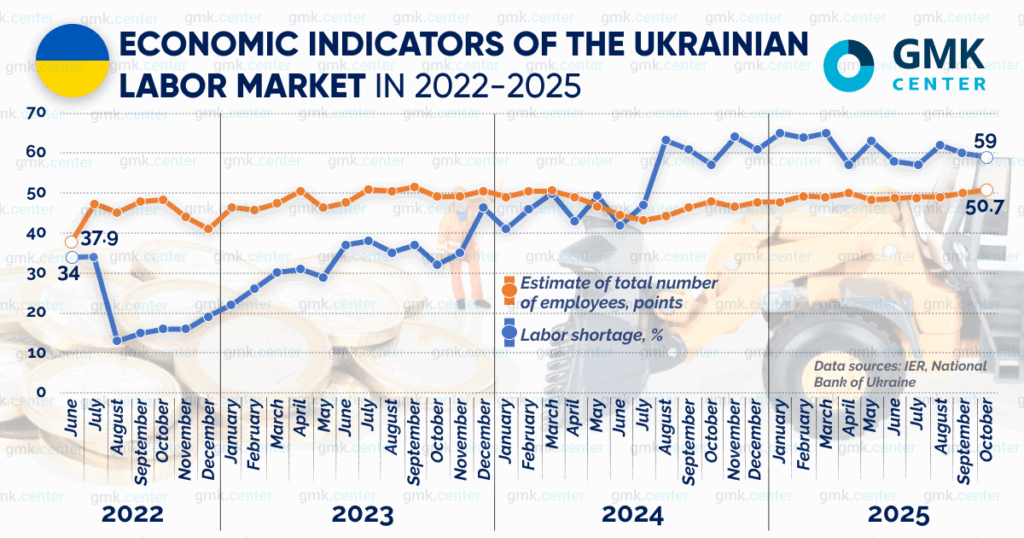
According to a survey by the European Business Association (EBA), only 5% of business respondents do not feel a shortage of personnel this year, while 74% (71% in 2024) consider this to be a significant problem.
“The most difficult vacancies to fill are those for blue-collar and technical positions due to staff turnover and low motivation to work offline. It is also difficult to find sales managers and middle managers, as their work requires constant presence, and booking opportunities are limited,” the EBA notes.
Although Ukrainian businesses rate the overall number of employees (orange line on the graph) above the neutral level (50 points). The results of the NBU survey in the third quarter of 2025 show that in the next 12 months, businesses give negative assessments of the dynamics of the total number of employees. Negative expectations were expressed by respondents in most sectors of the economy, especially construction.
Labor problems
Due to mass migration abroad and within the country, as well as mobilization caused by the war, there are many problems and imbalances in the Ukrainian labor market:
- Labor shortage amid high unemployment. According to NBU estimates, unemployment stood at 13.1% in 2024, compared to 8.2% in 2021. It is expected to decrease to 11.3% by the end of this year and to 10.2% in 2026.
- Structural imbalance between supply and demand. Employers need personnel with specific skills, but supply is limited due to the impact of war, migration, and changes in the structure of the economy. For example, many industrial enterprises have relocated to the Zakarpattia region, but it is practically impossible to find local workers with the necessary level of competence, as there have never been many industrial facilities in this region. This creates a local labor surplus in some regions and a shortage in others.
- A significant increase in the number of vulnerable groups. In two years of war, the number of people with disabilities in Ukraine has increased by 300,000 to 3 million. According to some estimates, only 18% of them are employed, while in the EU this figure is 55%. This category also includes veterans, who often face fragmented support programs, poor coordination between government agencies and businesses, and a lack of adapted workplaces and vocational rehabilitation.
- Low integration of internally displaced persons (IDPs). According to a survey by the International Organization for Migration, the unemployment rate among IDPs (17%) was almost twice as high as among those who returned to Ukraine (9%) and those who did not leave (10%). This group faces difficulties in finding employment due to a number of problems (lack of jobs in specific regions, low awareness, mismatch of qualifications, etc.).
- Growth of informal employment. Some able-bodied men who do not have a reservation or the right to deferment do not go to work even in the informal sector of the economy due to fears of mobilization and actually stay at home.
- Ill-considered decisions by the authorities. Allowing young people aged 18 to 22 to travel abroad amid a general labor shortage seems like an ill-advised decision. There are no accurate statistics on the number of people who have left, but their number may range from 50,000 to 100,000. This is a significant figure given that there were about 300,000 men in this age group in the labor market. As a result, according to OLX.Robota, in September, 55% of employers felt the impact of the departure of staff aged 18-22, with 41% feeling it significantly.
- Low flexibility of employers. Veterans, internally displaced persons, people with disabilities, and pensioners face systemic difficulties in finding employment.
Solutions
To overcome the shortage of personnel, Ukrainian businesses are taking the following measures:
- Increasing salaries and incentives. According to an EBA survey, in 2025, 96% of employers increased their employees’ salaries, mostly by 11–20% (64%) or up to 10% (28%). At the same time, businesses are actively improving working conditions, which has become an element of competition for personnel. Retention programs include social packages, insurance, housing assistance, psychological support, payment for courses, and more.
- Reserving key employees. The ability to reserve personnel has become a competitive advantage in the labor market. At the same time, businesses point to the difficulties of reserving employees and the imperfection of this procedure.
- Internal training and retraining. The shortage of personnel encourages employers to develop staff within the company and, in large enterprises, to retrain them in sought-after specialties. Companies are investing in training courses, launching internal training programs, and qualification training.
- Expanding categories of personnel recruitment. Businesses are forced to pay attention to young people under 22, pensioners, people with disabilities, veterans, and expand the recruitment of women, in particular by training women in professions that were previously only practiced by men. To a certain extent, this is yielding results. In particular, the number of companies employing people with disabilities increased to 50% in 2024 from 36% in 2023. For their part, many large companies have launched veteran reintegration programs.
- Cooperation with educational institutions and involvement of students. Companies invest in the training of future employees while they are still studying at universities and colleges, with subsequent employment. This makes it possible to recruit specialists who are ready for real production.
- Automation and technology implementation. The automation of routine processes makes it possible to significantly increase the efficiency of employees. At the same time, very few Ukrainian companies are already using artificial intelligence to solve the problem of staff shortages—only up to 15%, which also indicates the unrealized potential of technology. A study by Robota.ua showed that 40% of the companies surveyed are ready to invest in the implementation of artificial intelligence and process automation.
Employment reserves
In conditions of total labor shortage, the obvious source of replenishment is the return of refugees to Ukraine. According to the UN, as of mid-November 2025, there were 5.9 million people outside Ukraine. This could have a significant positive impact on the labor market outlook, demographics, and the recovery of economic and investment activity.
However, all the facts and forecasts indicate that the mass return of Ukrainians from abroad will be postponed at least until the complete cessation of hostilities and the availability of reliable security guarantees. The National Bank’s baseline scenario does not foresee a significant replenishment of the population through migration in the next two years.
«The net population outflow is expected to continue in 2025–2026 (approximately 200,000 people per year). Only in 2027 will a net return of migrants begin, but it will be quite slow (approximately 100,000 people),» NBU analysts note.
The International Monetary Fund predicts that there will be no mass return of refugees after the end of hostilities. The experience of the Balkan countries shows that an optimistic scenario would be the return of one-third of refugees. Already, the adaptation of Ukrainians abroad and problems in the country mean that more than 50% of Ukrainians (according to various surveys) associate their future with the countries that have accepted them.
On the other hand, the gradual end of temporary protection for Ukrainians in EU countries (it’s in place until March 4, 2027) and less financial support for refugees will lead to at least some of those who left coming back to Ukraine (if the war ends).
In addition to the return of refugees, there are reserves for attracting personnel within the country. An additional source could be the more active involvement of internally displaced persons, who, according to the latest data, number 3.7 million. Although many of them have already reintegrated into their new locations, up to a quarter are looking for work or are working unofficially.
Another resource is the reintegration of veterans and people with disabilities. Simple types of employment are quite suitable for attracting this category of the population, although employers will have to do some additional work.
There has also been a recent trend towards attracting migrants. Ukrainian employers are actively recruiting workers from South Asia (India, Bangladesh, Pakistan, Nepal) and other regions to work in construction, logistics, and agriculture. According to some estimates, Ukrainian employers are ready to hire up to 400,000–450,000 foreigners annually.
Conclusions
The labor shortage has become a long-term problem in Ukraine. On the one hand, this will help reduce unemployment, but on the other hand, it will limit the ability of companies to increase production or even maintain current levels of economic activity. This means that businesses will have to adapt to a new reality with fewer workers available.
Businesses are not planning to slow down yet. According to EBA estimates, 36% of medium and large companies intend to increase their workforce next year (in 2025, 83% of respondents hired new employees), while 55% do not plan any changes. At the same time, small and medium-sized businesses are making much more modest plans. A survey by Robota.ua showed that in 2026, about half (46%) of the companies surveyed do not plan to expand their staff. Another 30% will hire selectively, and 20% are preparing to increase their staff.
Solving this problem requires coordinated action by the state and business: simplifying booking procedures, creating adaptation programs for vulnerable groups, investing in automation and technology, and a well-thought-out migration policy.