




Posts Green steel green steel 2206 03 September 2025
The industry's green transition relies on manufacturers' own innovations and strong investment resources
The roadmap for decarbonizing South Korea’s steel industry envisages achieving carbon neutrality by 2050. By that time, greenhouse gas emissions from Posco, Hyundai Steel, and Dongkuk Steel should be reduced by 95% compared to the 2018 baseline. All of them are among the most successful players in the global steel industry, focusing on the production of high-margin products. Therefore, the task seems quite realistic, given the financial capabilities.
Three paths to one goal
Metallurgy is one of the main emitters of CO2 in South Korea. In 2018, it accounted for 39% of all emissions from national industry – 372.87 million tons, excluding Scope 3. This is due to the significant contribution of BF-BOF plants to the total volume of steel production. In subsequent years, the share of EAF plants declined even further, exacerbating the problem. Therefore, the industry’s decarbonization strategy primarily envisages the partial replacement of existing BF-BOF capacities with EAFs.
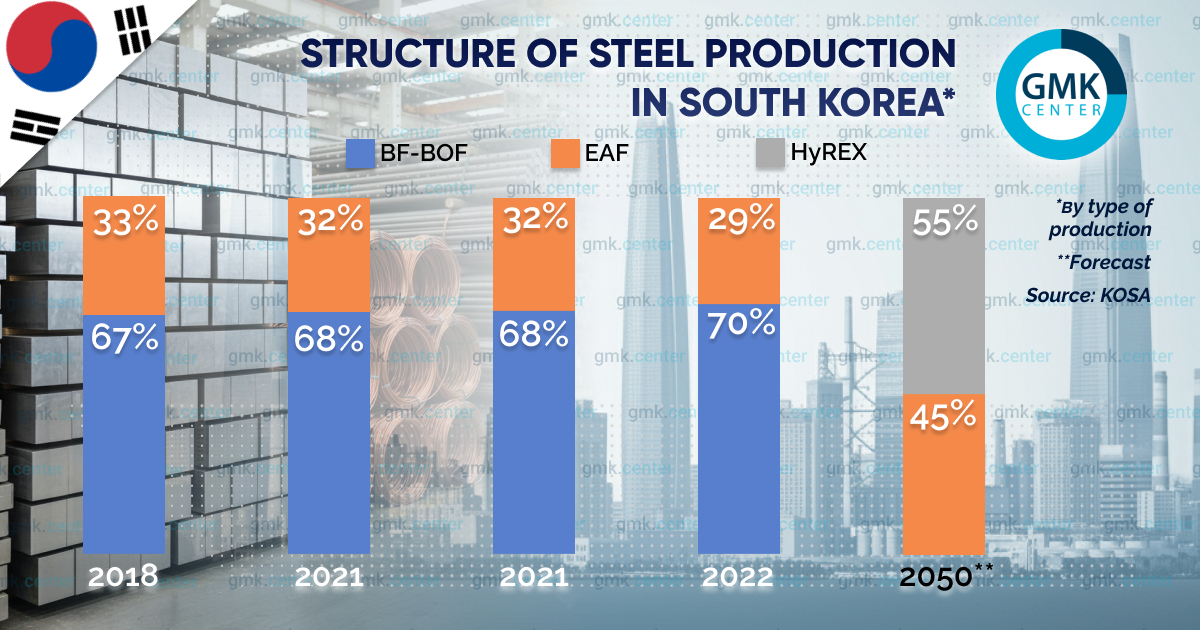
And here Posco, the biggest player, will have to make the biggest effort. It has all its steelmaking at BF-BOF. Moreover, Posco’s flagship mill Gwangyang ranked No. 1 in the world in terms of CO2 emissions (among steel mills) in 2022. It is much easier for the second largest company Hyundai Steel. It has both BF-BOF and EAF capacity. Finally, Dongkuk Steel, which rounds off the top three, receives all its steel using EAF. Accordingly, its products already fall under the definition of green.
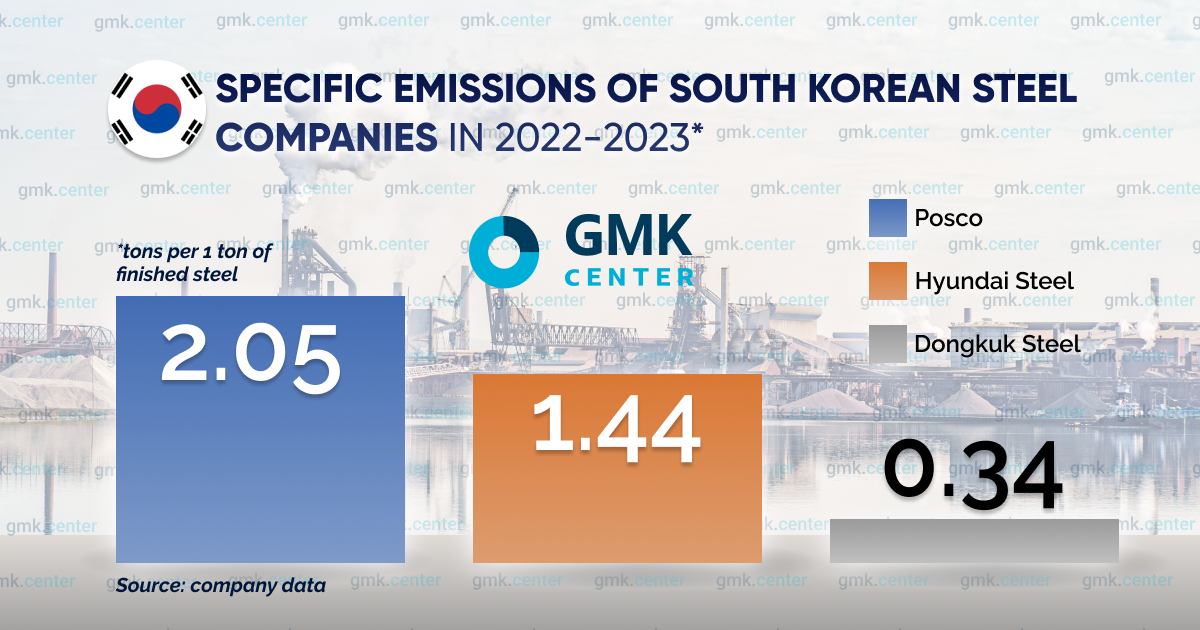
Hyundai Steel also has a decent score. But this is combined data. For BF-BOF, it is 2.2 thousand tons, and for EAF, it is 0.6 thousand tons. In other words, this manufacturer actually has partially green products. Based on this, it becomes clear which South Korean steelmakers are closer to the Net Zero 2050 target and which are playing catch-up. And why this is the case. Accordingly, each now has its own strategy.
Posco: betting on HyREX
The roadmap for decarbonizing steel production consists of three stages.
- The initial stage will last until 2030. The main focus will be on implementing energy efficiency measures and expanding the use of more environmentally friendly materials (scrap, DRI, HBI), which will reduce the share of pig iron in steel smelting. This should reduce CO2 emissions by 20% compared to 2018, to 6.3 million tonnes of carbon equivalent.
- The second stage, up to 2040, involves the use of H2 in blast furnaces to reduce the proportion of coke. CCUS will also begin to be used. In stage 1, the possibility of such projects with carbon sequestration in Indonesia and Australia is being studied. The company has signed relevant memoranda with local oil and gas producers. This will reduce greenhouse gas emissions by 50% compared to 2018, to 3.94 million tons.
- The final stage should be completed by 2050. It involves the transition from BF-BOF to HyREX technology. Its innovation lies in the fact that DRI produced using H2 and NG is not unloaded or transported anywhere. Right here, in the ore thermal furnace, it is used to produce pig iron. In 2024, the company signed an agreement with Primetals Technologies to develop and supply equipment for a pilot project with a capacity of 300,000 tons per year. Construction will begin after 2030 at the Posco Pohang plant site.
As the company plans to further increase production, it is also investing in new steelmaking capacity. Of course, this will be an EAF. Construction of a 2.5 million tonne per year facility began in 2024 at the existing Posco Gwangyang plant. It will cost $450 million.
Starting in 2040, steel production at all plants will be 100% powered by green electricity (e/e). To this end, Posco is upgrading 3.4 GW of equipment at its gas-fired power plant in Incheon for H2 use.
Hyundai Steel: Hy-Cube to the rescue
Hyundai Steel’s steelmaking capacity is evenly distributed between BF-BOF and EAF, with 12 million tons per year each. By 2030, the company intends to reduce CO2 emissions by 12% compared to 2018. This is a more modest goal than Posco’s. But Hyundai Steel’s carbon intensity is also lower.
It is also betting on its own innovations, combined in the Hy-Cube concept. The company is developing a technology (currently in the testing stage) for adding electric steel from EAF to BF. To this end, it plans to recommission an idle EAF at its Tangier plant with a capacity of 1 million tons per year. As a result, specific emissions from blast furnace production should fall to 1.8 tons of CO2.
The second stage will begin in 2029 and will be a reverse process. In this stage, pig iron from the BF will be fed into the EAF. This should reduce emissions to 1.4 tons. The key difference between the two mixing methods is the technology used to purify the steel from impurities. Other priority tasks until 2030 include:
- reducing electricity consumption at the sintering plant;
- introducing a dry quenching system (CDQ);
- testing H2 and LNG injection into the BF;
- increasing the share of scrap, DRI, and HBI in raw materials;
It is noteworthy that Hyundai Steel’s decarbonization roadmap does not include targets beyond 2030. At the same time, a similar document from the Hyundai Motors group, which includes Hyundai Steel, provides for a 40% reduction in CO2 emissions by 2035, a 60% reduction by 2040, and by 100% by 2045. Given that 60-70% of the steel this automaker purchases is sourced within the group, it is logical to assume that Hyundai Steel will also have to reduce its emissions after 2030. However, there is no direct correlation here, as steel accounts for up to 35% of a car’s carbon footprint.
Nevertheless, Hyundai Steel has declared its goal of achieving carbon neutrality by 2050. And in October 2023, it signed a contract with Primetals Technologies to conduct research on reducing CO2 emissions. This mainly involves the possibility of using H2 in blast furnace production.
For electric steel production, the company intends to reduce specific emissions to 0.2 tons through H2-DRI. This volume of greenhouse gases is planned to be neutralized using CCUS.
Hyundai Steel will also switch to 100% self-sufficiency in electricity by 2050. To this end, it began construction of a 0.5 GW gas-fired power plant last year. The company’s current production volumes require 2.1 GW. It currently has a 0.1 GW power plant that uses blast furnace gas.
Dongkuk Steel: decarbonization leader
South Korea’s third-largest steel producer already has the lowest emissions. One of its EAFs at the Incheon plant is labeled Eco-Arc. This unit consumes 30% less electricity than other EAFs due to scrap preheating and a continuous loading system. Therefore, the company’s short-term plans are to build a similar infrastructure for all electric furnaces. This is an innovative component.
In general, Dongkuk Steel divides 2 areas of decarbonization: steel production itself and energy. The latter envisages digitalization of the energy management system at the enterprise until 2030 and replacement of energy equipment with low efficiency.
In the long term until 2050, the production direction includes a transition to H2 plus further digitalization, including AI. The energy direction is scaling up solar power plants. In this way Dongkuk Steel intends to reduce CO2 emissions:
- By 2030 by 10% compared to 2018, to 277 thousand tons of carbon equivalent;
- By 2040 by 28%, to 223 thousand tons;
- By 2050 by 100%;
Resources for decarbonization
Realization of green plans of South Korean companies is impossible without the resource component – RES, H2 and steel scrap. These issues are being brought to the level of national incentive and development policies.
By 2050. South Korea intends to achieve a carbon-neutral economy. To this end, 30 coal-fired power plants will be shut down in the country by 2034. Their share will be taken by renewable energy sources and nuclear power plants. By 2036, 2 nuclear power units of 1.4 GW each plus a 0.7 GW modular power unit will be built.
According to the Basic Plan for the Development of the Electric Power Industry for 2024-2038, the national energy balance will change as follows.
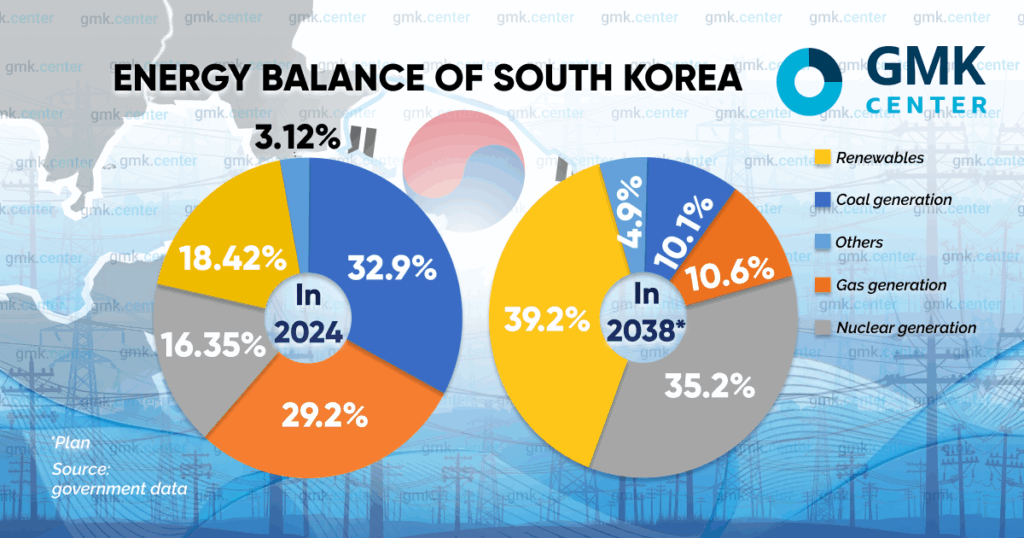
In addition, 12 coal-fired power plants will be converted to alternative fuels. By 2038, hydrogen fuel should account for 6.2% of the energy mix. Currently, South Korea produces “gray” H2, which has a significant carbon footprint.
South Korea’s hydrogen economy roadmap, approved by the Ministry of Trade, Industry, and Energy, envisages an increase in production from 0.22 million tons in 2020 to 1.94 million tons in 2030. Of this, 0.25 million tons will be green H2, 0.75 million tons will be blue H2, and 0.94 million tons will be gray H2. Local companies intend to import an additional 1.96 million tons of green H2.
Obviously, the bulk of it will be used in the power and cement industries, with metallurgy accounting for an insignificant share of total consumption at this stage. By 2050, the production of green H2 will grow to 3 million tons, and “blue” H2 to 2 million tons. South Korea plans to purchase 22.9 million tons of green H2 abroad. By this time, the use of “gray” H2 will be completely phased out.
The strength of the South Korean economy is based on developed mechanical engineering. Which, as we know, generates the bulk of scrap collection. Despite this, South Korea is already a net importer of scrap. In 2024, the volume of foreign purchases amounted to $1.15 billion, according to national statistics. Exports amounted to $305 million.
The total steel scrap market in South Korea in 2024 is estimated at $4.8 billion. Thus, approximately 20% is already accounted for by foreign imports. This share will only increase as new EAFs are built to replace BF-BOF capacities as part of decarbonization efforts.
South Korean steelmakers receive the main flow of imported scrap from Japan. In 2024, it accounted for 60% of foreign supplies. But even there, manufacturers, primarily Nippon Steel, are planning to switch from BF-BOF to EAF as they strive for carbon neutrality. This means a sharp reduction in export supply in the medium term, as domestic demand for scrap in Japan will begin to grow.
American and Russian scrap will be more expensive due to logistics. Therefore, we can predict restrictions or even a complete ban on scrap exports from South Korea after 2030. For now, local steelmakers are trying to expand their own scrap collection base as much as possible.
For example, Posco invested $140 million in this area in 2023-2025, increasing the number of scrap collection centers from 4 to 8. The company also announced the opening of such centers abroad. Obviously, other South Korean steel producers will follow suit.
Green government policy
The government does not single out metallurgy among other industries and sectors of the economy subject to decarbonization. South Korea was the first country in Southeast Asia to launch a national CO2 emissions trading system in 2015. Currently, K-ETS covers 79% of all greenhouse gas emissions. However, it does not apply to the steel industry. Steel companies still receive free quotas.
Following market trends, they are creating their own steel eco-brands. Posco has “Posco Greenable” and Hyundai Steel has “HyECOsteel.” However, South Korea does not have an officially developed and approved state standard for green steel (as, for example, in India).
In 2024, it became known that the government had begun consultations with industry representatives on the introduction of the CBA in South Korea. Since then, there has been no information on the progress of the initiative, which is designed to stimulate the transition to carbon-free steel production. However, this does not mean that local companies are completely deprived of state support.
Since the end of 2021, South Korea has had a national green taxonomy, K-Taxonomy. It contains environmental criteria for 69 types of economic activity. Compliance with these conditions entitles companies, including steel companies, to attract external financing for decarbonization projects on preferential terms. In particular, they can obtain insurance guarantees from the state-owned Korea Trade Insurance Corporation and the Export-Import Bank of Korea. This reduces the cost of loans.
Posco already has experience in this area. In 2021, the corporation issued $700 million in low-yield green bonds. In 2023, Hyundai Motors also secured a $940 million green loan on very favorable terms to build electric vehicle battery assembly plants in the United States. Obviously, this experience can be used by Hyundai Steel for its projects.
However, despite their enviable financial capabilities, South Korean steel companies prefer not to rush the green transition. They are building their decarbonization strategies based on a long-term perspective of 25-30 years.

-

11 June 2026
10 November 2025

16 October 2025
14 October 2025