




Posts Global Market electricity prices 1689 06 March 2026
The cost of electricity in Ukraine remains extremely high
Average monthly wholesale day-ahead electricity prices in Europe in February 2026 showed polar trends depending on the markets.
February trends
According to Ember, as of March 4, 2026, they were as follows:
- Italy – €114.23/MWh (-13.8% month-on-month);
- France – €46.95/MWh (-2.1 times);
- Germany – €96.69/MWh (-11.8%);
- Spain – €16.43/MWh (-4.3 times);
- Sweden – €102.14/MWh (+43.3%).
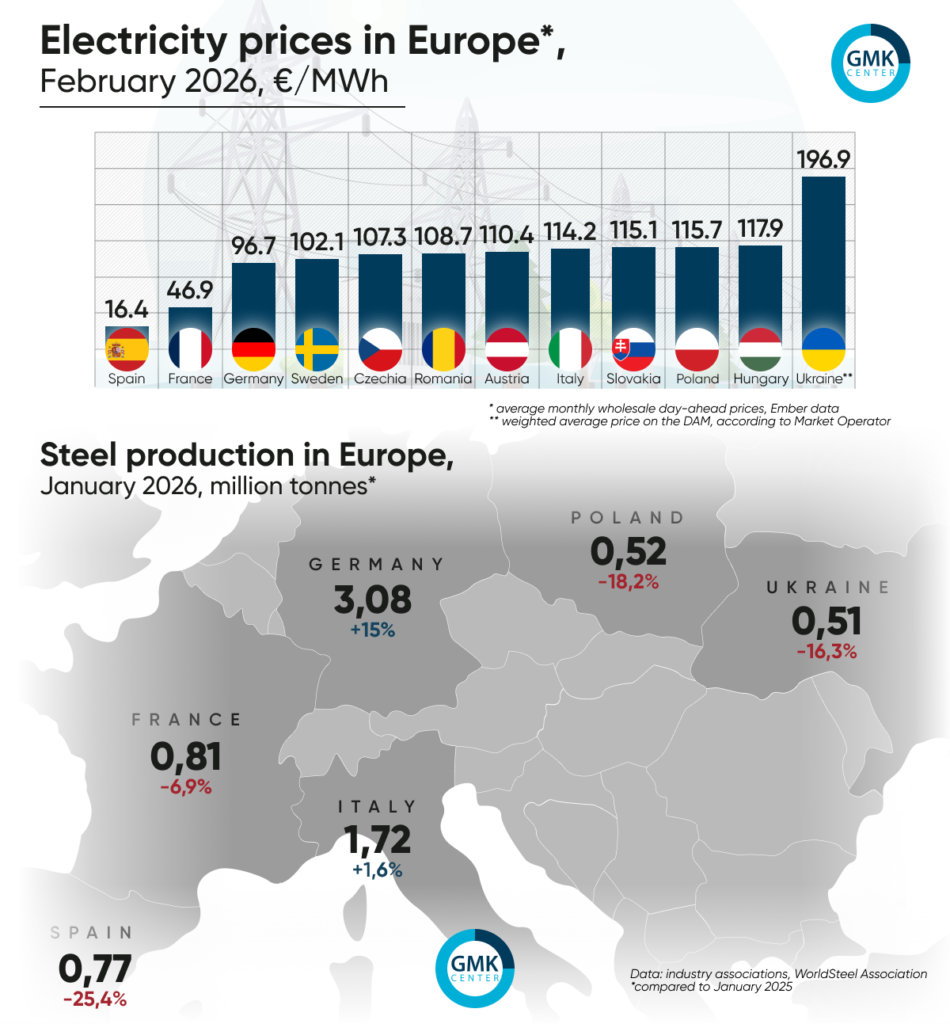
In Poland, the average monthly wholesale price for day-ahead electricity in January was €115.68/MWh, in Slovakia – €115.08/MWh, in Hungary – €117.95/MWh, which was lower than in January.
In February, AleaSoft notes, prices on most major European electricity markets fell, in some cases significantly, while in Scandinavia they reached historically high levels.
At the beginning of last month, the decline in electricity prices in Europe was driven by lower gas and carbon prices, milder weather, increased renewable energy production, and lower demand in most markets. This trend continued.
The Iberian market in February differed significantly from the rest of Europe, showing very low daily values (less than €5/MWh) in some periods. This was facilitated by intense storms and high levels of renewable energy production, particularly wind power.
The Scandinavian market recorded an average weekly price of €125.08/MWh on February 10–16, and €128.91/MWh on February 18. The increase in electricity prices in Northern Europe in the first months of the year was caused by cold weather and higher demand.
The dynamics of March electricity prices in the region will largely be determined by the cost of gas, which has already skyrocketed on European markets in early spring amid the escalation of the conflict in Iran. In particular, on March 2, with the start of the new trading week, TTF futures for the month ahead, according to ICE, rose sharply. This continued until the end of trading, which finally closed at €44.5/MWh. On March 3, the price at the end of the trading day was €54.3/MWh, in the first half of the day on March 4, gas traded in the range of €49–51/MWh, and finally, the price settled at €48.7/MWh.
Electricity prices in Europe also began to rise. In Italy, as of March 3, they stood at €121.96/MWh (up from €106.42/MWh the previous day), in France, they rose to €59.9/MWh (up from €30.52/MWh as of March 2), and in Germany to €106.27/MWh (from €94.02/MWh the previous day). The cost of electricity on European markets continues to rise.
European appeals
Leading European business leaders at an industrial summit in Antwerp on February 11 called on the EU to take urgent measures to preserve the region’s industry. Among the main issues were lower energy and carbon prices.
The European Steel Association (EUROFER) supported the industry’s appeal adopted in Antwerp. The industry is demanding urgent measures to reduce the cost of electricity. The association stressed that consistently high and volatile electricity prices, further increased by taxes and carbon costs, have become one of the main obstacles to investment, electrification, and decarbonization of the metallurgical industry. According to industry estimates, returning tariffs to a level close to the pre-crisis 2021 level (approximately €44/MWh) is critical to preserving production chains.
Last month, a statement by the Alliance of Energy-Intensive Industries was also released. It called on the European Commission to ensure that the Electrification Action Plan (to be presented in May) takes into account a number of priorities, including setting a competitive benchmark of €50/MWh for total electricity costs for industry.
Italy is preparing for a large-scale reform of its electricity market. On February 18, the Italian government approved the so-called Energy Decree (Decreto Bollette) worth over €3 billion. According to Bloomberg, the measures provided for in this document are aimed, in particular, at reimbursing gas-fired power plants for the cost of carbon emission allowances under the EU ETS.
Since gas-fired plants usually set the cap price on the Italian wholesale electricity market, the mechanism will effectively exclude carbon charges from the cost paid by consumers. The country has the second-highest electricity prices in Europe for companies. Industry experts warn that the new provisions could undermine the competitiveness of renewable energy.
Situation in Ukraine
According to Market Operator, in February, the weighted average purchase and sale price of electricity on the DAM in Ukraine increased by 19.9% month-on-month to UAH 10,048.28 (€196.9/MWh at the average monthly exchange rate of the hryvnia to the euro).
Demand on the DAM last month decreased by 13.97% compared to January, while supply decreased by 9.64%.
According to preliminary monitoring by ExPro Electricity, Ukraine imported a record 1.26 million MWh of electricity in February 2026 (+41% month-on-month). In annual terms, the figure increased fivefold.
Despite political statements made last month by the leaders of two neighboring countries, Hungary continued to account for the largest share of imports for the period (49%). Compared to January, supplies from this country increased the most – by almost 54%. Slovakia’s share last month was 18%.
At the end of February, Prime Minister Robert Fico announced that Slovakia would stop emergency electricity supplies to Ukraine from February 23 in response to the suspension of Russian oil transit through the Druzhba pipeline. According to his statement, in January 2026 alone, these emergency supplies were needed to stabilize the Ukrainian power grid twice as much as in the whole of 2025.
NPC Ukrenergo reported that the possible suspension of emergency supplies from this country would not affect the situation in Ukraine’s integrated power system.
The company noted that no official documents had been received from the Slovak system operator, SEPS, at that time. The Ukrainian side recalled that both they and SEPS are full members of ENTSO-E and that relations between them must comply with the established rules of the organization. In addition, there was no mention of any restrictions on commercial imports from Slovakia.
On March 4, the CEO of SEPS announced his intention to terminate the contract with Ukrenergo for emergency electricity supplies, citing a decision by the country’s government.
Earlier, on February 21, Hungarian Prime Minister Viktor Orbán threatened to cut off electricity supplies to Ukraine, but Budapest reneged on these promises the very next day.

-

02 July 2026
16 June 2026
10 June 2026
27 May 2026