




Posts Global Market electricity prices 1804 09 February 2026
Ukraine imported record volumes of electricity in the first month of the year
Average monthly wholesale prices for electricity for the next day in Europe rose in January amid increased demand and higher costs of other energy sources.
January trends
According to Ember (as of February 4, 2026), they were as follows:
- Italy – €132.6/MWh (+14.8% month-on-month);
- France – €101.3/MWh (+47.5%);
- Germany – €109.7/MWh (+17%9%);
- Spain – €71.3/MWh (-8.4%);
- Sweden – €99.1/MWh (+116.3%).
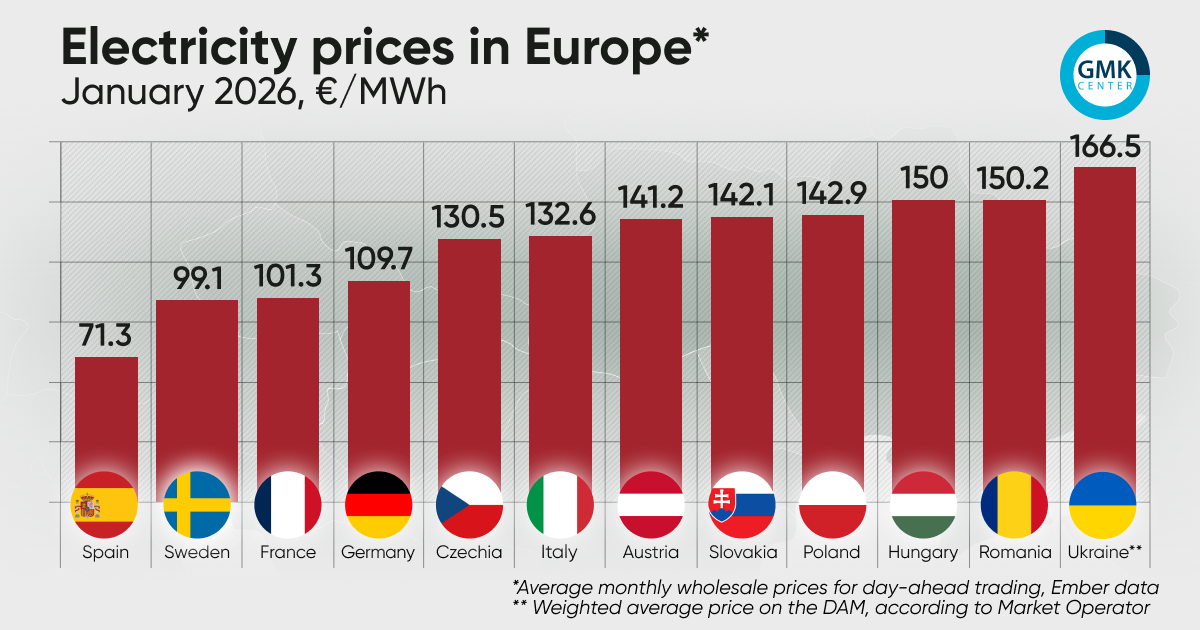
In Poland, the average monthly wholesale price for day-ahead electricity in January was €142.9/MWh, in Slovakia – €142.1/MWh, and in Hungary – €150/MWh, which is significantly higher than in December.
In January, AleaSoft notes, prices on most major European electricity markets (except for the Iberian market) exceeded €100/MWh, and on several of them, the monthly figure was the highest since at least March 2025. Demand for electricity in Europe rose last month amid low temperatures. Among other factors, the cost of electricity for the period was significantly affected by the rise in TTF gas futures, which reached their highest average value since July last year in January. CO₂ futures reached their highest levels in at least two years. At the same time, some countries recorded historic monthly wind energy production records in January.
According to a study by Ember, renewable sources provided almost half of the EU’s electricity last year. In particular, wind and solar energy accounted for 30% of the bloc’s energy balance in 2025, while fossil fuels accounted for 29%. Gas-fired power generation increased by 8% year-on-year, largely due to a decline in hydropower generation, but continues to decline.
However, European countries view gas-fired power plants as controllable reserve capacity during periods of insufficient generation from renewable sources. In January, the European Commission gave preliminary approval to Germany’s plan for new gas-fired power capacity and also approved Spain’s €3.1 billion state aid scheme to support cogeneration (high-efficiency CHP plants).
Situation in Ukraine
In January of this year, the weighted average purchase and sale price of electricity on the DAM in Ukraine, according to information from the Market Operator, increased by 21.8% month-on-month – to UAH 8,381.08/MWh (€166.5/MWh at the average monthly exchange rate of the hryvnia to the euro).
Demand on the DAM last month increased by 9.14% compared to December, and supply increased by 10.14%.
Last year, the weighted average purchase and sale price of electricity on the DAM was 5643.94 UAH/MWh (€119.9/MWh at the average annual hryvnia-to-euro exchange rate).
According to preliminary monitoring by ExPro Electricity, in January 2026, Ukraine imported a record amount of electricity – over 894 thousand MWh (+40% month-on-month, which was the highest figure since the start of the full-scale war.
Hungary continues to account for the largest share of exports (45%). Overall, supplies increased in all directions except Moldova.
ExPro noted that the level of use of imported crossings has increased significantly, with a substantial increase in the number of hours during which it is already being used at 100% capacity. This mainly applies to daytime hours and evening peak hours. On an hourly basis, the largest increase was recorded during daytime hours (8:00 a.m. to 5:00 p.m.).
Difficult situation
The Ukrainian energy system remains in an extremely difficult situation due to constant attacks by the aggressor country. According to Prime Minister Yulia Svyrydenko, since the beginning of 2026, Russia has launched 217 strikes on Ukraine’s energy sector (as of February 4).
In particular, on the night of February 3, the Russians used a record number of ballistic missiles —32 — against the energy sector. According to data provided by Ukrainian President Volodymyr Zelenskyy, another 11 missiles of other types that hit their targets along a ballistic trajectory, 28 cruise missiles, and 450 strike drones were also launched.
On January 16, a state of emergency was declared in the Ukrainian energy sector. At the same time, at an extraordinary meeting on the same day, the regulator, the National Energy and Utilities Regulatory Commission (NEURC), temporarily (from January 18 to March 31) set the maximum price limit for electricity on the day-ahead market (DAM) and the intraday market (IDM) at UAH 15,000/MWh for the entire day. On the balancing market, the maximum price for the same period was set at UAH 16,000/MWh. The decision was made after Energy Minister Denys Shmyhal announced the government’s expectations to review the price caps for electricity on the spot market and equalize the day and night price caps to attract electricity imports throughout the day.
On January 31, a crisis arose in the country’s energy system: two accidents on high-voltage lines in the morning of that day, occurring within a minute of each other, caused a cascade of power outages in seven regions of the country and triggered automatic protection mechanisms at substations. Nuclear power plant units were also unloaded.
Denys Shmyhal reported that there was a technical failure with the simultaneous shutdown of the 400 kV line between the power systems of Romania and Moldova and the 750 kV line between the western and central parts of Ukraine. Theories about a cyberattack or external interference have not been confirmed. This technological accident also affected the power supply in Moldova.
The shortage of electricity and its high cost have a significant impact on Ukrainian business, in particular the iron and steel complex. In January, the mining company Ferrexpo announced a temporary suspension of operations due to Russian strikes on energy infrastructure. ArcelorMittal Kryvyi Rih announced last month that it would be forced to shut down its blooming shop in the second quarter. The company cited the final introduction of CBAM without exceptions for Ukraine as the key factor, with the extremely high cost of electricity in the country as an additional but no less significant factor.
The Ukrainian Association of Ferrosilicon and Other Electrometallurgical Products Manufacturers (UkrFA) appealed to the government regarding the critical situation in the industry and the possibility of piloting state support mechanisms. As noted, the situation in the industry is complicated by the constant increase in electricity tariffs (transmission, distribution, application of price caps), the lack of preferential lending for enterprises operating in the combat zone, and mechanisms for compensating investments in alternative energy projects.

-

02 July 2026
16 June 2026
10 June 2026
27 May 2026