




Posts Global Market steel consumption 23 28 July 2026
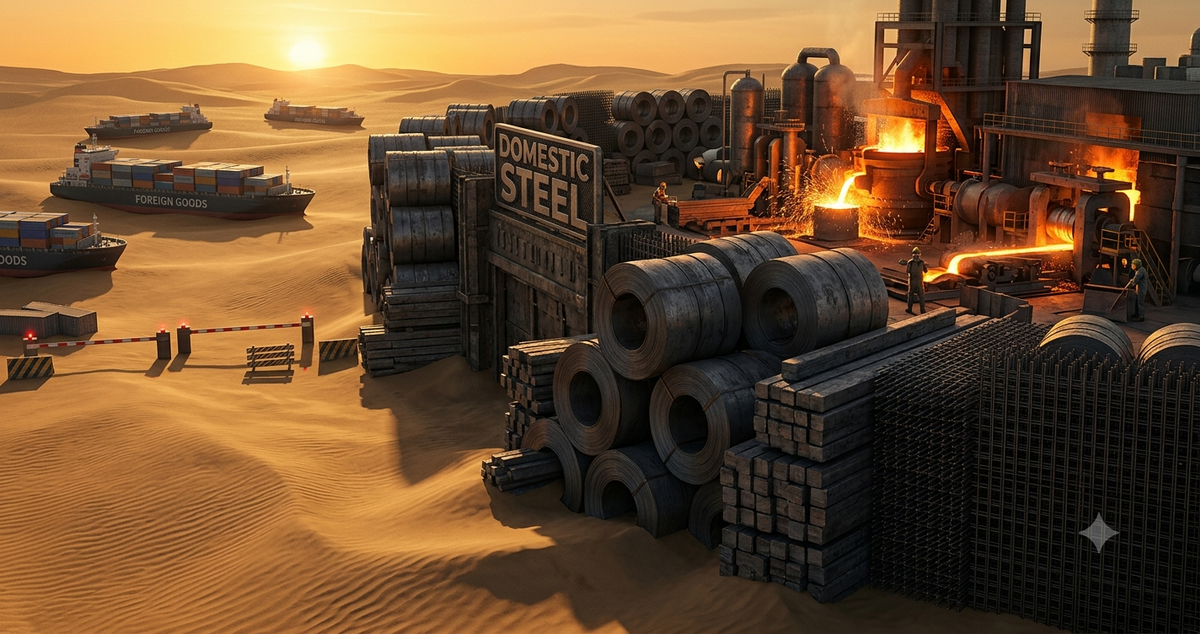
State protectionism created the conditions for the rapid development of the Algerian steel industry
The rate of growth in steelmaking and rolling capacity in Algeria is among the highest in the world. Major international players are investing huge sums here, building high-tech production facilities from scratch. In a very short space of time, the country has gone from being almost entirely dependent on imports for its steel consumption to becoming a net exporter, supplying the market with value-added products.
A legacy of the past
The industry’s pioneer is the BF-BOF plant Algérienne pour l’Acier (ALSOLB, formerly known as Sider El Hadjar) in El Hadjar. This state-owned enterprise has a nominal rolling mill capacity of 2 million tonnes per year. Due to equipment wear and tear and frequent shutdowns for repairs, actual output stands at 1–1.5 million tonnes.
In theory, the plant is capable of producing a wide range of products — reinforcing bars, wire rod, HRC and CRC, as well as seamless pipes for the oil and gas industry. However, it has been in operation since 1969, and the equipment was originally commissioned by Soviet specialists.
The rolling mills have suffered significant wear and tear over the years. They do not meet the strict thickness tolerances or surface quality required for modern production of cars and household appliances. The small volumes of HRC produced by ALSOLB are mainly supplied to the Alfapipe plant, which manufactures welded pipes for gas and water pipelines.
Between 2021 and 2025, ALSOLB attempted to revive production through budget injections totalling around $200–300 million. This funding was used to modernise the coking plant and to repair the blast furnace and rolling mills.
ALSOLB is attempting to install a modern Danieli section mill with a capacity of 800,000 tonnes per year at its site. The current Algerian authorities have confiscated it from the ETRHB holding company, which belongs to the disgraced oligarch Ali Haddad.
Local media claim that the project is stalling, with the mill’s components still lying in disassembled form in warehouses. According to their estimates, the installation and testing of the equipment will not be completed until at least 2028. Even if this forecast proves accurate, it will have no impact on the Algerian market. Due to ongoing problems with BF, the plant will be unable to ensure an acceptable utilisation rate for the rolling mill.
Tosyalı Expansion
The undisputed leader is the local subsidiary of the Turkish holding company owned by Fuat Tosyalı. Construction of the Tosyalı Algerie steelworks in the Bethioua industrial zone began in 2011, and by 2013 it had already produced its first steel. It is now a giant electric arc furnace (EAF) plant with an annual capacity of 6.2 million tonnes of steel and 5.9 million tonnes of rolled products. Of this, 3.5 million tonnes are rebar and wire rod, 2.4 million tonnes are HRC, 800,000 tonnes are CRC, 400,000 tonnes are GI, and 400,000 tonnes are LDP.
The hot-rolling mill is capable of producing coils up to 1,600 mm wide and 1 mm thick. This makes the company not only a monopoly in flat steel production within the country, but also a major exporter in the Mediterranean region.
Tosyalı Algerie’s main investments in 2021–2023 were directed towards the construction of a fourth-generation DRI complex. Following its commissioning, DRI production capacity doubled to 5 million tonnes per year.
In 2024–2025, the company commissioned EAF-3 with a capacity of 2.7 million tonnes per year and a new hot-rolling mill with a capacity of 2.5 million tonnes. HRC production capacity rose to 4 million tonnes. EAF-3 is connected by a conveyor to the Midrex metallisation plant. Feeding in DRI at a temperature of over 600°C reduces melting time and electricity consumption.
The total investment in these programmes is estimated at $1.5–2 billion. This figure also includes the costs of constructing port infrastructure and energy facilities.
Tosyalı Algerie is currently implementing a new, ambitious investment programme worth $2.5 billion. This programme includes plans to commission a new cold-rolling mill with a capacity of 1.4 million tonnes per year (scheduled to come on stream in August–September 2026), as well as increasing the capacity of the solar power plant to 1.2 GW.
This package also includes the construction of a concentrator plant with a capacity of 4 million tonnes of concentrate per year (in partnership with the Algerian state-owned company Feraal) in Béchara. The plant will process iron ore from the Gara-Jebilet deposit into a product suitable for DRI production.
Qatar’s stake
Qatar Steel International entered the Algerian market in 2013 through the establishment of the Algerian Qatari Steel (AQS) joint venture. The Qataris hold a 49% stake, the state-owned holding company Groupe Industriel SIDER (which also manages ALSOLB) holds 46%, and the remaining 5% is held by the Algerian National Investment Fund.
Construction of the EAF plant in the Bellara industrial zone began in 2015, and AQS produced its first reinforcing bars in 2017. Until 2019, the rolling mills operated using imported billets. Subsequently, the EAF-1 furnace was commissioned.
The AQS plant currently has an annual production capacity of 2.2 million tonnes of steel and 2 million tonnes of rolled products. The company specialises in rebar and wire rod.
In 2021, AQS commissioned a DRI module with a capacity of 2.5 million tonnes per year, also based on Midrex technology. In 2022–2023, the company refined the technology for the direct feeding of hot DRI from the shaft furnace into the EAF. In 2024–2025, process automation systems were implemented in collaboration with Danieli. This eliminated ‘bottlenecks’ in the transfer of billets from the continuous casting machine to the rolling mills.
The stabilisation of the raw material supply base thanks to the DRI module (the plant had previously relied on imported raw materials) and technological optimisation carried out with Danieli enabled a sustained increase in the utilisation rate of steelmaking and rolling capacities from 40–50% to 70–75%.
In 2026, AQS announced a new investment programme worth $2 billion. Its aim is to increase rolling production capacity to 4 million tonnes. The programme involves the construction of EAF-3 with a capacity of 2 million tonnes per year, new rolling mills and the expansion of the DRI module. Commercial contracts for the supply of equipment are currently being finalised, and tender documentation is being prepared.
AQS plans to do more than simply increase its production capacity. The aim is to establish the production of special steels and SBQ for the automotive and engineering industries.
Ozmert Integration
It is also worth noting Ozmert Algeria, an EAF plant with an annual capacity of 400,000 tonnes of steel and 450,000 tonnes of rolled steel. It is owned by the Turkish Ozmert Group. This is a diversified holding company which began operations in Algeria in 2007, producing crushed stone and concrete.
In 2015, Ozmert began construction of an EAF plant in the Tamzoura industrial zone. The first steel was produced there in 2017, and the first rolled steel in 2019. The plant specialises in reinforcing bars and wire rod. Like ALSOLB, it supplies the domestic market.
In 2024, Ozmert completed the construction of a DRI module with an annual capacity of 500,000 tonnes. The plant utilises Indian technology for the metallisation of iron ore pellets using coal. The ore is sourced from a mine with an annual capacity of 150,000 tonnes, located in the province of Bechar. Ozmert also built this mine from scratch, achieving full vertical integration from raw materials to finished steel.
The role of the state
The authorities use various models to support local steel producers. For ALSOLB, the state acts as an ‘investor of last resort’. The modernisation programmes for the El Hadjar steelworks are almost 100% funded from the state budget to prevent its closure and the inevitable social unrest that would ensue in the province of Annaba.
For Tosyalı Algerie and AQS, the state employs a partnership model. The Turkish holding company Fuyata Tosyalı and Qatar Steel International are investing billions of dollars in the industrialisation of the Algerian economy. The Algerian government is facilitating this.
- The state is creating the logistics infrastructure required by the steelmakers at its own expense.
The national railway operator, SNTF, has built a 1,000 km railway line connecting Gara-Jebilet with Béchar. It was commissioned in February 2026. For AQS, the state has modernised a 50-km section of railway line from the deep-water port of Jijel to Bellara. It has been converted to a double track; the existing track has been upgraded to accommodate heavy goods trains and electrified.
- The state is helping a private steel holding company to secure a raw materials supply base (the Tosyalı Algerie and Feraal projects).
- The state supplies Algerian steel companies with electricity and natural gas at below-market prices.
Tariffs for steel companies are not publicly available. In the case of Tosyalı Algerie, AQS and Ozmert Algeria, they are set out in individual agreements with the Algerian National Investment Development Agency (ANDI).
According to IMF estimates, domestic gas prices for industry in Algeria in 2023–2025 were less than 10% of production costs compared with global market benchmarks. This means that Tosyalı Algerie saves $50–80 per tonne of finished steel compared with competitors who obtain energy resources at market prices, according to the findings of the US Department of Commerce.
The state guarantees domestic sales to Algerian steel producers by completely closing the market to imports. Several instruments are used to achieve this.
- The basic duty is 30%. It applies to imports of most types of steel products. It covers wire rod, reinforcing bars and billets, regardless of origin.
Formally, an exception is made for EU countries with which Algeria has a free trade agreement. In practice, however, access to the local market for European steelworks is blocked in the same way as for all others.
- The National Preference mechanism. This is regulated by Presidential Decree No. 15-247 of 16 September 2015 and Law No. 23-12 of 5 August 2023.
Under these documents, products of Algerian origin receive a price preference of up to and including 25% when tender bids are assessed. This means that on public works projects (primarily infrastructure projects), the contractor is obliged to purchase Algerian reinforcing bars, even if they are 25% more expensive than imported ones.
But that is not all. Before importing any goods, the importer must obtain a special certificate from the Algerian Import Agency (AIA). The agency checks whether a similar product is manufactured within Algeria. If local steelworks produce even a similar range of rolled steel products, the certificate is automatically refused.
Foreign exchange restrictions
The Algerian authorities have established a system under which importing steel is not ‘expensive’ or ‘inconvenient’, but simply impossible due to the blocking of foreign exchange payments. Every import deal must undergo domiciliation — linking it to a specific local bank, which must first approve the contract. Only then is a letter of credit opened against it and the foreign currency released.
In practice, no account is opened for a foreign company or an Algerian importer, as the domiciliation process is dragged out on any pretext. Banks can conduct checks for months on end, demanding endless bundles of documents, citing ‘technical glitches’ or new internal circulars.
The importer is obliged to submit their Import Forecast Programme (PPI) to the Ministry of Foreign Trade six months or a year in advance. Without the Ministry’s approval of the PPI, no Algerian bank will even consider opening an account or processing a payment, as stipulated by the relevant directive from the central bank (Bank of Algeria).
Since 2025, the ‘one company – one bank’ rule has been in force. If a bank has blocked or delayed the process, it is not possible to approach another bank with the same contract – doing so results in fines and being blacklisted for fraud.
In the spring of 2026, the Bank of Algeria reduced the limits on foreign letters of credit and guarantees for commercial banks to 50% of their capital. From now on, banks cannot open new credit lines for many importers — the limits have been exhausted.
Foreign trade in steel
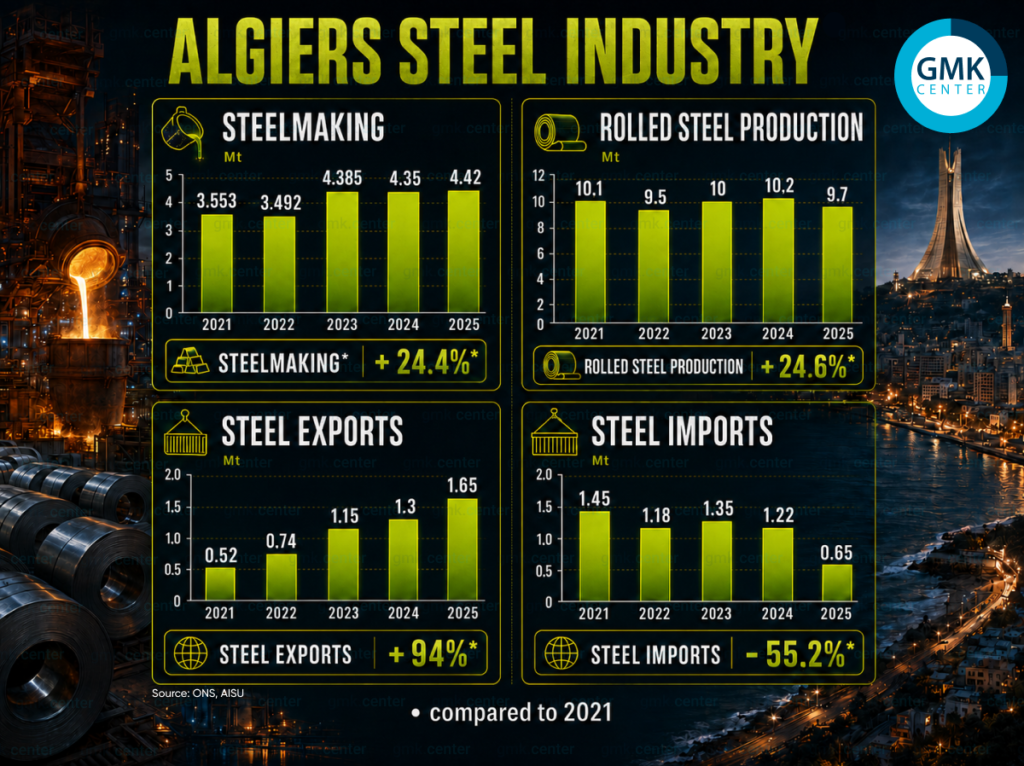
Algeria’s foreign trade balance for steel was already in deficit by 1 million tonnes back in 2021. By the end of 2025, the country had firmly established itself as a net exporter of steel, with a figure of 1 million tonnes. The slump in imports in 2025 was linked to the launch of hot-rolled coil production in Algeria itself.
The share of imports in steel consumption fell from 35% in 2021 to 16% in 2025. At the same time, Algerian consumers still cannot do without imported long products, the share of which has been steadily increasing within the structure of foreign supplies.
This segment is dominated by Chinese manufacturers of pipes, cold-rolled coils (CRC) and galvanised steel (GI). They account for 45–50% of Algeria’s steel imports. Next come:
- France, with a share of 10–12%. The main product categories are steel pipes and rails.
- Turkey, with a share of 10–12%. It supplies steel pipes, CRC and specialised sections.
- Italy, with a share of 7–9%. It supplies seamless pipes, steel springs and specialised sections.
- India, with a share of 5–7%. It supplies CRC.
There are virtually no exports of semi-finished products from Algeria. Around 92–95% of crude steel is immediately processed into finished rolled products. Up to and including 2024, 100% of Algerian steel exports consisted of reinforcing bars and wire rod. In 2025, Tosyalı Algerie began shipping flat rolled products to foreign markets. The main destinations for exports in 2021–2025 were:
- The USA, accounting for 25–30% of the total volume.
- Italy, accounting for 15–20%.
- Spain, accounting for 10–12%.
- Turkey, accounting for 8–10%.
- Tunisia, accounting for 7–10%.
Flat steel products were supplied to Spain, Italy and Tunisia. In some years, Lithuania and Romania were occasionally included in this top five when local developers required additional volumes of reinforcing bars.
The geography of supplies is currently undergoing a dramatic shift. On 29 April 2026, the US Department of Commerce imposed an anti-dumping duty of 127.32% on Algerian rebar. From 6 July, a countervailing duty of 72.94% was added to this. On 8 July, a provisional countervailing duty rate of 73.33% on Algerian wire rod came into force. The US market is now closed to Tosyalı Algerie and AQS.
Official Brussels cannot afford to take similar measures for political reasons. As part of the effort to replace Russian pipeline gas, Algeria has become the EU’s most important contributor to energy security, supplying over 12% of pipeline gas imports.
Algerian steel has an ultra-low carbon footprint and is cheaper thanks to state subsidies for energy sources. This is of paramount importance to European consumers in the context of the CBAM. Consequently, they (notably the Italian association Assofermet) have lobbied for an expansion of quotas for Algeria under the EU’s new safeguard measures.
The EU remains an important market for Algerian steelmakers. However, the 15% cap on the global quota for the ‘other countries’ category is forcing them to seek new markets, particularly in view of their planned expansion of production.
Conclusions
The Algerian authorities have succeeded in attracting substantial investment in the development of the steel industry, laying the foundations for the industrialisation of the economy. This has yielded positive results. The sharp rise in steel production from 2023 onwards was driven by the commissioning of EAF-3 at Tosyalı Algerie, as well as the completion of technological optimisation at AQS. The commissioning of a new hot rolling mill at the Bethioua plant and the increased utilisation of the AQS rolling mills have improved rolled steel production figures.
-

OpinionsGlobal Marketsteel consumption
13 July 2026
23 July 2026
22 July 2026
17 July 2026