





Posts Global Market steel consumption 15 23 July 2026
Administrative intervention by the authorities completely changed the situation in 2026
Egypt’s demand for finished steel is met primarily by its own production capacity. Attempts by foreign suppliers to enter the market with locally produced products are hampered by tariff barriers. The Egyptian government’s policy of localisation enables the country’s steelworks to plan for increased sales and higher profit margins.
Industry overview
The largest steel producer in Egypt and across the MENA region is Ezz Steel, with an annual rolling capacity of 7 million tonnes. Of this, 2.3 million tonnes is hot-rolled coil (HRC), with the remaining 4.7 million tonnes being long products. Next come Suez Steel and Beshay Steel, each with a capacity of 2.2 million tonnes, followed by Egyptian Steel with 1.5 million tonnes. The latter plant operates on scrap steel, whilst all the others use DRI—partly produced in-house and partly imported—for steelmaking in electric arc furnaces (EAFs).
Apart from Ezz Steel, flat steel production in Egypt is carried out by Kandil Steel, a rolling mill with a total capacity of 800,000 tonnes per year. Of this, 650,000 tonnes are cold-rolled coil (CRC), 350,000 tonnes are galvanised (GI) coil, and 150,000 tonnes are polymer-coated (PPGI) coil. The company operates its own coil slitting centre (SSC) with a capacity of 200,000 tonnes per year. Over 50% of its output is exported.
Local producers specialise primarily in rebar and wire rod. Beshay Steel is also capable of producing heavy-section rolled products.
In addition to the major players mentioned, there are many small rolling mills operating in Egypt. The country’s total rolling capacity stands at around 20 million tonnes. The average capacity utilisation across the sector is approximately 50%. Despite this, the Egyptian government has approved the construction of new steelworks in the industrial zones of Ain Sokhna and East Port Said, with a combined capacity of 3.8 million tonnes per year.
The investment strategy of Egyptian companies has two main objectives: energy efficiency and import substitution.
- Between 2021 and 2024, Ezz Steel made only minor investments, solely to maintain operational efficiency. However, in 2025, it approved a $1.16 billion investment programme aimed at expanding its rolling mill capacity.
First and foremost, this involves the modernisation of section mills, which enables a switch from steel reinforcing bars to SBQ. These products command much higher margins than standard reinforcing bars. They are used in mechanical engineering, the manufacture of automotive components and high-strength steel rebar.
Energy consumption management systems and EAFs are also being digitised. This will enable a reduction in specific electricity consumption (e/e) and CO₂ emissions. Without these improvements, it is difficult for the company to sell its products in the EU, where the CBAM is in force. This applies even with the ‘green’ NG-DRI EAF technology.
The next phase of the investment programme involves the development of finishing facilities, including the construction of galvanising and polymer coating lines. As early as 2027, Ezz Steel will enter the market with sheet steel for the production of profiled sheets and sandwich panels.
- Between 2021 and 2025, Suez Steel carried out a major modernisation of its 1.95 million metric tonne DRI module. As a result, specific natural gas consumption fell from 2.4 to 2.2 Gcal, which is currently the best result in the world. Electricity consumption fell by 15% compared with the global average, to 93 kWh.
Furthermore, energy intensity in steelmaking was reduced by 15–20% thanks to the introduction of hot DRI charging technology in the EAF. A pellet production plant was also constructed.
- Between 2021 and 2024, Egyptian Steel introduced a system for the continuous conveyor loading of preheated scrap into the electric arc furnace (EAF) and Endless Welding Rolling technology — direct rolling without reheating the billet. This reduced energy consumption in rebar production by 15–20%.
For 2026–2027, the company has approved an investment programme worth $42.3 million. The main project is the construction of its own limestone plant.
- Between 2021 and 2025, Beshay Steel commissioned a 2 million metric tonnes DRI module, implementing 2G-HOTLINK technology there, which allows DRI to be fed directly into the electric arc furnace at a temperature of 650°C (at Suez Steel the figure is 600°C, whilst the global average is 400–550°C). This has helped to save 100 kWh per metric tonne of steel. The company has also built a rolling mill for the production of heavy section steel with a capacity of 500,000 metric tonnes per year.
The role of the state
The Egyptian government is pursuing one of the most aggressive policies to protect its domestic steel market. In April 2026, a large-scale series of trade investigations came to an end, following which almost all steel imports were subject to restrictions, including semi-finished products. Egypt’s protective measures are as follows:
– Imports of billets are subject to a 13% duty, but not less than $65 per tonne. An annual tariff quota of 176,700 tonnes has been set. This is a concession by the government to small rolling mills that process imported semi-finished products.
– Imports of hot-rolled coils (HRC) are subject to a duty of 13.6%, but not less than $75.25 per tonne. The restrictions apply to more than 20 commodity codes.
– Imports of cold-rolled coils (CRC) are subject to a duty of 13.7%; hot-dip galvanised (HDG) coils to 14%, but not less than $95.2 per tonne; and pre-painted (PPGI) coils to 14.5%, but not less than $105.18 per tonne.
These rates will remain in force until 13 September 2026, after which a gradual reduction of 0.5–1% per year on average is envisaged over a two-year period. The protective measures will remain in force until mid-September 2028.
Anti-dumping duties have also been imposed on rebar and wire rod. These apply to producers from China (29%), Turkey (7–22% depending on the company) and Ukraine (17–27%). These measures were extended in 2023 for a further four years and remain in force until at least mid-2027.
The next mechanism is the ‘Buy Egyptian’ rule. State-owned companies involved in major construction projects in the Suez Economic Zone and the new cities are subject to a strict directive: priority must be given to the use of locally produced steel. Imports are permitted only if the required grade of steel is not produced in Egypt.
Law No. 5 of 2015 (‘On Preferences for Egyptian Goods in Public Contracts’) grants domestic goods a 15% advantage in tenders. Imports of reinforcing bars or other rolled steel products can only win a contract if the local manufacturer’s price is at least 15% higher. If their bid is 14% more expensive than that of a foreign competitor, the contracting authority is obliged to award the contract to the Egyptian supplier.
Public Procurement Law No. 182 of 2018 recognises a product as ‘Egyptian’ if the share of value added generated within the country is at least 40%. At full-cycle steelworks, this figure exceeds 60–70%, which is why they are given absolute priority.
Under the same law, procurement for major infrastructure projects has been transferred from the civilian Ministries of Transport and Housing to the Ministry of Defence and the Engineering Corps of the Egyptian Armed Forces. This allows military officials to reject any foreign offers to supply steel on a case-by-case basis, ‘on grounds of national security’.
As part of its updated Economic Strategy, the Egyptian government has set new localisation targets — up to 60–80% local content by 2030. This means that manufacturers of household appliances or car parts are obliged to purchase steel sheets from Ezz Steel and Kandil Steel, rather than importing them.
Another important instrument for supporting the sector is the Export Burden Rebate Programme, which provides direct export subsidies. For the current financial year (until 1 July 2027), the total amount of payments has been set at $920 million. Under the programme, Egyptian steelworks receive cash-back payments for steel exported. Payments are calculated using a formula that takes into account the level of local value added and energy efficiency indicators.
In 2026, at the IMF’s request, the Egyptian government implemented a large-scale increase in electricity and natural gas tariffs for industry, ranging from 20–91% depending on the consumer category. For steelmakers, the final cost of electricity reached $40.3–50.35/MWh, and that of natural gas —
$277.5–279/1,000 m³.
To cushion the blow to the sector, the authorities, through the energy regulator EgyptERA, allowed steel companies to enter into direct long-term power purchase agreements (PPAs) with private solar and wind power plants, bypassing the sole state supplier, EETC. This has enabled prices to be reduced to $25–30/MWh.
Market profile
Egyptian steel exports, in monetary terms, reached a local peak in 2024. In physical terms, the volume of exports in 2024 fell to 2.1 million tonnes, compared with 2.25 million tonnes in 2023. The increase in value terms was achieved thanks to Ezz Steel’s strategy of exporting more hot-rolled coil (HRC) and less rebar.
Subsequently, exports returned to post-COVID levels against a backdrop of new regulatory barriers and aggressive dumping from China into Europe. The decline was also driven by the introduction of protective duties on wire rod in Turkey. In the same country, an anti-dumping investigation into steel pipes from Egypt was launched in 2025. This forced Egyptian producers to limit their supplies.
However, in 2025, Turkey became the main export market for Egyptian steel — $290 million. It was followed by Brazil — $161 million, Lebanon — $133 million, Saudi Arabia — $113 million, Sudan — $84 million, and the USA — $80 million.
Most of the shipments to Brazil consisted of wire rod. This country became a new export destination following the tightening of trade conditions in the EU. Previously, the European market accounted for 60–70% of Egyptian steel exports.
Despite a domestic shortage of semi-finished products, Egyptian producers shipped $150 million worth of billets to overseas customers in 2025, mainly to Turkey. However, finished rolled steel accounted for over 90% of total steel exports.
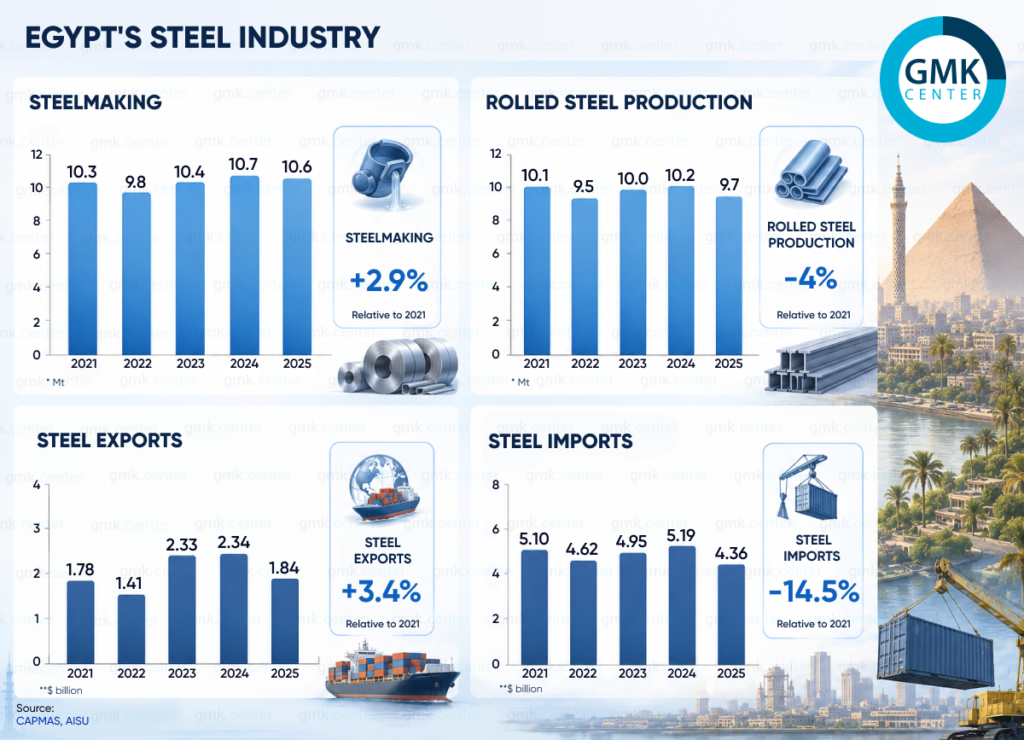
Steel imports in 2022 fell in physical terms due to the devaluation of the Egyptian pound in monetary terms. A recovery was observed in 2023–2024, driven by market adjustment. In 2025, there was a further decline as a result of an even more severe wave of devaluation.
Over the past five years, there have been significant changes in the structure of imports. In 2021, the share of finished rolled products stood at 95%; by 2025, this had fallen to 55%. The share of semi-finished products rose from 5% – to 45%.
Imports of finished rolled steel exceeded 2.5 million tonnes in 2021 against the backdrop of a construction boom, which local producers were unable to keep up with. Imports of billets remained at a technical low of just 127,700 tonnes. In recent years, Egypt has achieved almost complete self-sufficiency in long products (100% for reinforcing bars), thanks both to the commissioning of new capacity and to the contraction of the construction sector. At the same time, dependence on imported semi-finished products has increased.
In 2025, long products accounted for 12% of the total volume of imported finished steel, amounting to 200,000 tonnes. These were specific large channels and I-beams, which are not rolled in Egypt itself. The remainder consisted of flat products.
In the period from January to June 2026, Egyptian steel exports fell by approximately 30–35% year-on-year, to $600–650 million. The reason for this was intense price pressure from China and Turkey in the main export markets, which intensified in the spring of 2026.
Steel imports (including semi-finished products) fell by approximately 10–15% due to safeguards, to $1.85–1.9 billion. The market is being artificially ‘dried up’ to support integrated local players.
Statistics show that, in just one year, Egypt has moved from free trade in steel to total protectionism in the domestic market.

-

OpinionsGlobal Marketsteel consumption
13 July 2026

22 July 2026
17 July 2026

14 July 2026