




Interviews scrap market 578 17 June 2026
The ability of scrap processing companies to respond quickly to changes is becoming increasingly important
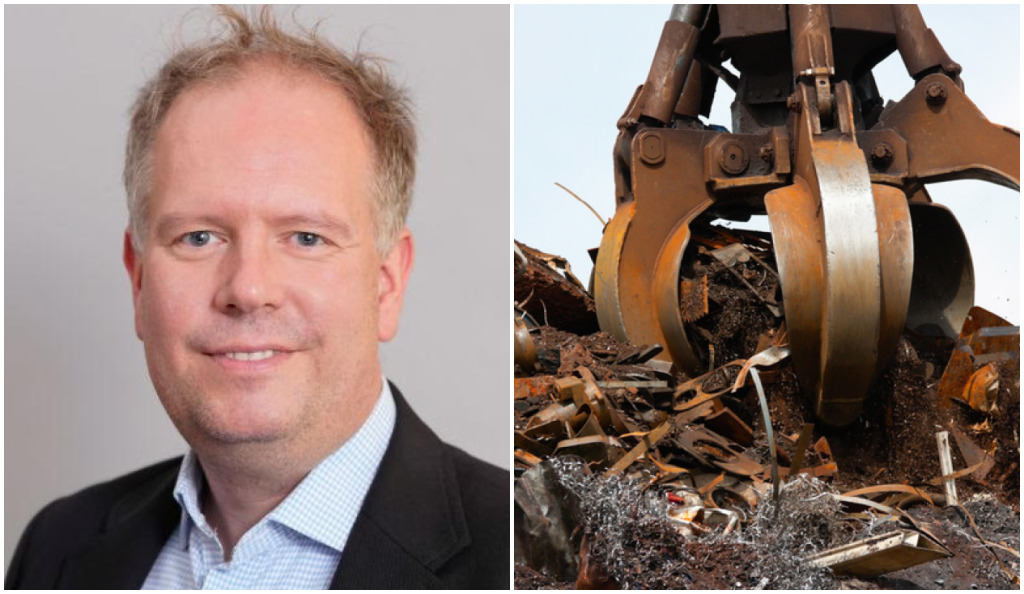
Last year, German steelworks reduced their scrap consumption by 5% year-on-year due to a decline in the country’s steel production. In the EU, this figure fell by 0.4%, a decline that was less pronounced than the drop in steel output. Sebastian Will, Deputy Chairman of the German Association for Secondary Raw Materials and Waste Management (BVSE), spoke to GMK Center in an interview about the current situation in the European market, the factors hindering its development, and what an effective circular economy should look like.
The BVSE and Recycling Europe regularly analyse the scrap market in the EU. How much has it changed over the last three years, and what key events have influenced this?
The scrap market in the EU is characterised by a decline in demand, driven by a steady reduction in steel production, which is relevant for both Europe and Germany.
In Germany, steel production in 2025 reached a historic low of 34.1 million tonnes. Since reunification, lower steel output has only been seen during the 2009 financial crisis.
Following 2021, which saw a ‘rebound effect’ after the COVID-19 crisis, we have observed an almost continuous decline in steel production volumes in the European Union. Last year, output also fell to a historic low of 125.9 million tonnes.
This points to an extremely difficult situation in the domestic market for the scrap sector. The trend is accompanied by a steady decline in industrial production, as well as a difficult economic situation since 2019; in other words, these are not the best of circumstances.
Although the circular economy in general, and the waste recycling sector in particular, have attracted attention, accelerating the debate on decarbonisation projects, there has been no corresponding increase in the use of scrap. The main political focus of the EU and Germany is on supporting and preserving major players using blast furnace and converter technology. So, we are seeing an increase in the share of electric arc furnace production in the German market, but as far as efforts to expand the use of secondary raw materials are concerned, nothing has changed.
In a recent market review, the BVSE described the past year as turbulent due to the uncertainty caused by both geopolitical factors and the state of the German economy. How quickly is the German market adapting to changing conditions — both domestic and external?
Experience shows that adaptation takes time, especially if the associated regulatory constraints are expanding rather than being simplified. The energy crisis caused by the conflict in the Middle East, and the associated rise in energy and logistics costs, can only be passed on to consumers gradually. At present, scrap processors have to cover these additional costs themselves, as well as the expenses associated with additional regulatory measures such as the WSR (Waste Shipment Regulation), DIWASS (Digital Waste Shipment System) and others.
Supply chains are disrupted by crises that are becoming increasingly frequent and occurring at ever shorter intervals. The economy has no time to recover. This applies to all sectors, but it is particularly hard on a system based on SMEs, as is the case in Germany.
We are witnessing fragmentation in the German scrap market. The pressure on economic actors is increasing significantly, particularly from consumers like, steelworks and foundries, which are pursuing an increasingly demand-oriented collection policy. This creates turbulence. Whilst one buyer ensures stable demand for scrap, another nearby buyer may face a significantly worse situation with orders.
The scrap market is becoming increasingly regional and differentiated. The harmony in the behaviour of scrap consumers that often prevailed in the past no longer exists. The ability of scrap processing companies to respond quickly to changes is becoming increasingly important.
What is the current situation regarding scrap consumption in Germany? Why did German steelworks reduce their consumption last year? According to 2025, the BVSE notes weak domestic demand for scrap. This is rather surprising, given that it is a key raw material for the green transition in the steel industry.
According to our estimates, scrap consumption by steelworks fell to around 12 million tonnes in 2025. This is closely linked to the situation regarding production volumes in the steel industry.
Scrap consumption by foundries fell sharply by 7.9% last year. Generally speaking, when the steel and foundry sectors are thriving, we have a reasonable volume structure that is workable.
There are also issues on the supply side. Unfortunately, an increasing number of enterprises are facing enormous difficulties, leading to an exodus in industrial production. In some cases, this concerns only processing operations that generate high-quality scrap, whilst in others, entire industrial enterprises are relocating.
So, are we talking about the threat of deindustrialisation in Europe, which industry associations are currently warning about?
Deindustrialisation is nothing more than a reaction to uncompetitive operating conditions. High energy costs, an ever-increasing bureaucratic burden, lengthy and complex permit procedures, the green transition and a circular economy that has not been fully thought through. This list of shortcomings could go on indefinitely.
One thing is certain: economic transformation takes time and proper regulation. First, new technologies need to be developed and implemented; then they must be scaled up to an industrial level. Politicians are not paying enough attention to systemic changes. This leads to subsidies becoming the go-to solution for a few large corporations. There is a lack of pragmatism when it comes to creating additional incentives. Instead, regulation is becoming increasingly inconsistent, and the European Union is losing its greatest potential: the single market and the free movement of goods and services especially for recycled metals.
How does the association assess the first quarter for the German scrap market, and what are the overall forecasts for the current year?
We are seeing a slight recovery compared with the historically low production levels of 2025. This was largely felt at the end of the first quarter, probably due to supply chain risks linked to the conflict in the Middle East. However, there is certainly no basis for sustained improvement or euphoria. We do not know whether new tensions and crises will arise globally, nor how existing ones might be resolved.
Economists are divided on the future course of the economy, yet they do not foresee any significant upturn. German experts express cautious optimism that a moderate recovery will not occur before 2027.
Last year, the share of steel produced in EAFs in Germany’s total steel output rose to 30.6%. Will this trend continue, and can we conclude that hydrogen-based projects are being put on hold, whilst the steel industry refocuses its attention on decarbonisation projects based on scrap and electric arc furnaces?
When interpreting the percentage of steel produced in EAFs, one must be careful not to draw hasty conclusions about trends. The increase in the share of electric arc furnace production is taking place against a backdrop of a decline in overall production volumes. This is undoubtedly linked to the current difficulties in the automotive industry, where the transition to new drive technologies has led to a decline in volumes. It is therefore too early to speak of a long-term trend towards electric steel.
Hydrogen remains a complex issue. The infrastructure for it still lags significantly behind. Even if we are able to import hydrogen from abroad or even produce it ourselves, it will be very difficult to deliver it to consumers, as there is no comprehensive supply system. This is impossible due to the economic challenges associated with transport.
Regardless of which form of decarbonisation we choose, the scrap-based approach is and remains the most environmentally friendly technology. It can be used to produce almost 100% of new steel. This is a prime example of a circular supply chain. As for other materials, we can only dream of such a scenario.
Recycling Europe has consistently criticised the «gliding scale» method for defining green steel, arguing that it increases the EU’s dependence on imported raw materials rather than encouraging the use of scrap. What is your view on this?
As the proportion of scrap in the steel production process increases, the CO2 emission limits under the ‘sliding scale’ method for classifying green steel gradually become stricter. In other words, if you produce steel from 100% scrap, the requirements for you are higher than for those who produce steel from ore. The ‘sliding scale’ method undermines the goal of creating closed-loop material cycles in the steel industry and creates perverse incentives that are diametrically opposed to the circular economy and decarbonisation strategies.
If we want to create an effective market mechanism, we must change this. In this context, BVSE, together with Recycling Europe, endorses the methodological approach developed by the Joint Research Centre (JRC) to determine the efficiency classes of five typical intermediate products in the steel industry. The chosen methodology has a number of significant advantages, as it encourages the circular economy and the use of recycled materials, is technology-neutral and genuinely promotes decarbonisation. It rightly recognises the carbon footprint as a decisive product parameter, applying a product-specific approach and avoiding factors that distort the results.
In July 2025, the European Commission introduced controls on the import and export of scrap. How do you assess these measures and how do they affect the sector?
It is good to see that attention is being paid to material flows. Sometimes I am shocked by how little decision-makers and politicians know about them and raw materials. To draw the right conclusions and take appropriate action, data-driven analysis of material flows is essential.
Scrap exports are a response to many market-influencing factors – an outlet for surplus volumes. When production volumes shrink, it is normal to export surplus scrap to maintain circularity. Otherwise, we would have to stop recycling. Export is therefore a necessity for circularity.
If we compare the circular economy to a ship, we can steer it, as in the days of Christopher Columbus, relying solely on the stars. We need modern, up-to-date tracking and navigation systems that give us an idea of our current position in the waste recycling sector. There were times when we had a solid data framework, but this was stifled in the wake of compliance and data protection regulations.
How important is free trade for the scrap sector, and how is it affected by EU safeguard measures (CBAM, new quotas, etc.)?
A thriving steel industry is essential for the effective processing of metal scrap. We operate in a context of tension between the high-performing European and domestic steel industries, but at the same time we need an export market to sell scrap there when the domestic market is congested.
The free movement of goods ensures the continous functioning of the scrap recycling sector., Particularly during periods of declining domestic demand. The export market is avital valve for our sector, as it allows us to sell the volumes of product that are not purchased on the domestic market, thus keeping processing levels high and steady and cost under control.
Open markets promote innovation through competition and specialization, lower production costs, and create jobs. Our economic systems are designed for global trade. Free trade is the central driver of global prosperity and economic growth.
Is there enough scrap in the EU? How do you assess the market’s capacity and potential? Will the EU be able to restructure its steel industry, focusing primarily on this raw material?
Recent studies show that there are sufficient scrap reserves, so we do not expect a shortage either now or in the future. Researchers at the University of Jena (EAH Jena), led by Professor Pothen, forecast moderate annual growth in household scrap volumes of around 1.6% until 2050.
Technological transformation in the steel industry will lead to changed demand for scrap. I am certain, that like in the past decades the European recyclers will be able to cover any demand our buyers issue. Our industry is versatile, flexible and loyal. We adjust quickly to any market circumstances and adopt new technologies and circumstances. This has enabled the european recyclers to survive in a highly competitive and increasingly capex intensive sector for more than a 100 years. We intend to do so in the future.
If imbalances arise in the scrap market regarding specific grades of scrap, the market in principle has sufficient regulatory mechanisms to correct them. Intervention in the market should always be a last resort, as we must first and foremost trust in its self-regulatory mechanisms.

-
13 July 2026

08 June 2026

04 May 2026
15 April 2026