




Infographics macroeconomics 2020 17 February 2026
Ukraine needs new drivers of growth, which can only be found in the industrial sector
The overall economic situation last year was difficult due to constant systematic shelling of all types of critical infrastructure. Ukraine was effectively left without drivers of growth – the main factor supporting the economy was external financing, which amounted to $52.4 billion last year.
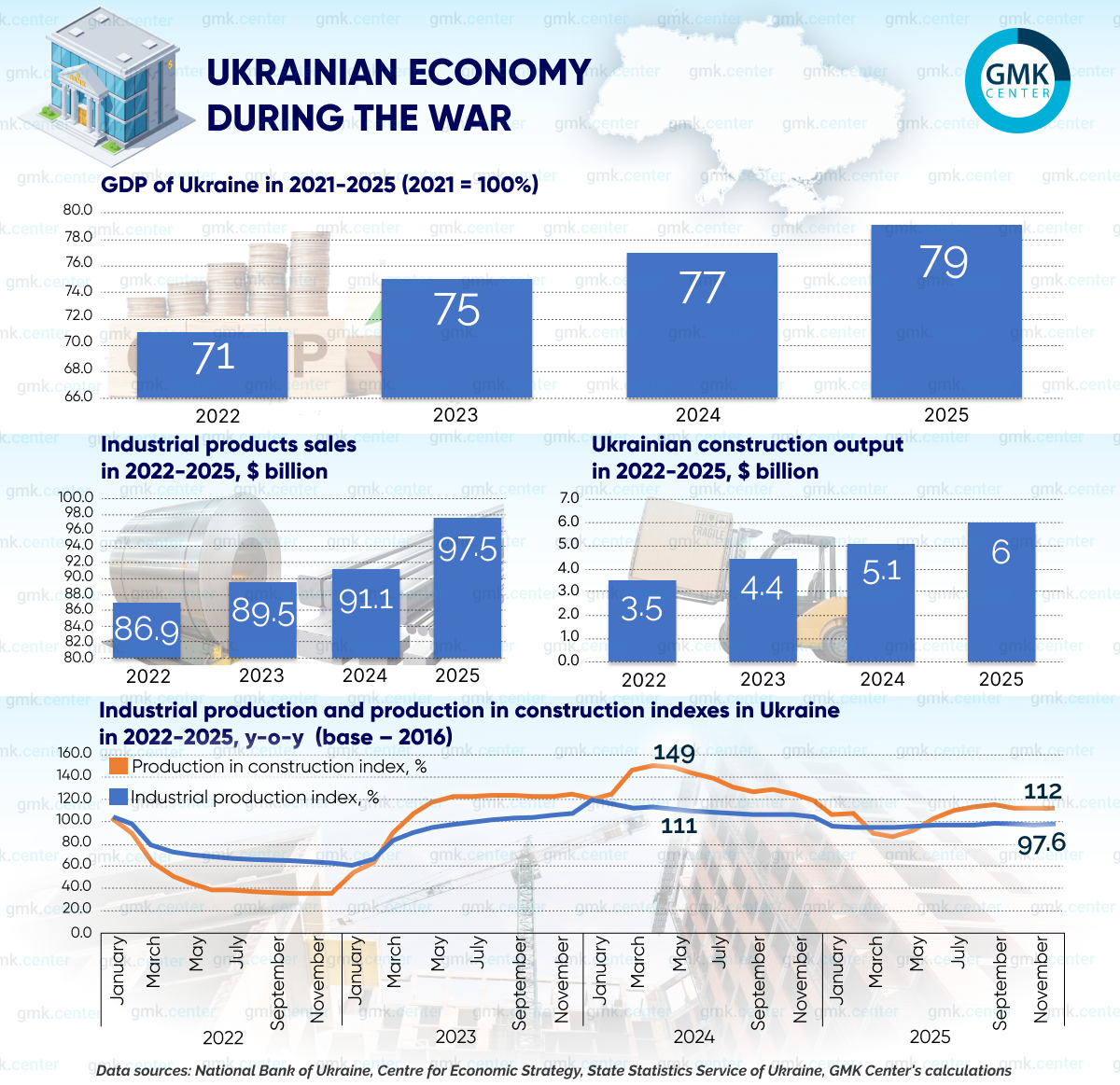
By the end of 2025, real GDP had recovered to 79% of its 2021 level. Achieving pre-war levels of real GDP in wartime seems an almost impossible task. At the same time, according to preliminary estimates, Ukraine’s nominal GDP in dollar terms in 2025 amounted to about $207 billion, exceeding the pre-war value of 2021 ($200 billion).
A number of important macroeconomic indicators are already showing negative dynamics. Industrial production in Ukraine fell by 2.4% y/y last year, while in 2024 it grew by 3.6% y/y. At the same time, there was growth in defense, pharmaceutical, and steel production.
The dynamics of industrial production can be roughly illustrated by the volume of industrial sales. In 2025, this indicator grew by 7% y/y to $97.5 billion, which is 26% less than in pre-war 2021 ($131.5 billion).
At the same time, the volume of construction work performed in Ukraine last year increased by 12% y/y to UAH 248 billion. Growth in 2024 amounted to 15.5% y/y. According to GMK Center estimates, the volume of the construction market in dollar terms in 2025 increased by 18% y/y to $6 billion. However, this is 35% less than in 2021 ($9.3 billion).
Important: calculations in US dollars do not take into account dollar inflation, which amounted to approximately 19% in 2022–2025. Therefore, a significant increase in one or another Ukrainian indicator expressed in US dollars will actually turn out to be a modest increase when inflation is taken into account.
The dynamics of individual economic indicators in the fourth year of the war were mixed: for example, construction was more active than industrial production. The industrial production index in Ukraine (base – 2016) was 102.1% in December 2021, compared to 97.6% in December last year. The construction output index (base – 2016) for the same period was 112% and 106.8%, respectively.
Significant constraints to economic recovery in 2026 remain:
- Continued active hostilities. The area of shelling of Ukrainian territory is constantly expanding, and its intensity is increasing.
- Lack of electricity. In January, enterprises in key sectors of the economy were forced to suspend operations. According to NBU estimates, the growing electricity deficit could lead to a loss of 0.4 percentage points of GDP growth in 2026. If systematic shelling of energy infrastructure continues throughout the year (not only in winter), the damage to the economy will be significantly greater.
- High prices and tariffs of state monopolies on electricity and gas. Due to expensive imports and rising domestic tariffs, the cost of energy resources for industrial consumers in Ukraine in 2025 was higher than in Europe.
- The labor shortage is a major obstacle to doing business, approaching the significance of military risks. There are no prospects for solving this problem in the foreseeable future.
- Impact of CBAM. Ukraine did not receive a temporary exemption from CBAM, which will negatively affect exports in the iron and steel cement, and a number of other industries.
- Restrictions on maritime logistics. Due to the electricity shortage and the consequences of shelling of port infrastructure, physical volumes of maritime exports have already fallen by 25–35%. A further deepening of the energy crisis and/or intensification of shelling of ports could lead to even more serious consequences for the export logistics of the agro-industrial complex and iron and steel industries.
Under the current conditions, Ukraine can demonstrate minimal economic growth at best. Ukraine needs new drivers of development, which can only be formed in various industries. Focusing on industry will allow Ukraine to increase domestic production, significantly enhance the potential of its own economy, and increase budget revenues.
-

Opinions Industry steel consumption
13 July 2026

22 July 2026

20 July 2026

06 July 2026