




Infographics rail transportation 433 29 April 2026
The iron and manganese ore shipments fell by 45%, while that of ferrous steel fell by 55%
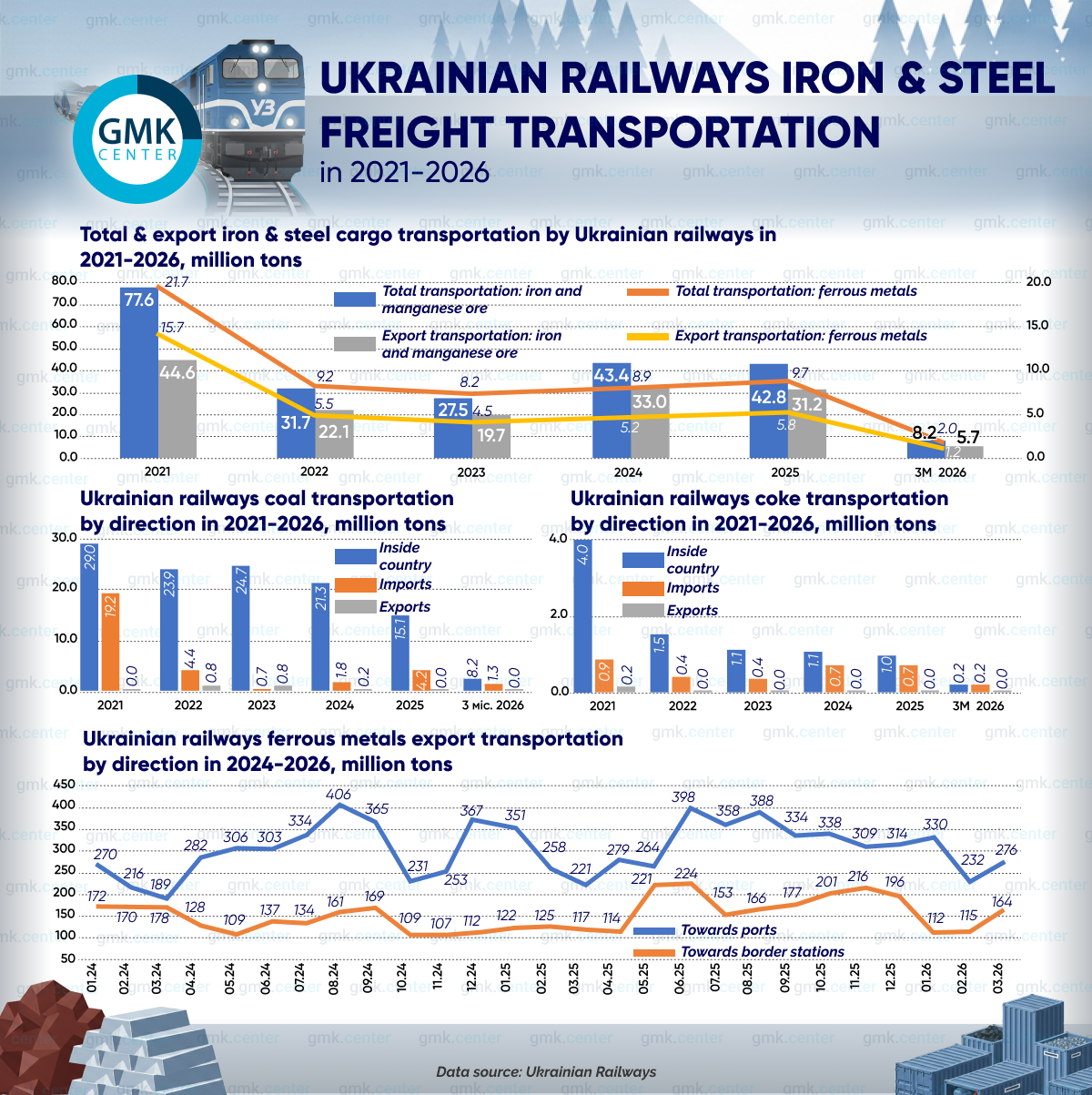
Cargo from the iron and steel sector (iron ore, ferrous metals, coal, coke, and limestone for fluxing) accounts for an average of 47% of Ukrzaliznytsia’s total freight volume. The total volume of iron and steel sector freight in 2025 decreased by 53% compared to 2021—from 163.3 million tons to 76.8 million tons.
Over the past year, the volume of iron and steel sector freight fell by 4.6% year-on-year, or by 3.7 million tons, to 76.5 million tons. In January–March 2026, the figure decreased by 14.7% year-on-year, or by 2.6 million tons, to 15.3 million tons. The main factor was a sharp drop in iron ore exports by 2.6 million tons (-31% year-on-year).
The dynamics of transportation of products and raw materials for the iron and steel sector were as follows:
- Iron and manganese ore. Total freight volume in 2025 decreased by 45% compared to 2021—from 77.6 million tons to 42.8 million tons. Export shipments fell by 30% – to 31.2 million tons. As of the first quarter of this year, total freight volume decreased by 24,2% year-on-year to 8.2 million tons due to a decline in exports.
- Ferrous steel. Total freight volume last year fell by 55% compared to pre-war 2021 — to 9.7 million tons from 21.7 million tons. Export shipments decreased by 63% – to 5.8 million tons. In January–March of this year, the total volume increased by 6,5% year-on-year, or by 121,300 tons, to 2 million tons. This growth was recorded across all categories: exports (65,300 tons), transit (43,800 tons), and domestic shipments (17,000 tons).
- Bituminous coal. The total volume of shipments in 2025 decreased by 62% – to 19.3 million tons compared to 2021. At the end of the first quarter, the figure decreased by 4.2% year-on-year, or by 178,000 tons, to 4 million tons.
- Coke. Total shipments last year fell by 66% compared to 2021, to 1.7 million tons. At the same time, import shipments for the same period decreased by only 16%, to 726,000 tons. Due to the loss of coking coal mines, Ukrainian steelmakers are forced to import this raw material and coke directly. In January–March of this year, the figure decreased by 2,3% year-on-year – to 0.4 million tons.
- Limestone. Total shipments in 2025 fell by 67% compared to 2021, to 2.9 million tons. In the first quarter of 2026, the figure rose by 12% year-on-year (60,000 tons).
The main departure points for ferrous steel in the first quarter were the Zaporizhzhia-Liva station, which, with a volume of 790,000 tons, was nearly twice that of its closest competitors. Other major industrial hubs included Kamianske (423,000 tons) and Kryvyi Rih (380,000 tons).
The main destinations were export routes—the Odessa-Port station (511,000 tons) and Berehove (226,000 tons). There is also active use of western railway crossings, such as Mostyska II (148,000 tons) and Izov (99,000 tons) toward Poland. The Port of Izmail—96,000 tons—remains a key hub for Danube routes.
In the first quarter’s transport mix, the largest shares were held by: cast iron—24%, steel billets—19%, rails—6%, pipes and ferroalloys—1% each. Other types of rolled steel products account for the bulk of shipments (49%).
The trend in ferrous metal exports shows a shift following the launch of the maritime corridor in August 2023, which enabled the resumption of ferrous steel exports from Black Sea ports. While in 2023 the share of export shipments to western border crossings reached 62%, by the end of 2025 it stood at only 35%. Accordingly, port transshipment of ferrous steel last year accounted for 65% of exports.
Ukrzaliznytsia currently operates 15 railway border crossings: 4 with Poland, 2 each with Slovakia and Hungary, and 4 and 3 with Moldova and Romania, respectively. The crossings are operating at 35–45% of their capacity, which allows for a twofold increase in cargo volumes if necessary.
-

Opinions Industry steel consumption
13 July 2026

20 July 2026

06 July 2026

01 July 2026