
Posts Industry anti-dumping measures 48 15 June 2026
Between 2022 and 2025, 131,000 tonnes of pipes were imported into Ukraine from Turkey, with the annual import volume increasing two to threefold
Turkey is an important geopolitical and economic partner for Ukraine: a mediator in negotiations, a major export market, and a supplier of essential goods and materials. At the same time, Turkey is also a conduit for Russian economic aggression in the Ukrainian market. Turkish manufacturers are processing large quantities of cheap Russian slabs — raw materials that bypass sanctions — and supplying finished pipe products to Ukraine at prices with which domestic plants simply cannot compete. The GMK Center investigated what can be done in such circumstances.
The scale of the problem
Since the start of the full-scale invasion, the annual volume of Turkish pipe imports into the Ukrainian market has increased two to threefold. In total, 131,000 tonnes of pipes were supplied to Ukraine from Turkey between 2022 and 2025. This import volume is effectively equivalent to the production output of a single average Ukrainian pipe mill.
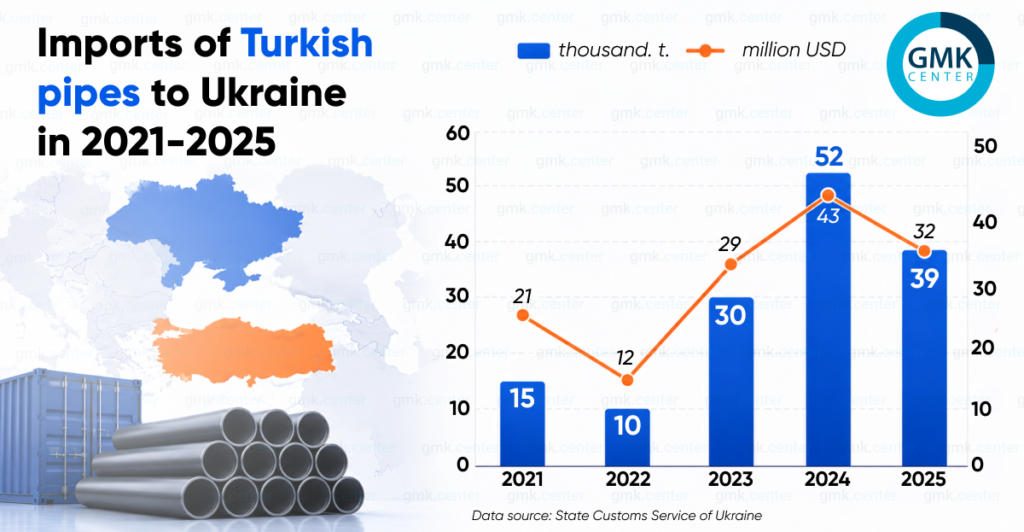
According to Ukrainian producers, between 2021 and the first quarter of 2025, imports of welded steel pipes from Turkey to Ukraine rose by more than 400%, compared with domestic consumption and production of similar products, which increased by 348% and 692% respectively. At the same time, the average prices of these imports were lower than the cost price of similar products from domestic manufacturers.
It is worth noting that pipe imports into Ukraine are one element of Turkey’s steel expansion into the Ukrainian market. In 2021, the share of Turkish metal product imports in the Ukrainian market stood at 17% and 14% of the total volume in physical and monetary terms, respectively. By 2025, these figures had reached 48% and 33% respectively.
The factor of price attractiveness
Ukrainian consumers purchase Turkish pipes due to their price attractiveness. This, in turn, is determined by supplies of slabs from the Russian Federation to Turkey at prices below market levels. In this case, slabs serve as raw material (feedstock) for the production of pipe products, sheet and coil rolled products.
Since the start of the full-scale aggression, Russia has supplied 7.4 million tonnes of slabs to Turkey. According to TUIK data, in 2025 Russia became the main source of supplies, with a volume of 2.1 million tonnes, which is 22% more than the previous year. The share of Russian slabs on the Turkish market rose to 52% by the end of last year, up from 42% in 2024.
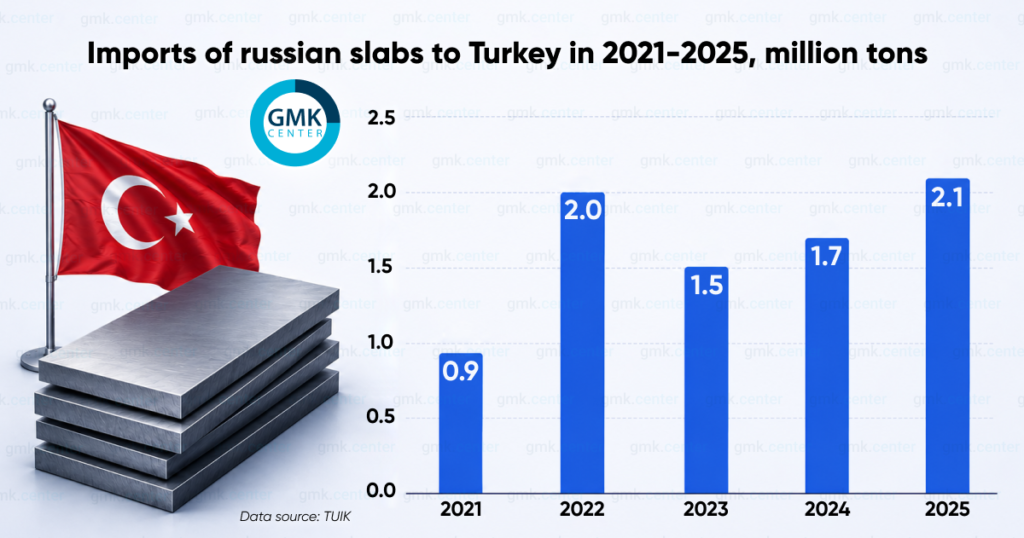
In effect, cheap Russian semi-finished products are subsidising Turkish exports. According to Serhiy Povazhnyuk, deputy director of the state-owned enterprise Ukrpromzovnishchexpertiza, in the production of hot-rolled coils (HRC), for example, the cost of slabs accounts for 85% of the total production cost. Therefore, if Russian slabs are purchased at 20% below market price, the cost price of the finished coil will decrease by 12–15%.
The availability of cheap billets narrows the gap between HRC and pipe products. For instance, the difference between HRC and pipe in Turkey fell to $31/t in 2026 from $51/t in 2024. These figures are several times lower than the production cost of welded pipes in Ukraine.
Consequences for domestic producers
A wide range of steel products from Turkey flooded into Ukraine after the war began. Whilst in 2022 this import flow could still be viewed as a substitute for the local shortage that arose in the first months of the war, it subsequently began to pose a threat to domestic producers.
As for imports of Turkish pipes into the Ukrainian market, their volume was extremely low until 2022. The situation changed after Turkey introduced quotas and duties on pipe products manufactured from coiled steel of Russian and other origins, thereby protecting its domestic market. As a result of these protective measures, Turkish pipe manufacturers shifted their focus to exports, including to Ukraine.
‘The rise in imports of Turkish pipes in 2023–2024 has significantly exacerbated the situation at our company. Against the backdrop of the war, the domestic market had already contracted, and imports have further reduced domestic production and sales volumes. According to our estimates, Turkish imports account for 10–15% of the entire Ukrainian pipe market. This directly worsens the plant’s financial position: it has a negative impact on job security, wage payments and the production process as a whole. At the same time, the expansion of pipe products from Turkey is having an extremely negative impact on the entire Ukrainian pipe sector, not just our company,” said DMZ Kominmet, a producer of welded pipes, in a comment to GMK Center.
Imports of welded pipes and other Turkish metal products after 2023 have led to a deterioration in the performance indicators of domestic manufacturers: production volumes, domestic sales, and capacity utilisation. All this automatically reduces tax revenues, jobs, and support for local communities, as a significant number of pipe manufacturers are key employers in their towns.
Ukrainian pipe manufacturers operate in conditions where every cost factor works against them: expensive electricity and its constant shortage for industrial consumers, the impact of the SWAM, staff shortages, the risks of operating in frontline regions, and so on. Under such conditions, the pressure from cheap Turkish imports is an additional factor threatening the operations of these enterprises.
The difference in production costs is structural, so it cannot be overcome by market mechanisms. Without anti-dumping duties and a ban on products made from Russian raw materials, Ukrainian manufacturers are doomed to be squeezed out of their market, regardless of their efficiency or the quality of their products.
What needs to be done
The first step towards restricting imports of Turkish pipes into Ukraine has already been taken. At the end of January, the Interdepartmental Commission on International Trade (ICIT) decided to launch an anti-dumping investigation following a complaint from Ukrainian producers (DMZ Kominmet, Trubostal, Metinvest-SMZ, Zaporizhstal, etc.). The IITC established that the complaint contained sufficient substantiated evidence that imports into Ukraine of steel welded pipes from Turkey were being made at dumped prices, and therefore the level of the dumping margin cannot be considered minimal, nor the import volumes insignificant.
“Anti-dumping duties remain the most accessible and practically applicable mechanism for protecting the domestic market, as alternative instruments (such as anti-subsidy investigations) are complicated due to the complexity of the evidence base and lengthy procedures. To ensure the effectiveness of the measures, the Ministry of Economy should promptly impose provisional anti-dumping duties at the initial stage of the investigation upon the detection of the first signs of abuse,” said Oleksandr Kalenkov, President of the Ukrmetallurgprom Public Organisation, in a comment to GMK Center.
Anti-dumping duties on Turkish pipes must be introduced as soon as possible, particularly given the reduction in quotas for Turkish products to the EU from 1 July, as these exports may be redirected to Ukraine. It is important to note that anti-dumping investigations are already underway into imports to Ukraine of rebar, wire rod and coated rolled steel from Turkey.
“In wartime, spending foreign currency on imports of goods whose domestic production is well established is economically unwise. Such imports must be restricted by law — by analogy with the ‘critical imports’ mechanism that was in place in 2022. The state must support domestic producers, drawing on the successful experience of European countries: through the introduction of anti-dumping duties or import quotas,” DMZ Kominmet notes.
Against the backdrop of dumped imports, it is also necessary to introduce a ban on imports of products manufactured from Russian raw materials. Such a ban is fully in line with the European ‘melt and pour’ practice, which has been successfully in place in the EU since September 2023.
“The situation in which Russian raw materials enter the Ukrainian market in the form of Turkish products is unacceptable for economic and moral-ethical reasons. Furthermore, this measure will enable domestic regulations to be brought into line with EU standards, which take a more consistent stance on this issue,” emphasises the president of the Ukrmetallurgprom Association.
However, this control mechanism (similar to the European one) will not be a panacea, as Turkish manufacturers may redirect products containing Russian metal to other markets and export pipes to Ukraine without using it.
In the near future, Ukrmetallurgprom plans to appeal again to the Ministry of Economy and will insist on the introduction of a mechanism to control the origin of metal products at Ukraine’s border, following the example of EU practice.
In wartime, protecting the domestic market is effectively tantamount to supporting defence capabilities, as it is domestic manufacturers who pay taxes and form the ‘economic rear’. Without the latter, victory in the war is impossible.