




Infographics China 1658 24 December 2025
The growing role of semi-finished products and the redistribution of supply routes are becoming the main trends in Chinese steel exports
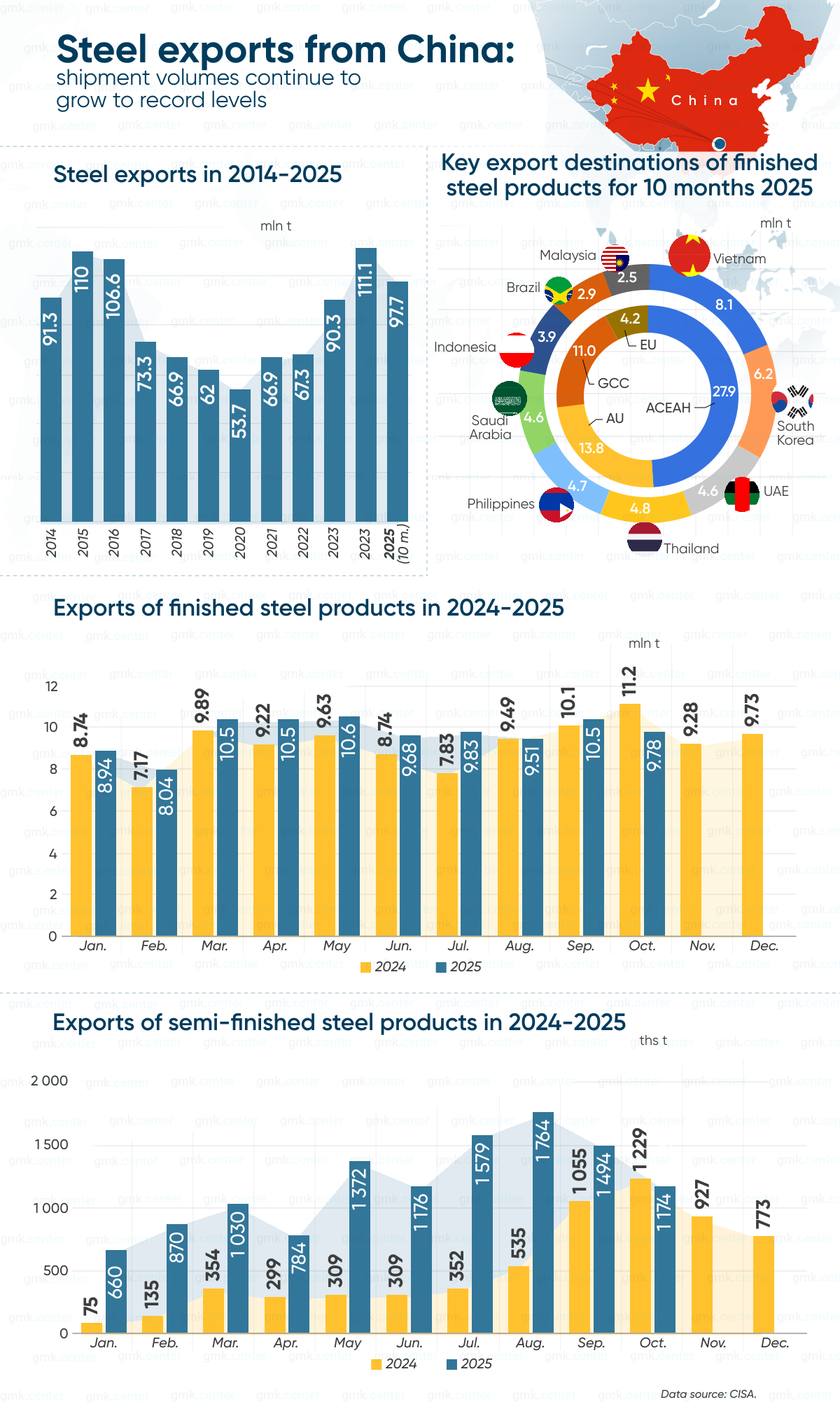
Steel exports from China in 2025 are likely to break the record again, reaching more than 115 million tons. In 2024, these volumes reached 111.1 million tons (+23.1% y/y) – the highest level in history. 2026 could be a turning point for Chinese exporters due to a combination of domestic regulatory changes and the transformation of the structure and geography of external supplies.
During January-October 2025, Chinese steel enterprises exported 97.7 million tons of steel, which is 6.2% more than in the same period of 2024. According to market data, shipments exceeded 10 million tons in November, with exports reaching nearly 107 million tons in 11 months. Assuming that the average monthly level in December remains at around 9.8 million tons, the annual figure could reach 117.3 million tons.
The structure of exports is changing more and more noticeably. Deliveries of finished steel products in the first 10 months of 2025 increased by 6.2% y/y to 97.74 million tons. The main driver of overall growth was the semi-finished products segment. Their exports in January-October increased 2.6 times y/y, to 11.9 million tons. For comparison: in 2024, China shipped 6.3 million tons of semi-finished products, and in 2023, only 3.3 million tons.
There are several interrelated reasons for the sharp increase in exports of slabs and billets. Anti-dumping and safeguard measures against finished rolled products from China are covering an increasingly wider range of countries. In 2024–2025, new or expanded investigations and duties were introduced in Southeast Asia, the Middle East, Latin America, and Europe. In many jurisdictions, semi-finished products are either not subject to such measures at all or are subject to significantly milder restrictions.
Exporting semi-finished products allows Chinese manufacturers to reduce trade risks and transfer part of their margin and carbon footprint to the next stage of processing. This is particularly important in light of the CBAM’s current implementation and future full-scale launch in the EU. Although the mechanism already applies to semi-finished products, the actual financial pressure on them is still lower than on finished products with high added value. Exporting semi-finished products is becoming a relatively safer channel for China to maintain its presence in foreign markets.
Weak domestic demand for steel in China, particularly from the construction and infrastructure sectors, is forcing steel mills to maintain capacity utilization through exports. The sale of semi-finished products makes it possible to quickly free up volumes without the need to aggressively dump finished products, which increases the risk of trade conflicts.
Among the main markets for Chinese steel in January-October 2025 are ASEAN countries – 27.95 million tons (-1% y/y), the African Union – 13.78 million tons, the Persian Gulf countries – 11.01 million tons (+12.1% y/y), and the European Union – 4.18 million tons (+25.1% y/y).
Despite preparations for the introduction of CBAM and the overall tightening of EU trade policy, Chinese steel exports to the bloc continue to grow at double-digit rates.
The main change for the industry will be the introduction of mandatory licensing for exports of certain types of steel products from China starting in 2026. Although this mechanism is officially declared as a tool for monitoring and regulating trade, in reality it will mean tighter state control over volumes, nomenclature, and directions of supply.
This will have several consequences for the market. The role of administrative regulation will grow, affecting not so much the total volumes as the range of products and priority export destinations. Competition for licenses may stimulate consolidation among exporters and give an advantage to large state-owned and semi-state-owned groups.
The export structure may change again: some manufacturers will try to optimize their supply portfolio by the end of 2025, while in 2026 the focus will increasingly shift to semi-finished products, as well as to more marginal or strategically important markets.
Combined with the expansion of anti-dumping measures around the world and the full financial launch of CBAM in the EU, this creates conditions under which Chinese steel exports in 2026 will increasingly transform in terms of product structure and supply geography. China is already making more active use of semi-finished product exports as a tool for adapting to the new global trade reality, seeking to maintain its presence in foreign markets in the face of growing barriers.
-

Opinions Industry steel consumption
13 July 2026
20 July 2026

06 July 2026
01 July 2026