




Infographics electricity prices 2479 06 October 2025
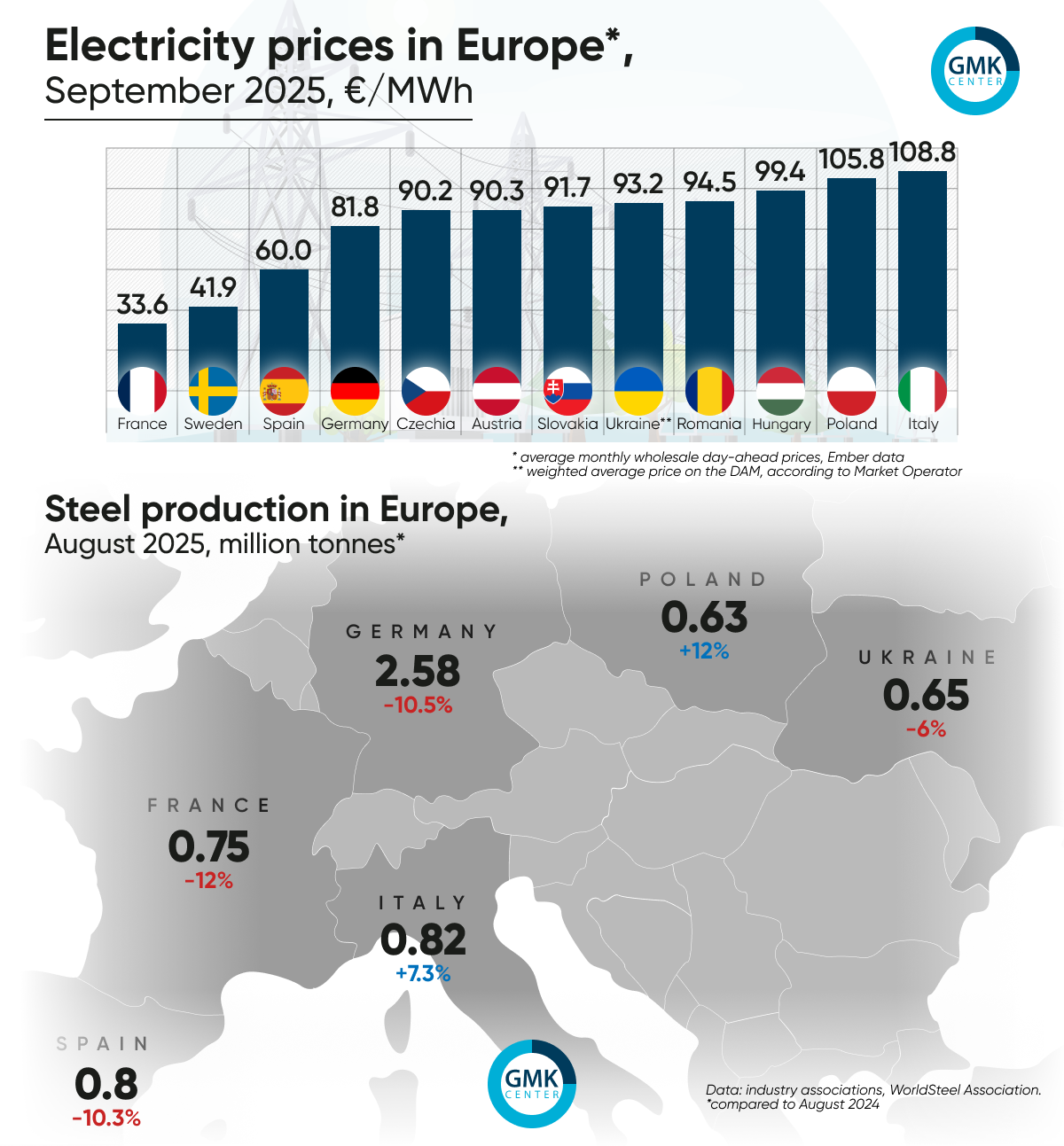
The weighted average price for day-ahead trading in Ukraine last month was €93.2/MWh
In the EU, average monthly wholesale prices for day-ahead trading in September showed mixed dynamics.
Trends in Europe
According to Ember (as of October 2, 2025), this price on European markets, in particular, was:
- Italy – €108.83/MWh (-10.4% month-on-month);
- France – €33.65/MWh (-37.9%);
- Germany – €81.84/MWh (+5.2%);
- Spain – €60/MWh (-12%);
- Sweden – €41.93/MWh (-0.9%).
Last month, the average monthly wholesale price for day-ahead electricity in Poland was €105.77/MWh, in Slovakia – €91.67/MWh, and in Hungary – €99.45/MWh. In all these countries, it increased compared to August.
Last month, electricity prices in Europe, according to AleaSoft, fluctuated depending on the volume of generation from renewable sources, growth in demand amid changing weather conditions, changes in gas prices, and carbon emissions.
In particular, in Germany on September 8, the cost of electricity rose to its highest level since February amid forecasts of a sharp drop in wind power generation. The day-ahead price rose to €142.45/MWh on that day, and from 7 p.m. to 8 p.m., it traded at around €400/MWh.
Overall, prices on most major European markets rose in the third quarter of 2025, exceeding €65/MWh. This was caused by increased demand and a decrease in wind power generation compared to April-June, as well as rising CO₂ emission prices.
Situation in Ukraine
In September of this year, the weighted average price of electricity trading on the DAM in Ukraine, according to the Market Operator, fell by 16.6% month-on-month to UAH 4,521.85/MWh (€93.3/MWh at the average monthly hryvnia-to-euro exchange rate).
Demand on the DAM last month fell by 17.05% compared to August, while supply decreased by 15.39%.
According to preliminary monitoring data from ExPro Electricity, Ukraine reduced its electricity imports by 47% month-on-month in September to almost 140,000 MWh. Compared to September 2024, this figure decreased by almost 70%. Hungary continues to account for the largest share of imports (58%).
Electricity exports from the country in September increased by 41% month-on-month to 635,000 MWh. Hungary also accounts for the largest share of exports (40%).
In Ukraine, following the results of trading on the DAM on the Market Operator platform, there has been a sharp drop in electricity prices since September 1. In particular, as of September 5, the BASE base load price index on the DAM was 3,084.83 UAH/MWh. MWh, with an average value of 3,328.02 UAH/MWh since the beginning of September. This is 36% less than in August, according to Interfax-Ukraine.
On September 10, the regulator, the National Energy and Utilities Regulatory Commission (NEURC), announced that it was conducting a preliminary investigation into possible abuses in the wholesale energy market in August-September. However, experts explain the situation in early September by entirely natural causes: a decrease in overall demand and an increase in supply after the completion of repairs to generating facilities.
In late September and early October, Russia intensified its attacks on Ukraine’s energy infrastructure, leading to power outages for consumers. Ukrainian gas transportation infrastructure facilities were also targeted.
Gas storage capacity
According to the AGSI platform, as of October 1, 2025, European gas storage facilities were 82.57% full (on the same date in 2024, the figure was 94.31%). However, stock levels vary from country to country.
The futures price of the Dutch TTF (November contract) in September, according to the ICE exchange, was in the range of €31-33/MWh.
The EU is starting the heating season with higher gas reserves than expected, and markets are calmer at the moment, Bloomberg notes. However, traders are waiting to see if price volatility will return in 2026 in the event of a cold winter.
The agency forecasts that, barring any sudden disruptions, Europe will end this heating season with gas storage facilities filled to around 33% of capacity, well below the five-year average of 45%. In cold weather, they could fall to 22%.
A severe winter in Europe or Asia and the geopolitical situation could affect supply reductions. Prices and withdrawal rates will also be influenced by the situation in the wind energy sector if gas needs to be used for electricity generation.
Germany’s Commerzbank notes that nervousness on the European gas market could quickly rise again amid the announcement of new repairs at Norway’s Troll Gas and Germany’s lag in filling gas storage facilities, provided that temperatures drop. In addition, a gradual recovery in industrial activity could lead to an increase in gas consumption. The financial institution expects gas prices to rise to €40/MWh in the coming months.
On September 19, the European Commission proposed the 19th package of sanctions against Russia. It includes a ban on imports of Russian LNG (according to the EC, it continues to be supplied to Belgium, the Netherlands, France, Spain, and Portugal). If the package is approved, it will accelerate the cessation of Russian LNG supplies to the bloc by a year (until January 1, 2027).
-

15 June 2026

22 June 2026

18 June 2026

17 June 2026