




Posts Green steel green steel 1971 09 September 2025
Decarbonization of the industry is receiving strong financial support from the government
The peculiarity of the Japanese approach to the green transformation of metallurgy lies in the understanding of one simple truth. It is not a “headache” of the companies themselves. It is a national task. Hence the unprecedented tax incentives for market participants. Even in spite of their own huge financial capacity.
EAF-transition and government policy
Japan is the third largest steel producer in the world. At the same time, approximately one-third of production is exported. Therefore, the contribution of local companies to the decarbonization of the global industry is highly valued.
The Japanese steel industry today is primarily 24 blast furnaces in 12 cities with a total capacity of 83 million tons. The capacity of electric steel furnaces is considerably inferior, with 37 million tons. Thus, the BF-BOF process route prevails over NG-EAF-scrap based.
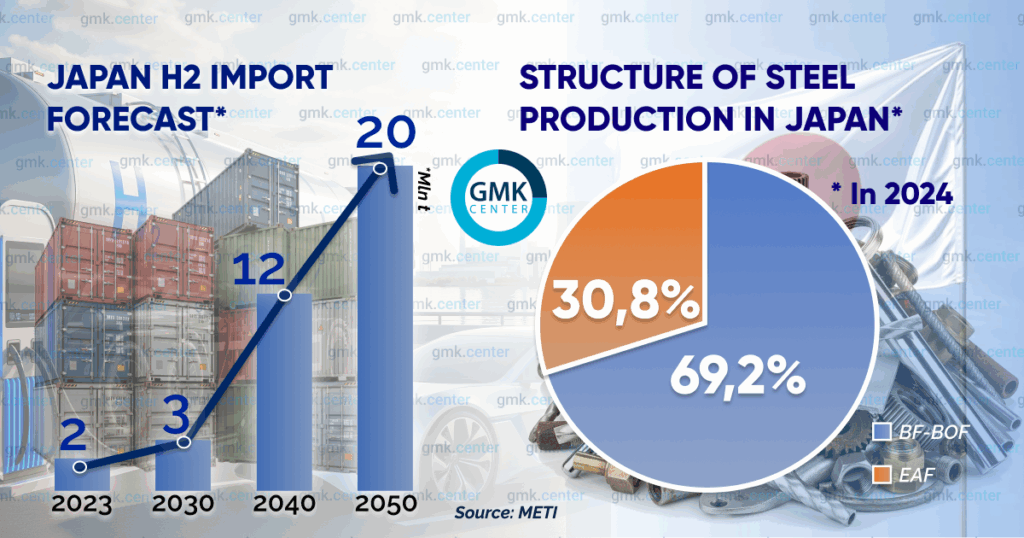
In this regard, metallurgy accounts for about 40% of Japanese industry’s CO2 emissions. Even though blast furnace production in Japan is considered to be the most energy efficient in the world. A vivid illustration of the fact that the possibilities of the best available technologies (BAT) have their limits. And they are not an exhaustive answer to the challenges of green transformation, requiring more radical solutions. First of all, transition to new steelmaking technologies.
Therefore, unlike most countries, it is not BAT that serves as the main driver of the transition period in the Japanese steel industry. The transition period will last until 2030 and provides for a 30% reduction in CO2 emissions by the base year of 2013, when they reached 200 million tons. The main effect will come from the development of electric steelmaking.
The largest local player, Nippon Steel Corp. in June 2025 announced investment of $6.05 bln in the construction of EAF at Kyushu Works, as well as in the expansion and reconstruction of 2 existing EAFs. The facilities are scheduled to be commissioned in FY 2029 (ending March 31, 2030), with a total capacity of 2.9 million tons of steel per year.
Second-largest producer JFE Steel Corp. announced in April 2025 the construction of a 2 million tpa EAF at West Japan Works in Kurashiki. Costing $2.2 billion, the facility is scheduled for commercial launch in Q1 2028 FY.
It is important to emphasize the high share of state participation in these projects. For Nippon Steel – $1.75 bln, for JFE Steel – $690 mln. Financing will be provided under the GX Green Transformation Promotion Act.
But no, the government will not spend Japanese taxpayers’ money on the EAF. The funds are being allocated in the form of tax credits. For every ton of green steel produced at the new facilities, companies will receive $149 in tax credits. Subject to a number of conditions:
- Transition from BF-BOF to EAF;
- Production of electric steel with a quality no worse than previously under the blast furnace-converter method;
- Cost of investment projects not less than $81 million, capacity of new EAF not less than 200 thousand tons per year;
Obviously, any even not the largest company easily fulfills these criteria within the framework of green transformation. The Japanese media called this initiative a «rather generous offer» by the government. And one can agree with them. However, there are also skeptics who are still undecided.
Kobe Steel Ltd., the third-largest steelmaker, announced in May 2025 that it will sequester its decarbonization investment budget for 2024-2026 from $2.09 billion to $1.05 billion. The company explained that the board made the decision amid concerns from shareholders. They believe that the impact of green transformation and related costs on the competitiveness of future products has not been sufficiently studied.
At the same time, Kobe Steel emphasized its commitment to its previous goal of reducing CO2 emissions by 30% by 2030. But so far, it is the only major player that has not embarked on an EAF transition. The company is still evaluating the possibility of building a new electric furnace to replace the blast furnace at Kakogawa. The project is planned to start after 2030.
In the meantime, Kobe Steel’s efforts are focused on increasing the share of scrap in iron smelting feedstock, utilizing biomass for power generation (e/e), and further improving energy efficiency. I.e. on BAT. Which, as noted, are unlikely to achieve a 30% reduction in greenhouse gas emissions.
Interestingly, the most ambitious targets are set by Tokyo Steel, the largest producer of electric steel. Its emissions are already lower than those of the above companies, about 1.7 tons per 1 ton of finished steel. Including Scope 1 for HRC – 0.683 tons, for HRP – 0.622 tons. Nevertheless, Tokyo Steel intends to reduce greenhouse gas emissions by 40% by 2030 compared to 2013. It is planned to achieve this by increasing the use of renewable energy sources to 40%.
By the way, Tokyo Steel and other electric steelmaking companies have been disadvantaged by the GX Leadership Act, which prioritizes government purchases of environmentally friendly steel. It refers to another document that defines «balanced steel,» i.e., «low-emission products» produced in the traditional BF-BOF process. And there is no mention of EAF steel.
It is clear that Japanese officials primarily wanted to provide incentives to decarbonize BF-BOF capacity, which produces the highest emissions and requires huge investments. But this discriminates against companies already producing green steel at no additional cost.
Similarly with the previously passed law on the promotion of green procurement. It also does not explicitly mention electric steel. But it talks about «balanced steel». Discussions on an appropriate amendment to this document are ongoing.
An important incentive that could accelerate the EAF transition would be the introduction of a greenhouse gas emission fee. The CO2 emissions trading market should be operational from 2026. The details of Japan’s EAF are still under consultation and have not been formally approved.
Japanese nuances
An important feature of Japanese steel decarbonization is the close cooperation of market participants. Unlike, for example, South Korea, where everyone goes their own way in developing technological solutions.
In 2022, Nippon Steel, JFE Steel and Kobe Steel together with the Japan Metals Research and Development Center formed the Hydrogen Steelmaking Consortium. The Consortium, supported by the NEDO Green Innovation Fund, has launched the Super Course50 project. Its goal is to reduce CO2 emissions in blast furnace production by 50% by using heated external H2 together with coke.
As part of Super Course50, a small pilot blast furnace has been built at JFE Steel’s Tiba plant. The facility has now achieved a 33% reduction in emissions compared to conventional units. Research is ongoing.
This implies that Japanese companies do not plan a full transition to EAF by 2050. They explain this by the inability to produce certain types of high-margin steel, including electrical steel, in electric furnaces. In addition, the strategy is to maximize the use of existing equipment. Whereas EAF will require the construction of new ones along the entire process chain.
At the same time, as Nippon Steel’s Executive Director for Environment Hideoki Suzuki emphasized, the use of H2 in blast furnaces does not imply a complete abandonment of coke. Therefore, the remaining volume of greenhouse emissions is planned to be neutralized with the help of CCUS.
Nippon Steel is working on the relevant developments. And everything rests on the price of the issue. Now the company has managed to achieve $149/t CO2 and this is the best achievement of Japanese engineers. But it is obvious that it is too high costs per 1 ton of finished steel. Therefore, it is very early to talk about readiness for commercial use. According to Suzuki, much depends on technical solutions in related industries, primarily in terms of transportation and storage of carbon. And it is very difficult to predict progress.
In turn, JFE Steel is studying the possibility of burying carbon from its facilities in Malaysia.
Another interesting nuance. Japan is one of the leading suppliers of steel scrap to the global market.
Nevertheless, in providing raw materials for future EAF capacities, local companies rely not on this resource, but on HBI/DRI.
* Nippon Steel is developing technology to produce DRI using H2 from low-grade iron ore (existing technologies use highly enriched material), primarily from Australian deposits. In addition, Nippon Steel has indicated a willingness to share in integrated overseas projects involving iron ore mining, green H2 and DRI production.
* JFE Steel in its Carbon Neutrality Strategy has also declared a commitment to utilize low-carbon hydrogen-based HBI/DRI. In partnership with Emirates Steel, the company has invested in the construction of a 2.5 million tons per annum DRI plant in the UAE. It is expected that 50% of the production will be sourced for JFE Steel’s plants in Japan.
Among large companies, only Tokyo Steel emphasizes the increase of scrap collection in its Roadmap.
Green components: H2 and RES
Back in 2020, Japan’s first 10 MW green H2 plant came online. Updated at the end of 2024, Japan’s Energy Policy Plan (7-SEP) aims to increase H2 electrolysis capacity to 15 GW by 2050. Production of green H2 should grow to 0.3 million tons by 2030 and to 5-10 million tons by 2050. At the same time, a significant part of the resource will still be imported.
Japan already has the necessary infrastructure for such imports. At the end of 2021, construction of a special terminal for transshipment of liquefied H2 was completed in the port of Kobe. And in February 2022, it received the first cargo from Australia.
At the same time, delivery costs are expected to drop to $2.25/kg by 2030 and to $1.5/kg by 2050. At the same time, Nippon Steel estimates that for large-scale adoption of hydrogen technologies in the steel industry, prices should be no higher than $0.6/kg.
In its turn, the Japan Hydrogen Association (JH2A) believes that by 2050 the steel industry alone will require 20 million tons of H2 per year, while the total demand of the Japanese economy will reach 70 million tons. In such a case, the announced production and import volumes are clearly insufficient.
Renewable energy in Japan began to develop from the mid-2010s, with the pace of new capacity commissioning accelerating significantly after 2020. Nevertheless, it is the current Prime Minister Shigeru Ishiba who can be called an «energy revolutionary».
The 7-SEP plan adopted by his government has for the first time officially declared a clear commitment to reducing dependence on fossil fuels, which play a key role in the national energy sector. And renewable energy was declared the priority and dominant resource in Japan’s energy policy.
In addition, the 7-SEP lifted the taboo on nuclear power development imposed by the authorities in 2011 after the famous Fukushima accident. Although nuclear power is not classified as green, it is nonetheless a carbon-neutral product that contributes to the decarbonization of the economy, including metallurgy.
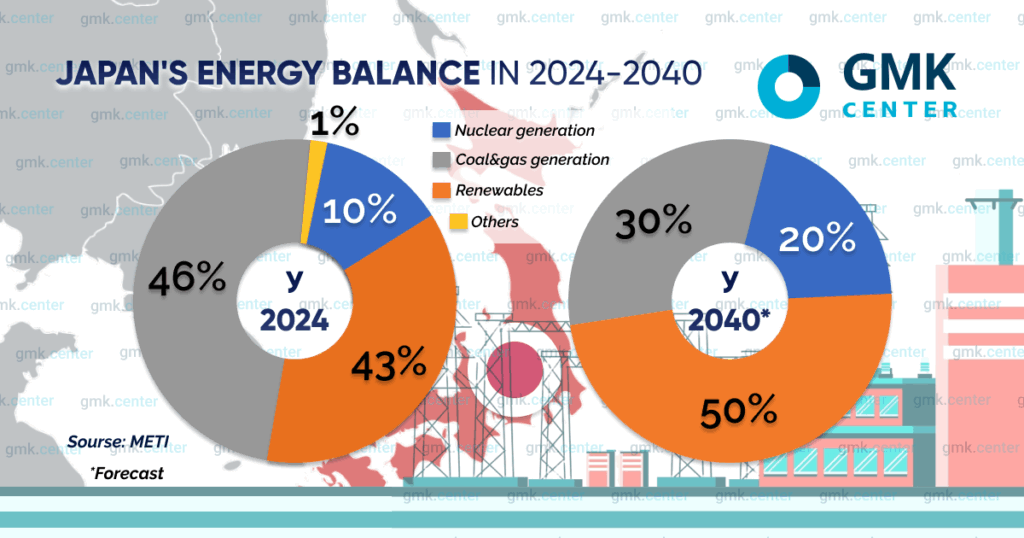
Transition Asia Research Center estimates that the EAF transition in Japan will require an additional 3 TWh of green power. This is 0.5% of total production by 2030 and 5-7% by 2050 to achieve zero-emission steelmaking. Based on this, the steel industry should be allocated 7-8% e/e of total RES production in 2040. This target is quite realistic.
Thus, the Japanese model of metallurgy decarbonization is characterized by a combination of two engineering solutions known today. These are the EAF transition and the introduction of hydrogen technologies for BF production combined with CCUS.
A prudent government policy, including financial support for the industry, serves as a key to future success. Providing tax credits to companies may prove to be a much more effective tool than subsidies and grants from the European Commission for European steelmakers.

-

OpinionsGreen steelsteel consumption
13 July 2026
10 November 2025
16 October 2025
14 October 2025