




Posts Global Market electricity prices 1842 16 January 2026
The price of DAM in Ukraine was €139.2/MWh, and the situation in the country's energy system is significantly deteriorating due to Russian attacks
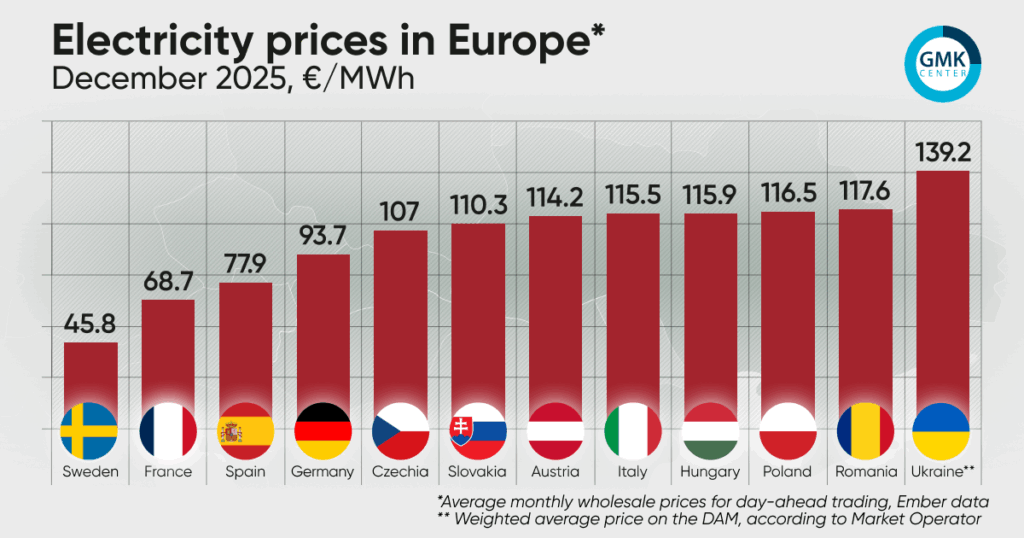
Average monthly wholesale electricity prices for day-ahead delivery in Europe showed varying trends in December.
According to Ember (as of January 13, 2025), they were as follows:
- Italy – €115.48/MWh (-1.3% month-on-month);
- France – €68.67/MWh (+16%);
- Germany – €93.67/MWh (-9%);
- Spain – €77.93/MWh (+32%);
- Sweden – €45.81/MWh (-22%).
In Poland, the average monthly wholesale price for day-ahead trading in December was €116.52/MWh, in Slovakia – €110.28/MWh, and in Hungary – €115.87/MWh, falling compared to November.
December trends
Average electricity prices in Europe in the last month of 2025 were largely determined by the cost of gas and carbon emissions. For example, in the first half of December, they fell amid a drop in gas prices to multi-month lows. In the third week of the month, prices on most major European electricity markets rose slightly, driven by higher demand due to lower temperatures, reduced renewable energy production, rising TTF futures, and the cost of carbon emission contracts. In particular, the base price for carbon (EUA) on December 15 (the last day of trading for the current December contract and the last primary auction of the year) rose to a two-year high of over €85/t.
Since the beginning of the new year, electricity prices in Europe have crept up due to low temperatures and higher demand, as well as an increase in the base price of CO2.
Renewable energy had a significant impact on the European electricity market last year. The region, according to Bloomberg, experienced record growth in negative prices. For example, Germany recorded 573 hours of such periods in 2025 (+25% y/y), while in Spain the number of such hours doubled. According to BloombergNEF, the trend will continue in 2026, as new renewable capacity is growing faster than grids, storage, and consumption. However, fossil fuels remain a critical part of the energy system, providing a reserve in case of a decline in wind and solar generation.
Situation in Ukraine
In December of this year, the weighted average purchase and sale price of electricity on the DAM in Ukraine, according to information from the Market Operator, increased by 0.7% month-on-month to UAH 6,880.55/MWh (€139.2/MWh at the average monthly exchange rate of the hryvnia to the euro).
Demand on the DAM last month increased by 16.76% compared to November, while supply increased by 11.52%.
According to preliminary monitoring by ExPro Electricity, Ukraine increased its electricity imports by 53% month-on-month in December to almost 640,000 MWh. This is a record for last year. Compared to December 2024, it increased by 48%.
At the end of the year, Ukraine increased its electricity imports by 24% year-on-year to 3.3 million MWh.
Hungary traditionally accounted for the largest share of electricity imports in December (41% of the total volume), followed by Slovakia (21%). ExPro notes that overall supplies increased in all directions except Moldova, where they fell by 25% in the last month of the year compared to November. At the same time, supplies from Poland increased significantly in December, by 85% month-on-month.
No electricity was exported from the country last month, as exports had been completely suspended since November.
In December, the national energy company Ukrenergo held its first joint monthly auctions at inter-state crossings on the borders with three EU countries (Hungary, Romania, and Slovakia). In this way, the state took a step towards the planned import of electricity from the European Union, with the aim of reducing its cost in the future, among other things. The auctions started on December 15 on the JAO platform, and direct deliveries based on their results were planned for January. As reported, during the auction, requests from potential supplier companies significantly exceeded the volume of supply offered for distribution.
In December, the Ukrainian government issued a resolution allowing Ukrenergo to purchase electricity for technological costs at special auctions with NAEK Energoatom. The Ministry of Energy initiated this resolution. The relevant ministry explained that this would help to obtain a weighted average price lower than the market price, which would reduce the burden on the system operator’s transmission tariff (the industry has repeatedly insisted on this). The first special auction took place on January 7.
However, the intensification of Russian attacks on Ukraine’s energy infrastructure during the winter period, especially with the significant strengthening of frosts in January 2026, has serious consequences – major power outages and blackouts in cities and regions across the country. For example, on the night of December 13, 2025, Odessa was left without power, and a state-level emergency was subsequently declared due to attacks on the region’s energy infrastructure. On January 8, 2026, the Dnipropetrovsk and Zaporizhzhia regions were almost completely cut off from power due to enemy attacks. The situation in the energy system of Kyiv and the Kyiv region remains extremely difficult after a series of large-scale attacks.
Regular rocket and drone attacks on energy infrastructure affect not only households and the municipal sector, but also business activities, in particular, metallurgical companies. Recently, emergency shutdowns have repeatedly halted the production capacities of key enterprises in the industry. For example, the Zaporizhstal steel plant has suspended operations twice. On January 8, ArcelorMittal Kryvyi Rih announced a temporary suspension of some production processes, which was safe in accordance with internal technological regulations.
As noted by Mauro Longobardo, CEO of PJSC ArcelorMittal Kryvyi Rih, Ukrainian steelmakers are working in extraordinary conditions, among other things, facing the lack of a real opportunity to invest in decarbonization due to the huge additional costs required to maintain assets in working condition under missile and artillery fire. The final introduction of the European CBAM forces the company to reduce the production of blast furnaces to a technological minimum, without changes the next step will be their shutdown.
Mauro Longobardo explained that working at the minimum production level will cause a chain reaction of stopping part of the processing production capacities, downtime of part of the personnel, and the cost of production will increase even more.
“This is happening amid the highest electricity prices in Europe and ongoing war losses, despite over $1 billion in support from our parent company. We urgently need the support of the Ukrainian government in the form of fairly regulated energy prices,» he added.

-
OpinionsGlobal Marketsteel consumption
13 July 2026

14 July 2026
16 June 2026
10 June 2026