





Opinions Global Market scrap metal 1794 11 December 2025
The EU is expected to increase scrap collection by 8 million tons in 2026

This will push up prices on the world market
The European steel market is preparing for significant changes in 2026. We see that the role of CBAM as a technical barrier is growing, which could reduce imports in the first quarter by 20-30% y/y. The new tariff quota system, which is expected to come into force in July 2026, provides for a 43% reduction in quotas, but import volumes may fall even further – by 50% y/y and more.
Under these conditions, European producers will need to increase steel production by 13–14% next year to compensate for the reduction in market supply while maintaining stable demand. This will require an additional 8 million tons of scrap, which is a rather sharp jump for the industry.
Assuming exports remain at this year’s level (17 million tons), scrap collection in the EU is expected to increase from 87 million tons in 2025 to 95 million tons in 2026. The European industry already experienced such growth in demand for scrap in 2017 and 2021, but this was accompanied by price increases. What consequences will this have for the scrap market both in the EU and globally?
Let’s look at the chart, as collection volumes and prices are closely linked. Particularly telling is the new normal in the scrap metal market in 2022-2025, which differs significantly from the 2015-2021 period, showing higher prices for similar volumes of scrap.
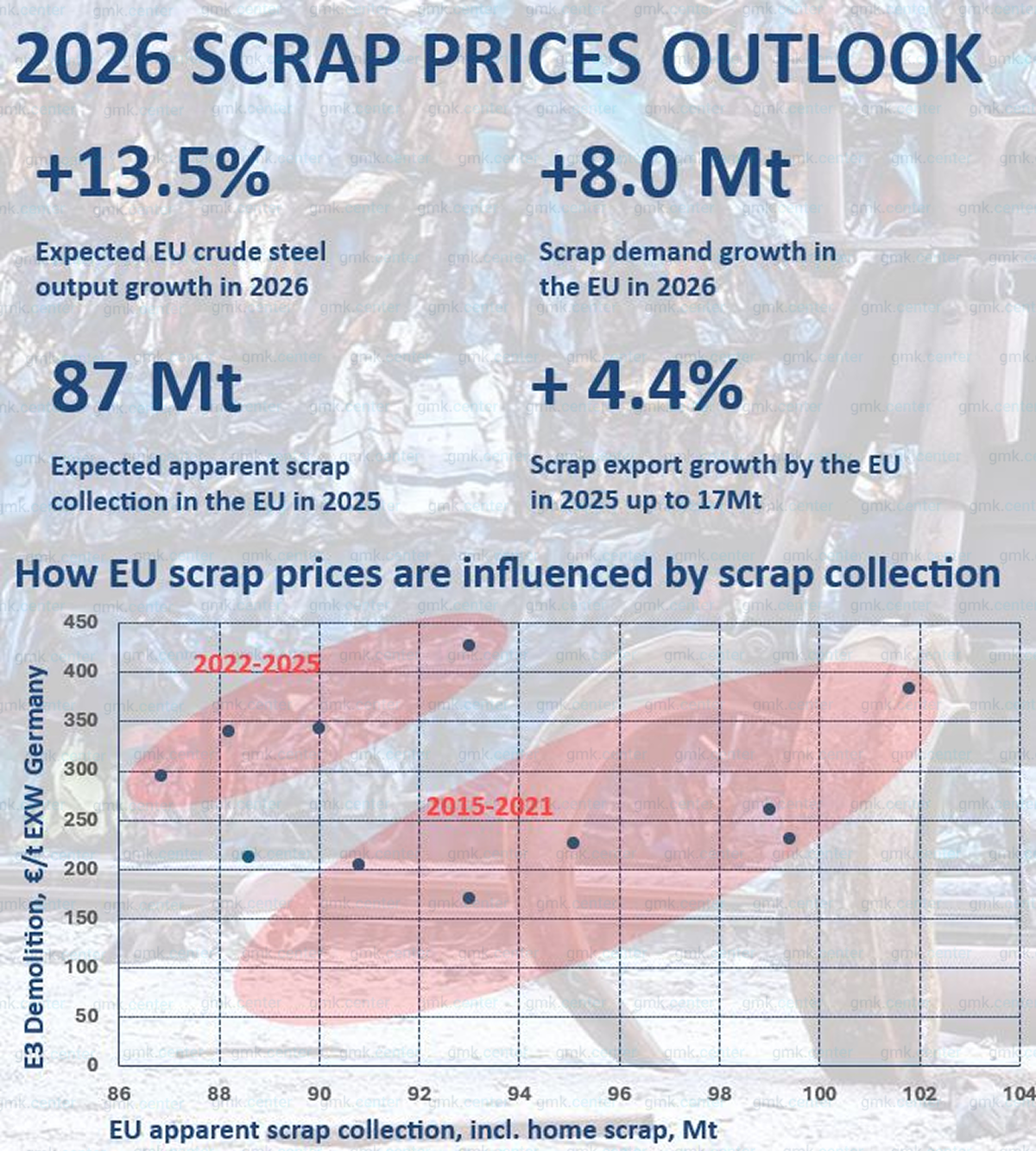
Historical data shows that such a jump in demand for scrap could raise prices by 33% from current levels to €400/t at E3 Demolition in Germany. For global scrap prices, this could mean approximately $500/t for HMS 1&2 (80:20) on CFR Turkey terms. However, neither European nor global markets can sustain such price levels, given the expected decline in iron ore prices and high steel exports from Asia.
As a result, scrap exports from the EU are likely to decline to 13–14 million tons, while collection will grow more moderately to 91–92 million tons. This scenario could lead to an increase in prices on the EU scrap metal market to €360/t for E3 Demolition Germany (20% higher than current levels) and, globally, to $420–440/t CFR Turkey.
This is only the first market factor affecting scrap prices in the EU. The second factor is regulatory: restrictions on scrap exports are expected to be introduced. The turmoil surrounding CBAM has overshadowed the fact that, as part of the European Action Plan for Steel and Metals, a draft of such measures was planned to be presented by the end of September.
The expected measures to restrict scrap exports from the EU will help mitigate the impact of growing demand for scrap on EU market prices. However, much will depend on the parameters of these steps. If they are not implemented, we may see scrap prices in the EU rise by €60/t.
In any case, the global market needs to prepare for higher scrap prices.

-

OpinionsGlobal Marketsteel consumption
13 July 2026

02 July 2026

15 June 2026

07 April 2026