




News Infrastructure Metinvest 1307 15 December 2025
Head of Metinvest CEO's office stresses need to reform railway operator
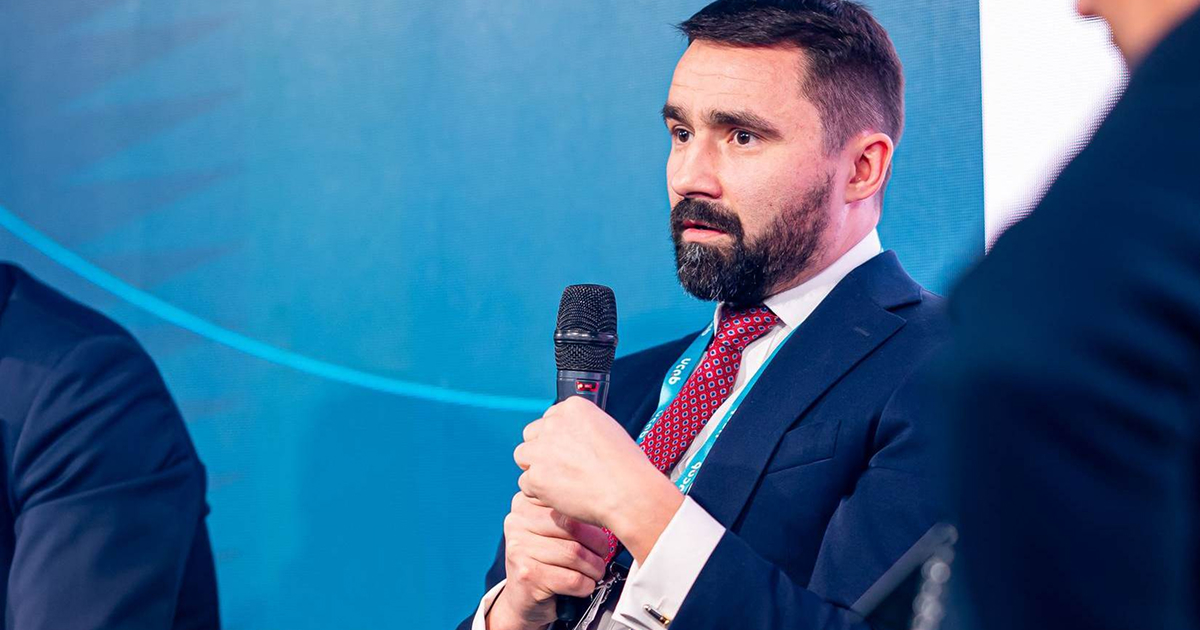
The state must act as an arbitrator between Ukrainian Railways (UZ) and businesses, namely agrarians and steelmakers. This opinion was expressed by Olexander Vodoviz, head of the office of the CEO of Metinvest Group, at the conference “Agribusiness in Ukraine.”
“The state should say: it is more profitable not to raise tariffs, but to subsidize Ukrainian Railways, because this will bring in more taxes and export revenues, and the country as a whole will benefit. But there is no such arbitrator at the moment: the state is siding with Ukrainian Railways,” he said.
Oleksandr Vodoviz explained that Metinvest is currently working to survive, not to develop. The company has been operating at a loss for two years and has suspended operations at the Ingulets Mining and Processing Plant. In such conditions, an increase in freight tariffs could lead to the shutdown of even more of the group’s enterprises.
According to him, the company can compete in certain markets in Egypt, for example, by delivering its products there, earning a margin of $5–7 and maintaining its presence.
«However, the increase in tariffs makes such deliveries impossible, forcing us to shut down the blast furnace. When the furnace stops, another iron ore plant stops,» explained the head of Metinvest’s CEO office.
At the same time, he noted the state monopoly’s greatest openness in the last 10 years and its willingness to engage in dialogue with business.
Oleksandr Vodoviz also noted the profitability of freight transportation and the significant pressure of the passenger segment on freight tariffs. In European Union countries, this problem is solved by financing national logistics operators from the budget. Domestic businesses sought a similar solution for Ukrainian Railways.
“But parliament did not provide for this in the law. UAH 16 billion has been allocated to some resolutions. If the funding does not come, the railway risks coming to a standstill – and without it, we will not be able to deliver cargo,” emphasized Oleksandr Vodoviz.
He cited the existence of about 525 low-activity freight stations as another problem for the railway operator.
«We are asking Ukrainian Railways to close unprofitable stations, because businesses are actually maintaining them through tariffs. When transport volumes fell from 320 to 160 million tons, businesses were forced to lay off people and close enterprises. Businesses perceive tariffs as a tax that affects their costs, so the state must intervene. The same applies to financial obligations: if businesses can default, why can’t Ukrainian Railways?» he stressed.
The head of Metinvest’s CEO office also noted that the difference in tariffs for different categories of cargo is due to the uneven load on the infrastructure: the more stations and smaller shipments, the more expensive the transportation should be. According to Alexander Vodoviz, Ukrainian Railways’ new tariff model should be based on the principle of fairness. Currently, costs are distributed among everyone – both farmers and steelmakers – which creates an imbalance.
For example, ore, coal, and other large industrial cargoes are transported in route shipments (about 100 cars) and pass through only 1–2 stations. Meanwhile, grain and other agricultural cargoes are usually transported in small batches (8–10 cars) and pass through about 15 stations.
The head of Metinvest’s CEO office stressed that fair tariffs can only be achieved through the reform of the national carrier, which provides for a transparent tariff-setting mechanism.
We would like to remind you that Metinvest CFO Yulia Dankova believes that big business should be a priority in the state’s security policy. She stressed the importance of a predictable tariff policy for state monopolies and an investment-friendly tax policy.
-

15 June 2026
18 June 2026
09 June 2026
04 June 2026