




Infographics electricity prices 43 06 July 2026
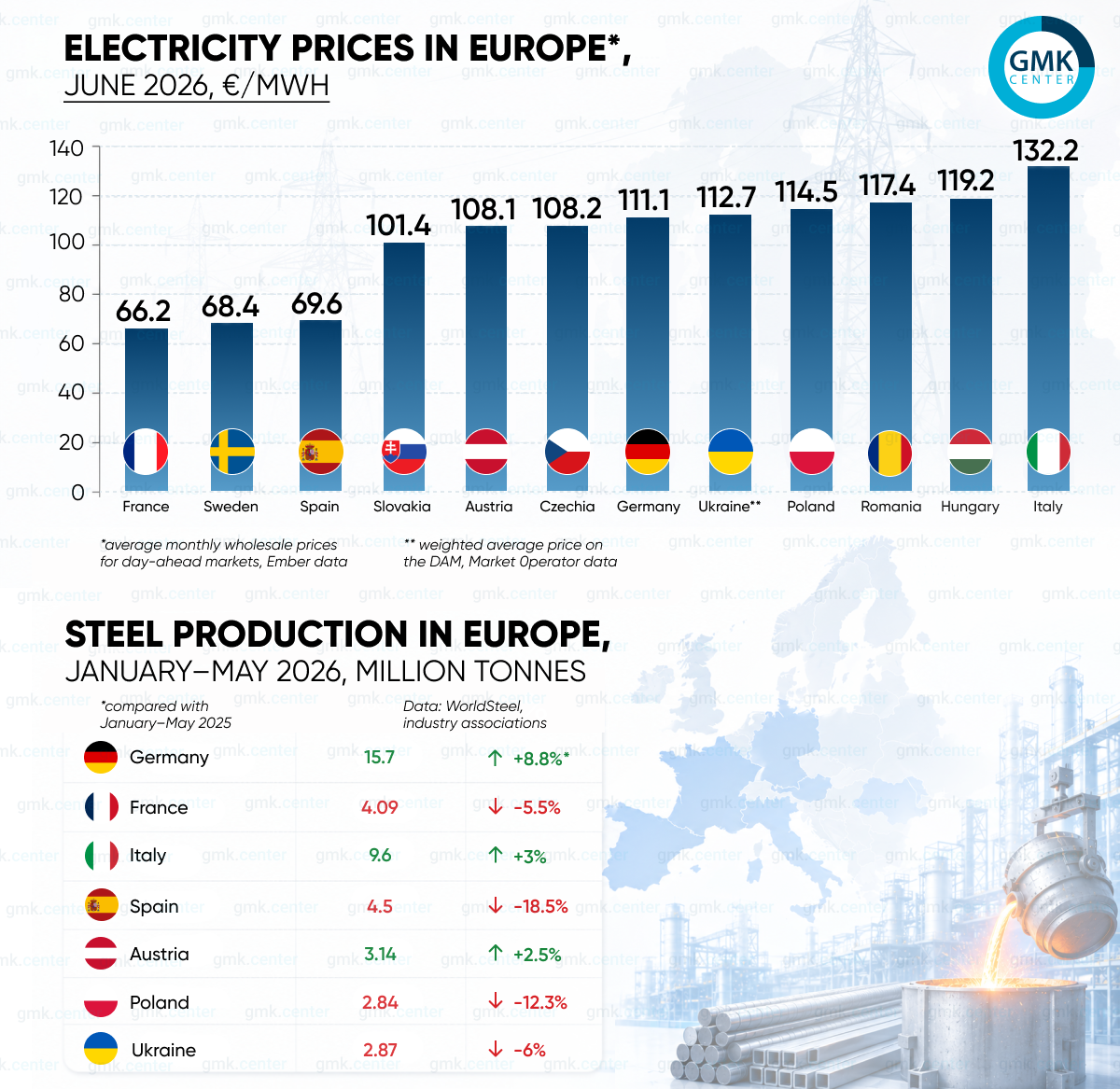
The price of day-ahead electricity in Ukraine last month stood at €112.7/MWh
Average monthly wholesale day-ahead electricity prices in Europe in June 2026 rose compared with May, against the backdrop of a heatwave that swept across the region at the end of the month.
According to Ember, prices for the period were as follows (as at 2 July):
- Italy — €132.27/MWh (+10.2% month-on-month);
- France — €66.25/MWh (+27%);
- Germany — €111.13/MWh (+16.3%);
- Spain — €69.58/MWh (+28.7%);
- Sweden — €68.37/MWh (-1.6%);
In Poland, the average monthly day-ahead wholesale price in June stood at €114.5/MWh, in Slovakia at €111.4/MWh, and in Hungary at €119.2/MWh, and was higher than in April.
June trends
A heatwave in Europe during the third ten-day period of June led to electricity prices rising to their highest levels since the 2022 energy crisis, despite high solar power generation in a number of countries. Whilst the average weekly price was below €95/MWh at the start of the month, by the end it stood at €115/MWh.
Electricity prices in some markets reached record highs during this period, with a significant spike observed towards the end of the day. For example, on the evening of 24 June (at 20:45), the wholesale price in Belgium exceeded €1,000/MWh, whilst the average daily price on that date stood at 257.5/MWh. This situation was driven by increased consumption and low wind levels, as well as more expensive imports from France, where nuclear power stations had reduced output due to high temperatures in the water used to cool the reactors.
The risk of further heatwaves in July is preventing European electricity prices from returning to lower levels following the sharp rise in June, notes Bloomberg. Forecasts suggest that such weather conditions could recur in the UK, Spain, Germany and France. Meanwhile, temperatures across most of Europe are expected to be 2–8°C above seasonal norms.
Markets are anticipating a repeat of the sharp price spikes seen in June — a return of the heatwave could once again significantly increase the load on the power system against a backdrop of weak wind power generation and restrictions on nuclear power in France.
The situation in Ukraine
According to the ‘Market Operator’, in June the weighted average price of electricity traded on the day-ahead market in Ukraine rose by 11.2% month-on-month to 5,808.64 UAH/MWh (€112.7/MWh at the average monthly hryvnia-to-euro exchange rate). Demand on the day-ahead market last month rose by 3.91% compared with May, whilst supply fell by 1.13%.
According to preliminary monitoring by ExPro Electricity, in June 2026 Ukraine reduced its electricity imports by 25% month-on-month to 295,000 MWh. Compared with the same period in 2025, the figure rose by 42%.
As is customary, Hungary accounted for the largest share of imports (42%).
Last month, supplies from Poland saw the sharpest decline — down 71% month-on-month. At the same time, imports from Slovakia rose significantly following the completion of repairs to the cross-border power transmission line.
Electricity exports from Ukraine rose by 61% month-on-month over the period, totalling 151.5 thousand MWh.
In June, the Ukrainian government approved the launch of long-term contracts on the electricity market. As noted, non-domestic consumers will be able to purchase electricity on fixed terms for an extended period through transparent, competitive auctions.
For the pilot launch, 4% of the generation volumes of state-owned electricity producers – Energoatom and Ukrhydroenergo – will be offered: 2% through quarterly contracts, 1% through half-yearly contracts and a further 1% through annual contracts. The first auctions have been announced for the near future.
At the end of June, the National Commission for State Regulation of Energy and Public Utilities approved an increase in the tariff charged by NEC Ukrenergo for dispatch services – from 1 July, it stands at 118.64 UAH/MWh (excluding VAT, +7.83%). At the same time, the regulator postponed the review of the electricity transmission tariff due to the need to resolve a legislative conflict that arose following the adoption of the law introducing the market coupling mechanism.
As in Europe, the Ukrainian power system was also affected by a heatwave at the end of June, prompting ‘Ukrenergo’ to announce consumption restriction measures on certain days — for domestic consumers as well as for industry and business. Furthermore, Russian troops continue to attack Ukraine’s energy infrastructure.
-

02 July 2026

01 July 2026

22 June 2026

18 June 2026