

Real wages are expected to grow by 6.2% this year, compared to a 15.6% increase in 2024
The Ukrainian labor market is undergoing significant changes amid the war. After a sharp decline in wages in 2022, they recovered rapidly in subsequent years and now exceed pre-war levels. The key factor driving wage growth remains a significant labor shortage, which will continue to influence wage dynamics, albeit at a slower pace.
Wage dynamics
According to the State Statistics Service, the average wage in October 2025 was UAH 26,900. In the third quarter, according to indirect estimates, average wages increased by 20% year-on-year in nominal terms and by 6.2% year-on-year in real terms. According to Work.ua, the median nominal salary offered in November increased by 20% year-on-year and amounted to UAH 27,000.
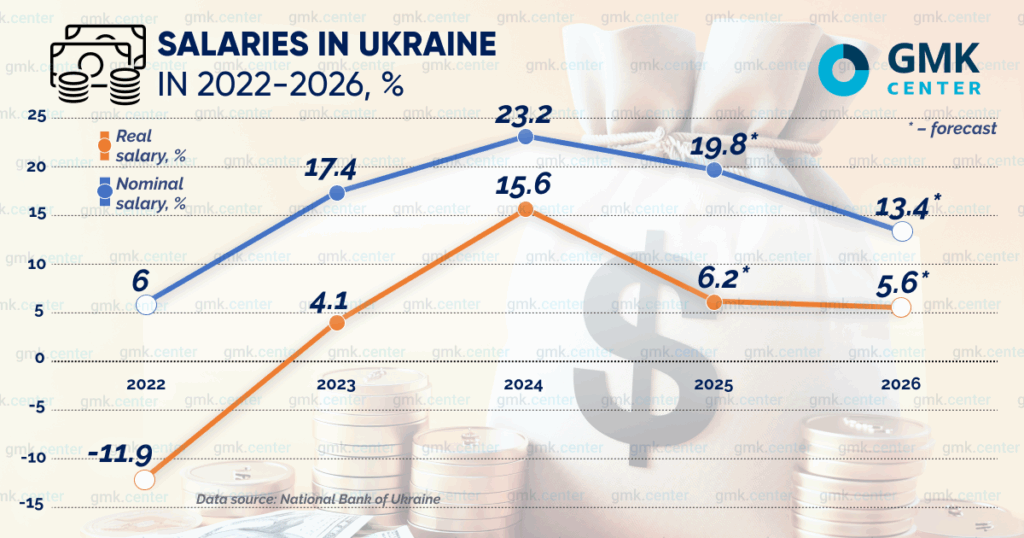
Real wages in Ukraine (adjusted for inflation) show sharp fluctuations. In 2022, they fell significantly by 11.9% due to the consequences of the war. At the beginning of the full-scale aggression, many enterprises in the frontline regions were damaged to varying degrees or completely destroyed, while others reduced production, and all business processes, including logistics, were hampered. In 2023, real wages began to recover gradually, growing by 4.1% year-on-year, and in 2024 – by 15.6% year-on-year.
According to a survey by the European Business Association (EBA), in 2025, 96% of employers raised their employees’ salaries — mainly by 11–20% (64%) or up to 10% (28%). At the same time, according to a study by Robota.ua, half of companies raised salaries for all staff this year. Another 41% increased wages selectively, and 9% left them at the same level.
The key factors driving salary growth in Ukraine are the labor shortage caused by mobilization, the large-scale exodus of refugees abroad, and changes in the balance of supply and demand in the labor market.
A positive factor is that, by all accounts, real wages in Ukraine have exceeded pre-war levels. At the end of 2024, the NBU predicted that this would happen at the end of the same year. The basis for this statement was that the National Bank, in its report for October 2024, improved its forecast for real wage growth to 14% y/y from 9.7% y/y. In fact, in 2024, it increased by 15.6% y/y. This indicates that wages have grown even beyond expectations.
Market trends
The following trends can be noted in the Ukrainian wage market:
- Overall wage growth amid labor shortages. The Ukrainian labor market is experiencing a “candidate’s market” with all the ensuing consequences for employers. Due to the shortage of personnel, employers are forced to increase wages. This was particularly noticeable in 2024, when the difference between nominal and real wages was 7.6%, while in other years it was no less than 13%.
- Imbalance in wage growth among professions. Businesses are in dire need of workers and technical specialists, so wages in this segment are rising faster than in others. An EBA survey showed that it is also difficult to find sales managers and middle managers, as their work requires constant presence and booking opportunities are limited.
- Salary leakage into the informal sector of the economy. Due to fears of mobilization, some Ukrainian men do not want to work officially, so they are employed without formal employment. According to some estimates, 2.2–2.5 million Ukrainians currently work informally. According to a study by CASE-Ukraine and ISET, the state budget loses between UAH 200 and 265 billion per year due to envelope wages.
- Increased regional wage disparities. Wage levels are changing under the influence of the consequences of the war—migration and changes in the structure of the economy. For example, many industrial enterprises have relocated to the western regions of the country, where production and construction have intensified, while economic activity in the frontline regions has declined significantly.
- The gap between candidates’ expectations and employers’ offers. Jobseekers have begun to demand higher salaries than employers can offer in wartime conditions. According to Robota.ua, the average offer from employers in 2025 was 24,500 UAH, while jobseekers expected 27,300 UAH.
- Growth in the number of additional incentives and support programs. According to the EBA survey, 59% of companies organized educational courses, and 52% provided psychological support. In addition, companies provided financial assistance: 26% compensated for housing rent, and 20% paid for health insurance for family members. Approximately 65% of employers traditionally gave gifts for the holidays.
Salary prospects
Salary increases are expected to continue in 2026. According to a survey by the EBA, 94% of companies plan to raise salaries. Specifically, 28% of companies anticipate increases of 11–15%, 23% anticipate increases of 5–10%, and 10% expect increases of 16–20%. Only 6% of business respondents do not intend to raise salaries next year.
In turn, a Robota.ua survey showed that 54% of the companies surveyed plan to increase salaries in 2026, while 8% will not do so. Half of the companies are planning to increase their wage bill by 6–15% next year.
At the same time, the real wage growth in 2026 will be lower than in 2024, although it will remain at approximately the same level as this year.
“A partial reduction in labor market imbalances is expected in the forecast horizon, which will slow down the growth of real wages and, accordingly, ease pressure on business costs,” the NBU’s October inflation report says.
The National Bank expects real wages to increase by 6.2% year-on-year in 2025, and nominal wages by 19.8% year-on-year. This is because Ukraine’s economic growth reserves have effectively reached their limits, as the recovery effect after the 2022 recession has been exhausted and there are no new drivers for economic growth in the context of the war. While Ukraine’s GDP grew by 5.5% and 2.9% year-on-year in 2023 and 2024, respectively, in the fall of this year, the National Bank downgraded its forecast for Ukraine’s GDP growth in 2025 to 1.9% from 2.1% year-on-year for the fourth time since the beginning of the year.