




Infographics electricity prices 1746 03 December 2025
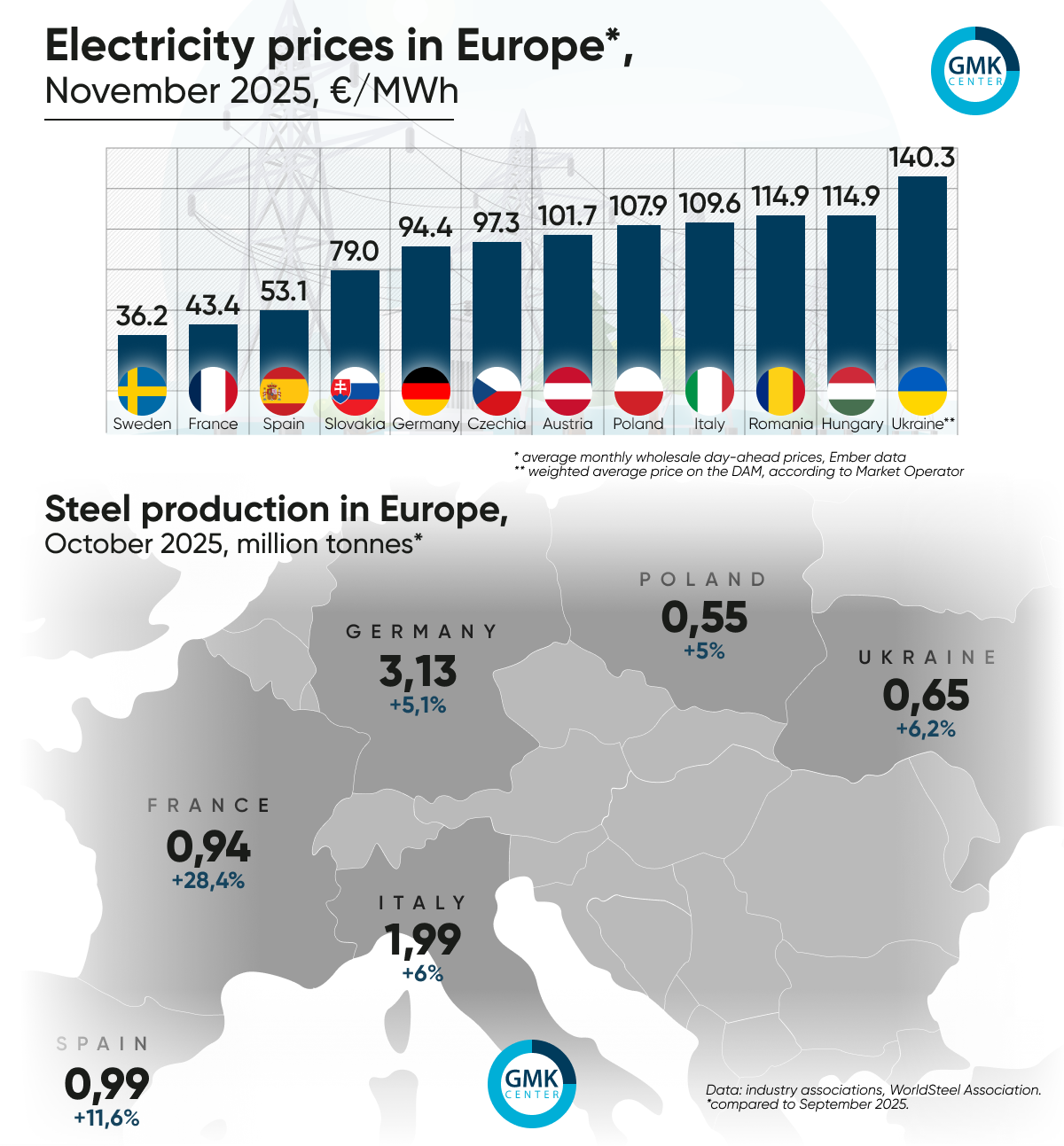
Last month, the price in Ukraine was €140.3/MWh, which is almost a third more than in Poland
Average monthly wholesale prices for electricity for the next day in Europe showed mixed trends in November.
The main factors affecting the cost of electricity during this period were fluctuations in renewable generation volumes, which had a strong impact on the markets of some countries, and increased demand due to weather conditions.
According to Ember (as of December 2, 2025), prices were as follows:
- Italy – €109.63/MWh (-1.6% month-on-month);
- France – €43.29/MWh (-24.5%);
- Germany – €94.41/MWh (+5.5%);
- Spain – €53.1/MWh (-29.8%);
- Sweden – €36.23/MWh (-27.5%).
In Poland, the average monthly wholesale price for day-ahead trading in November was €107.9/MWh, in Slovakia – €78.99/MWh, in Hungary – €114.92/MWh, which is higher than in September.
November trends
Last month in Europe began with an increase in electricity prices, AleaSoft notes, in particular due to the impact of CO₂ futures prices, which reached their highest level since mid-February at over €82/t during this period.
In the fourth week of November, day-ahead electricity prices in the region rose sharply in most major markets (with some exceptions), reaching values above €100/MWh.
Germany reached the highest average daily price during this period, specifically €220.52/MWh on November 25 (the highest since January 21). A significant drop in wind power generation coincided with a cold snap, while the country has a shortage of flexible capacity to compensate for the decline in renewable energy. On November 26, the Italian market recorded the highest electricity price since the second half of February – €147.32/MWh.
In contrast, the gas market remained relatively calm in November, with TTF futures falling below €30/MWh for the first time in 1.5 years at the end of the month.
Price dispute
One of the controversial topics for European industry has been the announced industrial price for electricity in Germany. The new government subsidy mechanism for energy-intensive industries is expected to be introduced in early 2026. Negotiations with the EC on this issue are in the final stages.
Germany is introducing a fixed electricity price for its energy-intensive industries of €50/MWh for three years. This measure is intended to support a number of sectors. Although the industry association WVStahl noted that European state aid rules mean that the steel industry is not covered by the regulation, their colleagues from other countries have expressed concern.
Italian associations have commented that the move distorts competition, with the country’s industry expecting government support and similar measures. According to Antonio Gozzi, president of Federacciai, if Europe allows countries with greater fiscal capacity to guarantee energy prices, the region risks collapse.
Ocelarska Unie, an association that protects the interests of Czech and Slovak steel producers and processors, believes that the Czech Republic should develop a plan to help steel companies with energy prices similar to the German scheme. The organization warns that different approaches by individual countries disrupt the single European market and could weaken the Czech Republic’s competitiveness.
Situation in Ukraine
In November of this year, the weighted average purchase and sale price of electricity on the DAM in Ukraine, according to information from the Market Operator, increased by 6.8% month-on-month. to UAH 6,830.49/MWh (€140.3/MWh at the average monthly exchange rate of the hryvnia to the euro).
Demand on the DAM last month increased by 0.66% compared to October, while supply decreased by 10%.
According to preliminary monitoring by ExPro Electricity, Ukraine increased its electricity imports by 15% month-on-month in November to 415,000 MWh. Compared to November last year, this figure increased by 150%. Hungary continues to account for the largest share of imports (44%). However, compared to October, the country sharply increased imports from Moldova and Slovakia – by two times and ten times, respectively. At the same time, imports from other countries decreased.
Electricity exports from the country fell by 94% last month compared to October and were completely suspended from November 11.
Due to systematic Russian attacks on Ukraine’s energy infrastructure in November, NPC Ukrenergo constantly introduced power restriction schedules for industrial consumers and businesses, which became round-the-clock from November 8.
Last month, Ukraine reached an agreement with ENTSO-E to increase the maximum capacity of international crossings for electricity imports to 2.3 GW from December 1. However, according to Vitaliy Zaychenko, chairman of the board of Ukrenergo, Ukraine was unable to fully utilize the 2.1 GW already available due to restrictions in the power system, namely the ability to transmit the corresponding volume to certain regions — energy experts are working on this.
-

15 June 2026
22 June 2026
18 June 2026

17 June 2026