




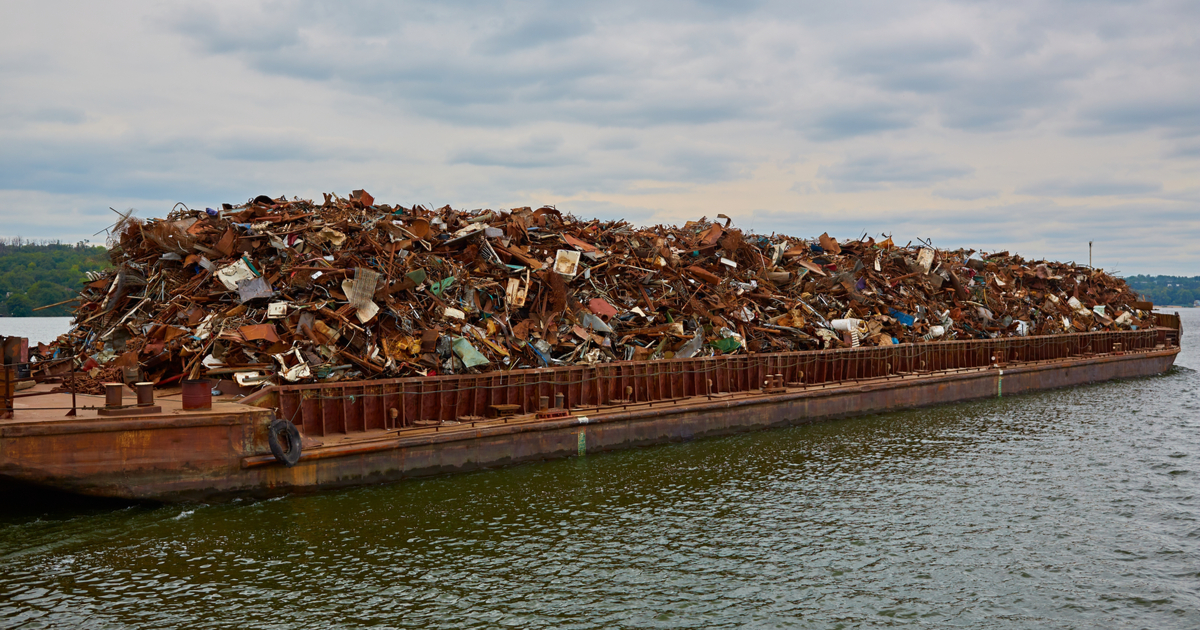
Raw material shipments have increased by 66.4% year-on-year since the beginning of the year
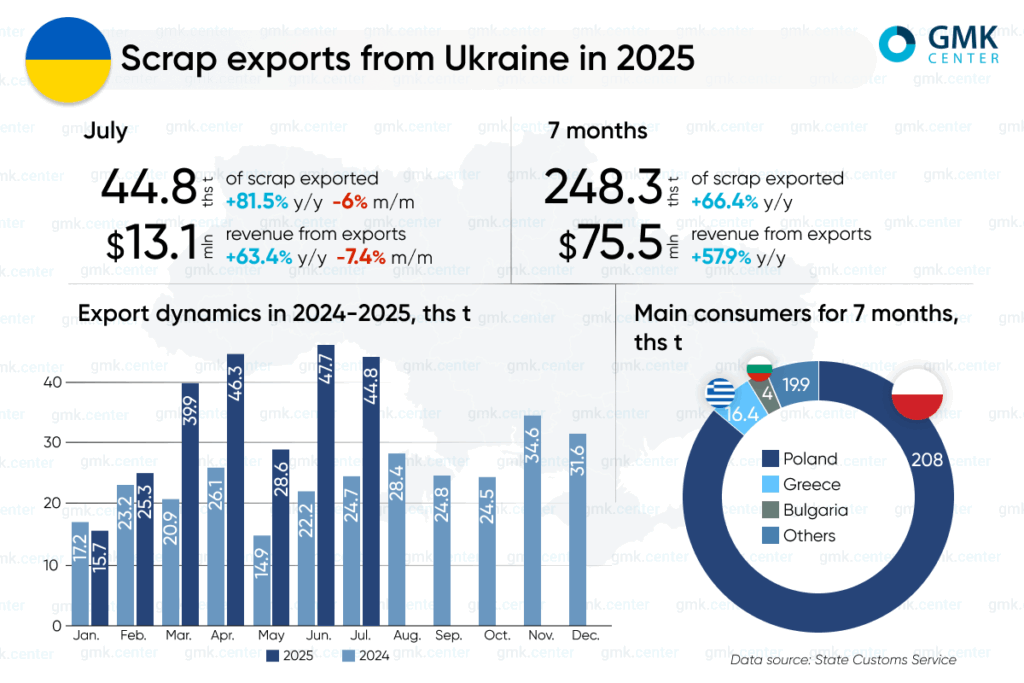
In July 2025, Ukraine’s scrap industry increased exports of ferrous metal scrap by 81.5% compared to July 2024, and reduced them by 6% compared to the previous month, to 44.84 thousand tons. This is evidenced by GMK Center calculations based on data from the State Customs Service.
Poland remains the key destination for raw material exports. 33.67 thousand tons of scrap (+77.6% y/y; +0.1% m/m) were exported to the Polish market, accounting for 70.6% of total shipments. A small part was sent to Greece – 4.37 thousand tons (-16% y/y; +19.6% m/m) and Germany – 0.4 thousand tons (-21.1% y/y; -6% m/m).
During January-July, scrap shipments from Ukraine increased by 66.4% compared to the same period in 2024, to 248.34 thousand tons. 208.04 thousand tons of raw materials were sent to Poland (+63.4% y/y), Greece – 16.44 thousand tons (-2.7% y/y), Bulgaria – 3.97 thousand tons (0.02 thousand tons in January-July 2024), Germany – 3.23 thousand tons (-32.1% y/y).
As noted by Rail.Insider, in July 2025, after a year-long pause, Ukrainian scrap metal was shipped for export to Transnistria, a Russian enclave on the territory of the Republic of Moldova. As in the previous year, the scrap exporter was the Ukrainian legal entity D-Kamet LLC, and the final recipient was the Moldovan Metallurgical Plant located in Rybnitsa.
The president of the Ukrmetprom public association, Oleksandr Kalenkov, considers the resumption of raw material exports in this direction to be absolutely unacceptable and even dangerous for the Ukrainian state.
«The security situation in the domestic metallurgical industry is constantly deteriorating due to a significant increase in scrap metal exports from Ukraine. It is already clear that this year’s export figures will exceed last year’s, which means even greater losses for the industry. In addition, the state budget is also losing out, as it does not receive export duties on these volumes. Against this backdrop, we are seeing a resumption of scrap metal supplies to Transnistria. It is absolutely unacceptable that during a large-scale war, Ukrainian strategic raw materials, which are in short supply on the domestic market, are being used to support the pro-Russian enclave,» he said.
Revenue from scrap exports in July fell by 7.4% compared to the previous month and increased by 63.4% year-on-year – to $13.14 million. In January-July, the figure increased by 57.9% year-on-year – to $75.5 million.
In 2024, scrap exports from Ukraine increased by 60% compared to 2023, reaching 293,200 tons. In 2023, shipments of raw materials abroad exceeded 182.5 thousand tons, which is 3.4 times more y/y, while in 2022, the figure was 54.1 thousand tons. The key consumers of raw materials last year were Poland (248,600 tons), Greece (34,200 tons), and Germany (6,500 tons).
In recent years, Poland has effectively become a transit point for Ukrainian scrap, which then goes on to Turkey, bypassing the export duty of €180/ton. Data shows that in 2024, Polish scrap exports to Turkey more than doubled to 529 thousand tons compared to 228 thousand tons a year earlier, and since 2022, volumes have increased almost threefold. At the same time, imports of raw materials from Ukraine have risen sharply: from 15,600 tons in 2022 to 159,000 tons in 2023 and 251,000 tons in 2024. This trend indicates the likely re-export of Ukrainian scrap metal through Poland to Turkish metallurgical plants.
According to a study by GMK Center, in the long term, scrap metal will gradually lose its status as an export commodity due to global trade barriers. Scrap is increasingly seen as a strategic resource for green metallurgy and decarbonization, so countries are seeking to retain raw materials for their own needs. It is impossible to produce it quickly in the required quantities, so an affordable price on the domestic market is becoming a key condition for the competitiveness of national steel producers.
Under these conditions, it is more expedient to export finished steel produced from scrap rather than the scrap itself, as metallurgical enterprises are among the largest taxpayers in Ukraine.
-

Opinions Industry macroeconomics
28 May 2026
06 June 2026
04 June 2026

04 June 2026