




Future of two integrated steel mills in question
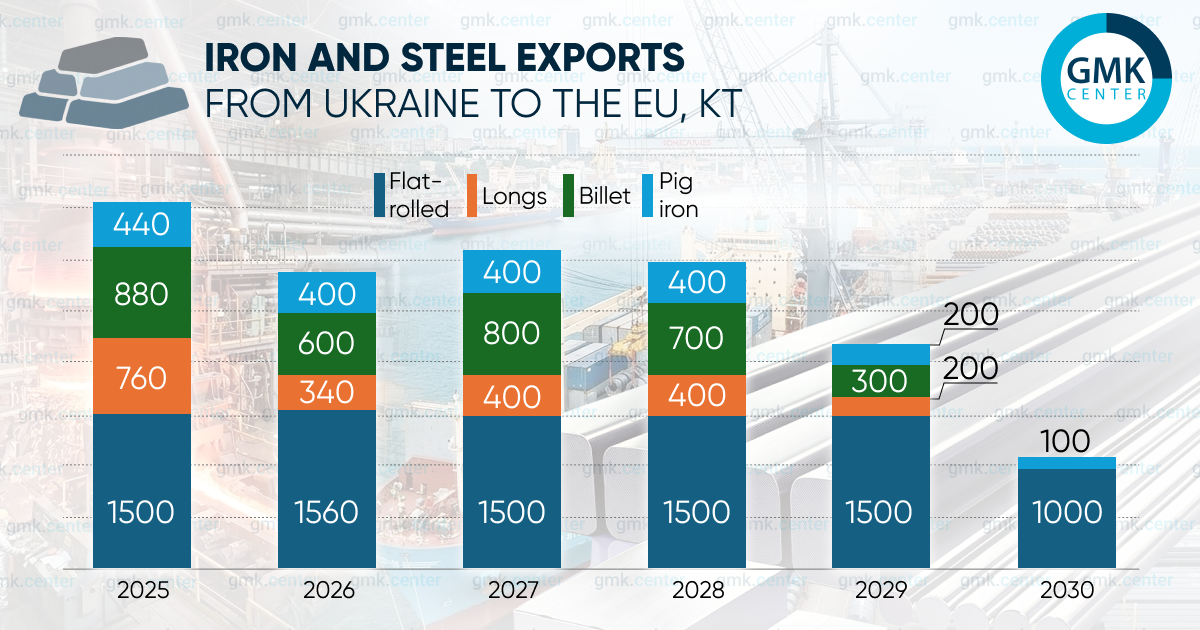
Ukrainian steel and iron exports to the EU face a diverging outlook under the carbon border adjustment mechanism (CBAM), with long products and square billet exposed to an immediate competitiveness shock with potential export losses of 2.5 million tons, according to a study of GMK Center which can be downloaded via the link.
Ukrainian HRC show carbon intensity of 2.3 tCO2, according to GMK Center estimations, resulting in a CBAM payment €10-15/t higher than other importers. However, a €110/t increase in EU HRC prices since October has partially offset the current weighted average CBAM payment, indicating successful cost pass-through into EU prices. Risks for flat-rolled exports from Ukraine to the EU are projected to escalate in 2029-2030, as the supply of low-carbon flat-rolled products increases and CBAM liabilities become more stringent.
The outlook for Ukrainian long products appears significantly more challenging. With average carbon intensity of 2.1 tCO2 for BF-based exports, Ukrainian suppliers face a €61/t CBAM payment, compared to €20/t for EAF-based producers. Rebar prices are projected to stagnate in H1 2026, failing to offset rising CBAM costs. This points to substantial export declines in January-June 2026. Ukraine’s longs exports slumped by 64% yr/yr in January-February.
A projected price recovery in H2 2026 could partially mitigate the impact. Ukraine’s longs exports may fall by 55% in 2026. However, a sharp rise in the CBAM-factor in 2029-2030 will mean a complete halt to Ukrainian long product and square billet exports to the EU starting from 2029.
Ukrainian pig iron, with carbon intensity of 2.1 tCO2 broadly aligned with market averages, is positioned to maintain medium-term competitiveness. The analysis identifies 2029-2030 as a critical inflection point. Hot-briquetted iron presents the most significant long-term challenge. HBI is projected to achieve a price advantage over pig iron of up to €110/t within five years. Once sufficient HBI supply becomes available after 2029-2030, it is expected to largely replace pig iron in the EU market, displacing Ukrainian exports.
The impact of CBAM on the Ukrainian economy will be -2.1% of GDP in 2030, which is strikingly different from the values in the European Commission report (-0.01% of GDP).
As reported by GMK Center, the Ukrainian Union of Industrialists and Entrepreneurs previously stated that the introduction of the CBAM without a transition period for Ukraine poses systemic risks to the country’s economic stability in the context of a full-scale war.
-

Opinions Industry steel consumption
13 July 2026
10 July 2026

09 July 2026
09 July 2026