




Infographics EU 1092 06 August 2025
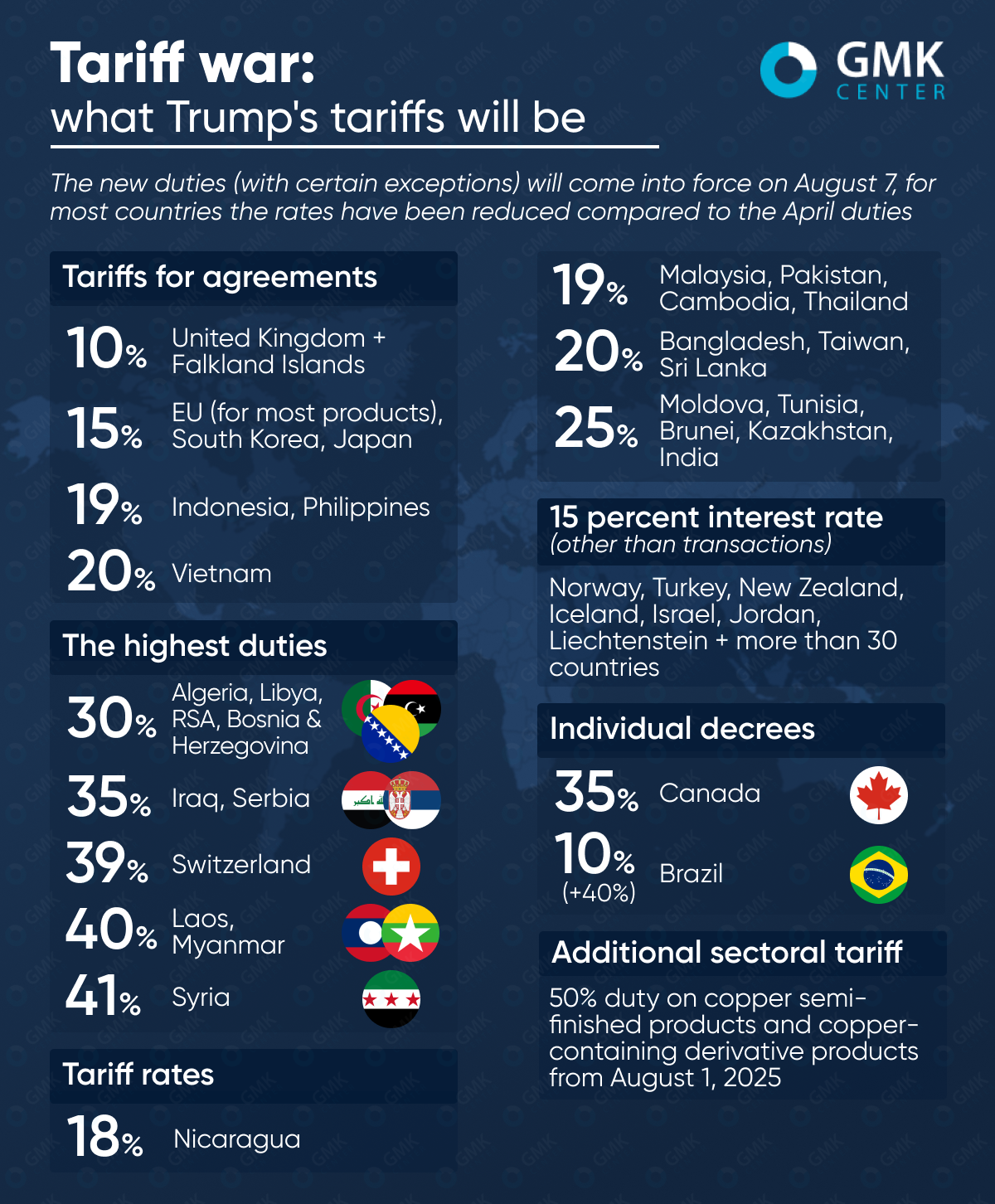
New tariffs (with certain exceptions) will take effect on August 7, with rates reduced for most countries compared to April
On July 31, US President Donald Trump announced new import tariffs for nearly seven dozen trading partners and the European Union.
Most of the new tariffs will take effect on August 7 to give customs and border services additional time to update the Harmonized Tariff Schedule of the United States (HTS).
Goods loaded onto ships before August 7 and imported into the US before October 5 will not be subject to the new tariffs.
«The minimum tariff rate for imports from most non-listed countries is set at 10%. Goods recognized as transiting while circumventing higher duty rates will be subject to additional charges,» according to a document released by the White House.
At the same time, tariffs for some countries, including China, Canada, and Mexico, are regulated separately.
Earlier, on July 30, Trump signed an executive order imposing new tariffs on imports from Brazil and issued stern warnings to India.
As for the former, from August 1 of this year, an additional 40% tariff will apply to all of its imports. Together with the standard 10%, this will amount to 50%. According to the US administration, the reason for the decision was Washington’s disagreement with Brazil’s domestic policy, in particular the prosecution of former President Jair Bolsonaro.
India, as Trump threatened, will be forced to pay 25% duties, as well as additional “penalty” tariffs due to the country’s participation in BRICS and trade ties with Russia. Trump subsequently continued to put pressure on the country, in particular, on August 4, threatening harsh tariffs over the purchase of Russian oil.
As for Canada, on July 31, Trump signed an executive order raising tariffs on imports from that country from 25% to 35% starting August 1. Prime Minister Mark Carney said he was disappointed with this decision. However, Ottawa remains optimistic about the possibility of reaching an agreement.
However, the White House has eased tensions in relations with Mexico. A day earlier, Trump said he had agreed with Mexican President Claudia Sheinbaum to extend the current tariffs for the country for 90 days to conclude a trade agreement. Canada and Mexico currently face 25% tariffs on imports not covered by the USMCA agreement, as well as sectoral tariffs.
At the same time, Switzerland was stunned after the introduction of a 39% tariff — one of the highest — on its imports. President Karin Keller-Sutter was accused of having a “bad” conversation with the White House the day before. Exports to the US account for about one-sixth of Swiss companies’ foreign sales. US import tariffs could trigger a recession in the country.
Business Minister Guy Parmelin told public radio RTS that the government must fully understand what happened and why the US president made this decision. Once this is on the table, the authorities will be able to decide how to proceed. Bern will review its proposal and hopes to achieve something by August 7. According to him, Trump is focused on the US trade deficit with Switzerland, which amounted to 38.5 billion Swiss francs last year. The country could offer to buy more American LNG, as the EU did, or Swiss companies could invest more in the United States.
The EU managed to reach an agreement with the US, but European capitals and industry reacted to this fact either cautiously or negatively. For example, metallurgists criticized the agreement because it maintained 50% tariffs on steel. In particular, the European Steel Association (EUROFER) emphasized that despite the diplomatic efforts of the European Commission, the bloc’s metallurgical sector continues to suffer significant losses. German politicians (German Chancellor Friedrich Merz, Finance Minister Lars Klingbeil) are actively raising the issue of quotas on metal products as a topic for further discussions with the US.
At the same time, senior officials from the US and China failed to agree last week on extending the 90-day pause in the application of tariffs, which expires on August 12. Currently, tariffs on Chinese imports to the United States are 30%.
-

15 June 2026

18 June 2026

17 June 2026

04 June 2026