





News Global Market Carbon prices 2964 26 March 2026
In particular, the European Commission has pledged additional support for industry to facilitate decarbonization
The price of European carbon emission allowances in March was influenced by both the energy market situation and political statements. However, the market reacted most strongly to the EU leaders’ summit, as the future of the emissions trading system was among the topics discussed there.
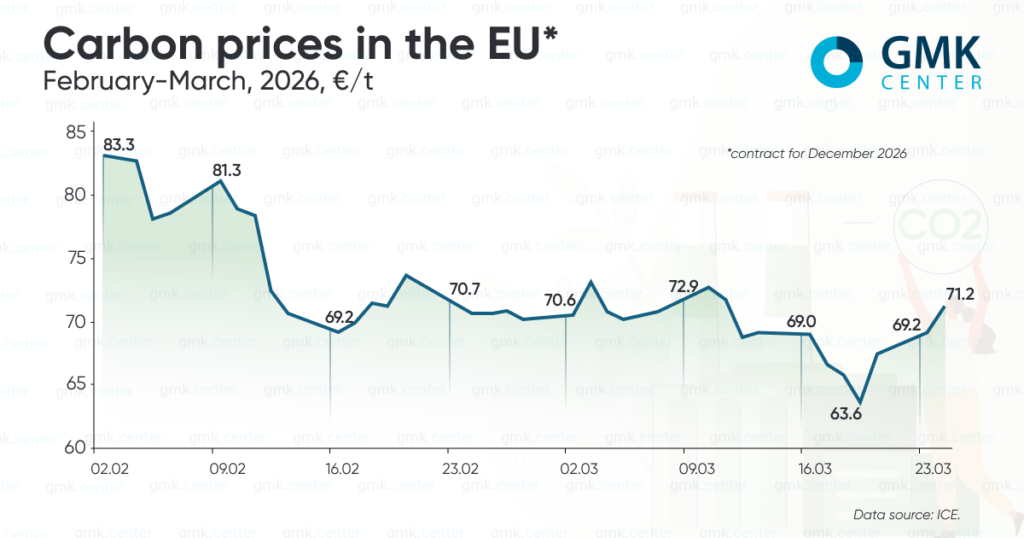
From March 9 to 15, high volatility in gas prices (TTF futures) affected the prices of carbon allowances (EUAs). At the start of the period, according to ICE, they traded in the upper ranges, reaching a monthly high of €72.9/t on March 10; however, by the end of the trading week, on March 13, they fell to €69.2/t.
On March 19, the price of the EUA (December 2026 contract) hit a year-to-date low of €63.6/t. This occurred against the backdrop of an EU leaders’ summit, where measures to reduce energy costs—including lowering carbon prices—were discussed. However, the very next day, it rose to €67.7/t, as the market did not receive specific details regarding adjustments to the emissions trading system.
On March 19, European Commission President Ursula von der Leyen outlined four key measures for reforming the EU ETS. First and foremost, these include updating the benchmarks for free EUA allocations and increasing the capacity of the Market Stability Reserve to reduce price volatility.
She also noted that the EC is working on a review of the ETS, including a more realistic trajectory for free allowances for industry after 2034 and a level playing field for the maritime sector. In addition, the European Commission pledged support for the industrial sector by proposing an ETS Investment Stimulus Initiative with a budget of €30 billion, to be funded by the sale of 400 million allowances. These two measures were announced as medium-term initiatives.
At the start of this trading week, European carbon prices traded within a narrow range of around €70/t, reacting sharply to an increase only on the morning of March 23—following the U.S. announcement of a deadline for Iran to open the Strait of Hormuz.
At the same time, the European Central Bank (ECB) revised downward its forecast for carbon prices in the ETS for 2026–2028 in its March review, despite higher inflation expectations. According to the regulator’s expectations, in 2026 it will amount to €72.9/t (-11.9% compared to the December 2025 forecast), in 2027 – €73.4/t (-13.8%), and in 2028 – €75.5/t (-13.8%).
As a reminder, in early March, European carbon prices withstood a sharp spike in gas prices amid the escalation of the conflict in the Middle East. The duration of the conflict could increase demand for carbon credits in mandatory markets if, due to disruptions in LNG supplies, industry and utility consumers are forced to switch to cheaper fuels with higher emissions.
-

Opinions Industry macroeconomics
28 May 2026
03 June 2026

03 June 2026

03 June 2026