




News Global Market ЄС 1306 19 November 2025
The indicator was influenced by a significant decline in imports by Germany and the Netherlands
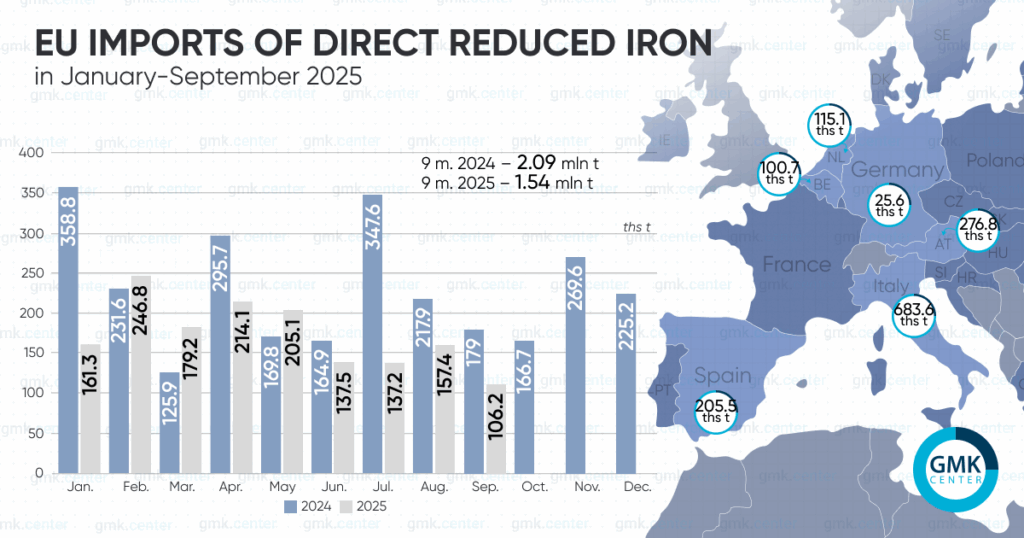
In January-September 2025, the European Union reduced its imports of direct reduced iron (DRI) by 26.2% compared to the same period in 2024, to 1.54 million tons. This is evidenced by GMK Center calculations based on Eurostat data.
The main importers of direct reduced iron among EU countries in the period under review were Italy, Spain, and Austria, in particular:
- Italy – 683.6 thousand tons (+33.1% y/y);
- Austria – 276.81 thousand tons (+32.4% y/y);
- Spain – 205.49 thousand tons (+6.4% y/y).
A significant decline in imports by Germany and the Netherlands had a negative impact on import volumes. In particular, 438.45 thousand tons of DRI were shipped to the German market in January-September 2024, while this year only 25.63 thousand tons were shipped, and 282.32 thousand tons were shipped to the Netherlands, compared to 115.14 thousand tons in the first nine months of 2025. At the same time, the resumption of supplies to Italy and other major consumers limited a deeper decline in the indicator.
The Russian Federation is the largest supplier of DRI to the European Union. In January-September, Russian companies shipped 474.68 thousand tons of direct reduced iron to European consumers, which is 39.9% less than in the same period last year.
The main importers of Russian products are Italy (266.44 thousand tons, down 32% year-on-year) and Poland (54.99 thousand tons, down 54.2% year-on-year). Belgium and Spain imported 84 thousand tons of DRI (-47% y/y) and 69.2 thousand tons (-19.2% y/y), respectively.
Libya shipped 183.95 thousand tons of DRI to the EU in nine months, reducing the figure by 54% y/y. Venezuela exported 484.88 thousand tons of the corresponding products to the European Union (+2.1 times y/y). Supplies from Venezuela are showing significant growth, indicating a reorientation of supply chains. In 2023, 133 thousand tons of DRI were imported from this direction, and in 2024 – 293.98 thousand tons. The US sent 297.54 thousand tons of products to the EU (+12.5% y/y).
In September, the EU imported 106,170 tons of DRI, which is 40.7% less y/y and 32.5% less m/m.
Libya exported 9.33 thousand tons of raw materials to the EU during the month (-34.3% y/y; 0 thousand tons in August), while Russia did not supply any. Venezuela sent 25.38 thousand tons to the European market (-72.2% m/m; -50% y/y), and the US sent 38.94 thousand tons (+35.7% m/m; +79.6% y/y).
As a reminder, at the end of 2024, the EU increased its imports of direct reduced iron from third countries by 5.4% compared to 2023, to 2.75 million tons. In 2023, there was an 11.1% y/y decline. The largest importers of DRI among EU member states last year were: Italy – 659.73 thousand tons (-23.7% y/y), the Netherlands – 527.27 thousand tons (+423%), Germany – 438.46 thousand tons (-33.5%).
-

Opinions Industry steel consumption
13 July 2026
24 July 2026

24 July 2026
24 July 2026