




News Global Market semis prices 2953 01 April 2026
The conflict in the Middle East has led to higher freight rates and prices, as well as a shortage of supply
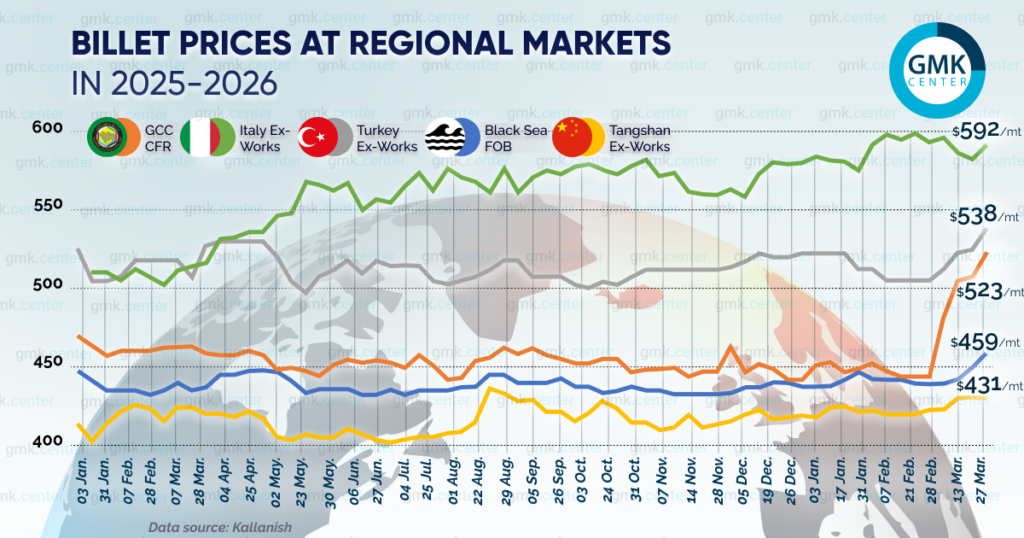
In most regional markets for square billets, prices rose by $10–40 per ton in March. A record increase of $80 per ton—unprecedented in other markets—was recorded in the Gulf countries, at the epicenter of the conflict surrounding Iran.
At the beginning of the month, due to the conflict in the Middle East, prices rose amid higher freight rates and disruptions to shipments from Iran. There is no clear shortage of billets on the global spot market, but redirecting supply flows takes time and is accompanied by higher prices. In the middle of the month, the upward trend continued and intensified against the backdrop of limited supply. By the end of the period, the market had stabilized somewhat, but prices continued to rise due to higher scrap metal costs.
Turkey
In the Black Sea market for square billets (Black Sea FOB basis), average prices rose by $19 in March, reaching a high for 2025 of $459/t. The main reasons for the increase: strong demand for scrap in Turkey, higher freight rates, and rising rebar prices in the country (to $590–610 per ton). Russian billet exporters are also benefiting from the weakening ruble.
The situation in Iran creates additional uncertainty: strikes against metallurgical enterprises could effectively halt exports of Iranian semi-finished products (about 230,000 tons of billets per month), which would support suppliers from China and Indonesia. Favorable price conditions are likely to persist throughout the conflict in the Middle East. With high freight rates, Russian billet supplies appear more competitive.
The price of square billet on Turkey Ex-Works terms also rose on average in March—by $33, to $538/t. According to Kallanish, the Kardemir plant sold 70,000 tons of billets in March, raising the price by $15 after a series of price cuts in previous months. A tender held in the middle of the month was conducted at the following prices: $505/ton (grade S235JR) and $510/ton (grade B420). These prices do not include 20% VAT.
According to the Turkish Statistical Institute (TUIK), billet imports to Turkey in January fell by 17.6% compared to December, to 294,000 tons. The leading suppliers were China – 64,000 tons (-38% y/y) and Ukraine – 47,000 tons (+126% y/y), accounting for 21.7% and 15.8% of the market, respectively. Notably, Russia—the largest supplier in 2025—reduced its shipments by 52% year-over-year, to 38,000 tons.
China
According to Kallanish, average prices for billets from Tangshan rose by $8 in March to $431/t. In the second half of the month, the increase was driven by rising steel futures prices and higher gas costs. Overall, the market remained active despite periodic shutdowns of rolling mills due to environmental restrictions.
Persian Gulf
The conflict surrounding Iran has significantly impacted the situation and prices for steel products throughout the Middle East. According to Kallanish, average prices in the Persian Gulf countries rose by $79 in March to $523/t (CFR). This significant increase is linked to a shortage of billets and logistical constraints in the region. The largest importers of Iranian billets have traditionally been the Gulf countries—Oman, the UAE, and Qatar.
Local billet producers are facing a shortage of raw materials (DRI, refractory materials, etc.). Some companies are attempting to switch to supplies from Russia, but are facing competition from the Turkish market.
Italy
Average prices for square billets in Italy (Ex-Works) fell slightly by the end of March compared to the end of February, reaching $592/t, although they had reached $600/t in February.
As previously reported, the National Bank of Ukraine (NBU) expects that in 2026, average prices for steel billets will rise by 5.3% year-on-year to $489.2 per ton (on FOB Ukraine terms). Forecast prices for 2027 and 2028 will be $510.4/t (+4.3% y/y) and $518/t (+1.5% y/y) (FOB Ukraine).
-

Opinions Industry macroeconomics
28 May 2026

04 June 2026

04 June 2026

04 June 2026