




News Global Market pig iron prices 4745 09 August 2025
Pig iron exports from Brazil are not subject to the new US tariffs, so local producers will be able to continue supplying the US market
The Brazilian pig iron market stalled in July due to expectations of US tariffs, which, after lengthy verbal battles, were scheduled to be introduced on August 7. Everything turned out to be simpler than expected – pig iron was excluded from the Donald Trump administration’s “tariff stranglehold.”
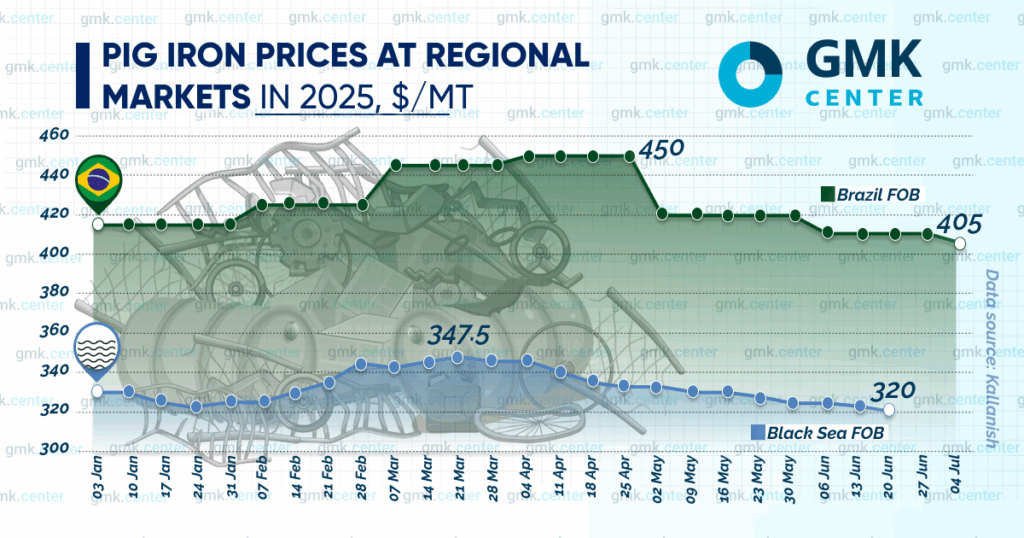
Export prices for Brazilian cast iron throughout July ranged from $400 to $410 per ton. Market activity was limited due to uncertainty caused by US trade policy, as buyers assessed the possible consequences of the new tariffs. This led to a number of manufacturers halting production due to the cancellation of US orders.
From August 7, the US will impose a cumulative 50% duty on goods produced in Brazil. Semi-finished and finished steel from Brazil is already subject to a 50% US tariff under Section 232. However, in both cases, cast iron is excluded from the tariffs. This is a positive decision for the local market, as in the first half of this year, Brazil sent 88% of its cast iron exports to the US – 1.62 million tons out of a total of 1.85 million tons.
The overall indicators for the industry are quite positive. According to IAB data, Brazil exported 1.8 million tons of pig iron in January-June (2.8% y/y), with the June figure rising by 32.3% compared to May, to 358,100 tons. Total pig iron production in the country in June amounted to 2.24 million tons, which is 5.6% more than in May.
The situation was somewhat different in the Turkish market. Domestic pig iron production in January-June amounted to 4.1 million tons, which is 13% less y-o-y. In June, production amounted to approximately 700,000 tons (-15.4% year-on-year).
According to TUIK data, pig iron imports to Turkey in June decreased by 17.3% compared to May, to 203,000 tons. As before, Russian pig iron dominates the market (90% of the market), with imports in June increasing by 33.5% month-on-month to 182,100 tons.
The increase in the inflow of Russian pig iron to the Turkish market was expected, as Russia had already exhausted its quota for EU supplies in 2025 (imports of pig iron from Russia to the EU in January-May increased by 68.5% y/y to 697,000 tons, which corresponds to the quota level of 700,000 tons), which led to a reorientation of supplies to Turkey and other markets. Russian pig iron was supplied at $348/ton, while the average import price was $354/ton. At the same time, in June, domestic pig iron production in Russia decreased by 2% year-on-year to 4.1 million tons.
Simultaneously, in June, supplies of pig iron from Ukraine to the Turkish market, which amounted to 44,200 tons in May, completely ceased.
The downward trend in prices on regional pig iron markets continued in June. Thus, average prices for Brazilian pig iron on FOB terms in June decreased from $420/t at the end of May to $410/t (as of June 20).
As previously reported, global pig iron production in January-June 2025 decreased by 0.8% compared to the same period last year, to 698.6 million tons. The largest pig iron producing countries at the end of the period were China – 434.7 million tons (-0.8% y/y), India – 76.4 million tons (+7.7% y/y), and Russia – 29.7 million tons (-1% y/y).
-

Opinions Industry macroeconomics
28 May 2026

04 June 2026
04 June 2026
03 June 2026