




News Global Market pig iron 1302 24 December 2025
In 11 months, pig iron production amounted to 1.26 billion tonnes
Global pig iron production in November 2025 decreased by 3% compared to November 2024, to 107.6 million tons. Compared to the previous month, the figure fell by 3.6% and is at its lowest level in at least the last three years. This is evidenced by data from the World Steel Association (WorldSteel), according to Ukrmetprom.
In November, 96.3 million tons of pig iron were produced by the blast furnace method, which is 4.5% less than in November 2024 and 3.9% less than in September, and 11.3 million tons by the direct reduction method (+4.3% y/y; -0.7% m/m). Thus, the overall indicator remains low, especially in blast furnace production, continuing the negative trend since the beginning of autumn, while direct reduction production volumes are showing an upward trend.
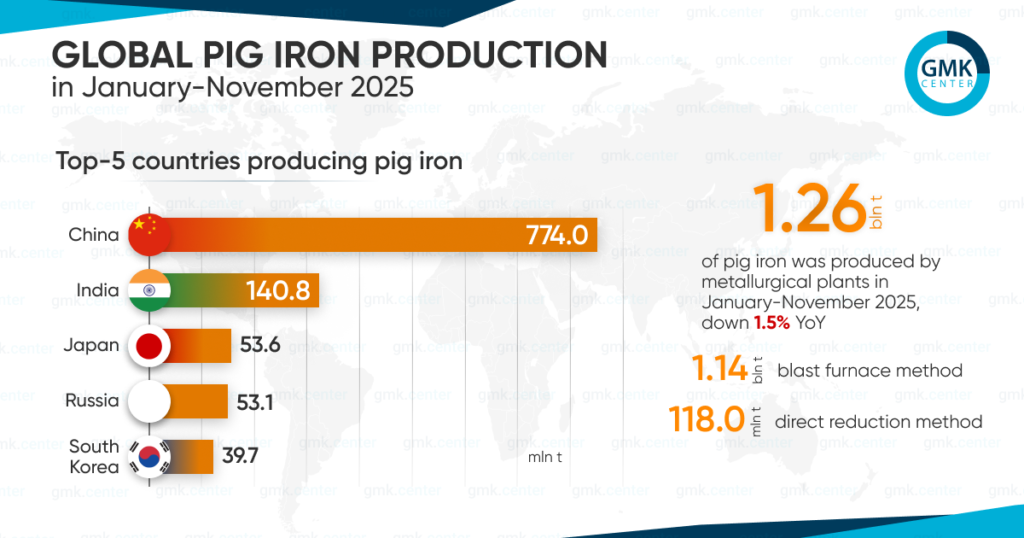
In January-November, pig iron output decreased by 1.5% compared to the same period last year, to 1.26 billion tons. 118.02 million tons were produced using the direct reduction method, and 1.14 billion tons using the blast furnace method.
The largest pig iron producing countries for the period are:
- China – 774.05 million tons (-2.3% y/y);
- India – 140.8 million tons (+6.7% y/y);
- Japan – 53.63 million tons (-4% y/y);
- Russia – 53.15 million tons (-1.6% y/y);
- South Korea – 39.75 million tons (+0.1% y/y).
Ukraine ranks 13th among 40 pig iron producing countries with 7.19 million tons in January-November (+10.2% y/y).
 As reported by GMK Center, in 2024, global pig iron production decreased by 1.3% compared to 2023, to 1.391 billion tons. Blast furnace production amounted to 1.265 billion tons of pig iron, down 1.6% y-o-y, while direct reduction production amounted to 125.57 million tons (+4.5% y-o-y).
The largest pig iron producing countries in 2024 were China – 851.74 million tons (-2.3% year-on-year), India – 144.91 million tons (+6.7% year-on-year), Japan – 61.03 million tons (-3.2% y/y), Russia – 58.99 million tons (-5.4% y/y), and South Korea – 44.11 million tons (-2.4% y/y).
-

Opinions Industry macroeconomics
28 May 2026
04 June 2026

04 June 2026

04 June 2026